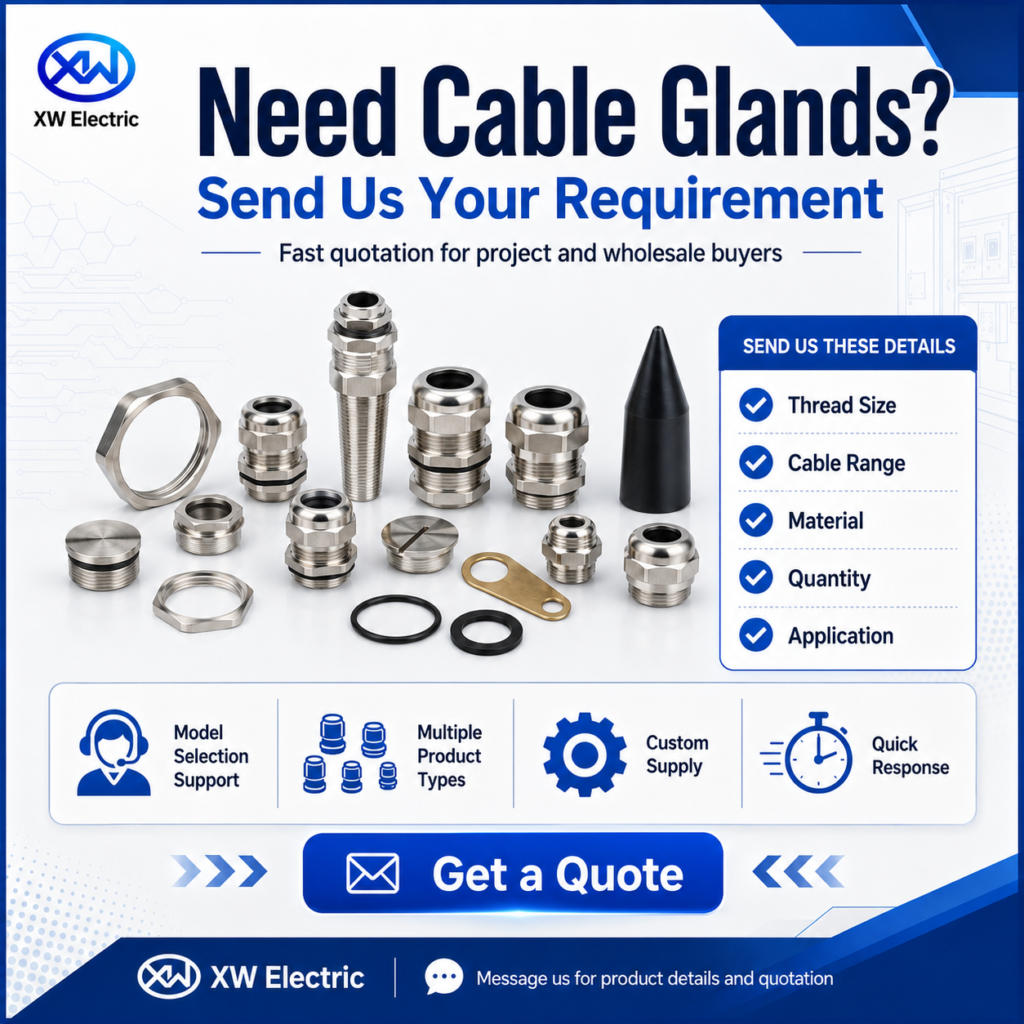
A cable gland—often referred to as a cable connector, fitting, or cord grip—is a mechanical cable entry device designed to secure and attach the end of an electric cable to an enclosure or piece of equipment. While its basic purpose sounds straightforward, selecting the correct gland is critical for protecting sensitive electrical systems from mechanical strain, moisture, dust, and environmental hazards.
According to IEC 62444, the primary international standard governing these components, a cable gland must maintain the technical integrity of the enclosure it enters while providing adequate strain relief. Beyond simple cable retention, high-grade cable glands fulfill four primary functions in industrial installations:
- Environmental Sealing: Preventing dust, water, and ambient moisture from entering the cabinet.
- Strain Relief: Absorbing mechanical tension, bending, and twisting to protect internal wiring joints from being pulled out.
- Earth Continuity: Maintaining electrical bonding between armoured cables and metallic enclosures (particularly critical in EMC or hazardous environments).
- Hazardous-Area Protection: Containing potential internal explosions or preventing hot gases from igniting surrounding volatile atmospheres.
You will find cable glands installed across almost every major sector—from industrial control panels and marine vessel decks to explosion-hazard processing facilities, solar combiner boxes, and outdoor EV charging infrastructure.
Cable Gland Components and How They Work
To understand how a cable gland achieves a reliable physical and environmental seal, it helps to examine its mechanical construction. Rather than relying on adhesive or permanent potting, a standard gland utilizes precise mechanical compression against an elastomeric sealing element.
Anatomy and the Sealing Principle
A standard industrial cable gland consists of five primary components arranged in sequence:
- Entry Thread / Body: The main structural piece that threads into the enclosure wall or passes through a clearance hole.
- Locknut: Threads onto the entry body from inside the panel wall to clamp the gland firmly in place.
- Sealing Insert (Grommet): An elastomeric ring (typically made of NBR rubber or neoprene) situated around the cable sheath.
- Compression Nut (Cap): The outer nut that threads onto the main body, driving the internal components together.
- Optional Accessories: Earth rings for earthing continuity, metallic washers, or O-rings fitted at the entry thread to enhance the panel-side IP seal.
When the compression nut is tightened onto the body, it drives an internal clamping claw against the elastomeric sealing ring. This forces the rubber insert to constrict uniformly inward around the cable’s outer jacket. The resulting radial pressure creates a gas-tight and liquid-tight seal while simultaneously gripping the cable sheath to prevent physical pull-out.
Cable Gland Materials: Brass, Stainless Steel, and Nylon
Material choice directly dictates how long a cable gland will survive in its operating environment. While engineering plastics suit indoor or light-duty applications, industrial installations rely heavily on metallic glands to endure mechanical stress, extreme temperatures, and harsh chemicals.
Brass (Nickel-Plated)
Nickel-plated brass is the undisputed workhorse material across factory automation, power distribution, and machinery manufacturing. Standard untreated brass naturally oxidizes and tarnishes when exposed to air and moisture. Applying a uniform nickel plating significantly improves surface corrosion resistance, prevents galling on entry threads, and gives the hardware a clean, professional aesthetic. Brass glands provide exceptional mechanical rigidity and thermal tolerance at an economical price point. For standard distribution boards and indoor industrial panels, explore the XingWei nickel-plated brass standard cable glands range.
Stainless Steel (304 vs. 316)
When equipment faces aggressive chemical wash-downs, high salinity, or strict hygiene mandates, stainless steel becomes mandatory. Type 304 stainless steel offers high tensile strength and superior resistance against general atmospheric exposure, making it ideal for food and beverage processing plants. Type 316 stainless steel contains added molybdenum, granting it superior protection against pitting caused by chlorides, saltwater spray, and chemical acids. For marine decks, offshore platforms, and coastal installations, review the XingWei stainless steel cable gland range.
Polyamide (Nylon PA66) glands represent a lightweight, non-conductive alternative. They are immune to metallic corrosion and cost-effective for general junction boxes, though they offer lower impact strength and tighter operational temperature limits than metal.
Cable Gland Functional Types
Different installation environments require distinct internal mechanical designs. Cable glands fall into four primary functional categories depending on cable construction, electromagnetic interference (EMI) requirements, and hazardous atmosphere ratings.
Compression Type: Single vs. Double
Single-compression cable glands compress a single seal against the outer sheath of an unarmoured cable. They provide reliable weatherproofing and strain relief for standard power, signal, and control wiring.
Double-compression glands, by contrast, feature two distinct sealing points. They are engineered specifically for armoured cables (such as Steel Wire Armoured – SWA, or Aluminium Wire Armoured – AWA). An inner seal tightens onto the internal cable sheath, an internal metallic ring clamps the exposed wire armour to ensure mechanical grounding and pull-out strength, and an outer seal compresses against the outer sheath for weatherproofing.
EMC, Explosion-Proof, and Marine Variants
- EMC Glands: Designed for applications where signal interference must be mitigated (such as variable frequency drives or automated robotics). These incorporate a 360-degree spring contact ring that bites into the cable’s copper braid or foil shield, maintaining continuous grounding to the metal panel enclosure.
- Explosion-Proof Glands: Engineered for hazardous environments containing flammable gases or combustible dusts. These heavy-duty glands restrict flame propagation and maintain pressure-resistant seals according to international hazardous-area standards. Note: Equipment specifiers must verify individual certification scope (such as ATEX, IECEx, or UL listings) directly with the manufacturer prior to installation. You can review technical parameters on the XingWei BDM-VI/D explosion-proof cable gland category page.
- Marine Glands: Built specifically for marine vessels and offshore structures where saltwater exposure and severe vibration are constant. Marine glands frequently utilize specialized Japanese Industrial Standard threads (JIS F 8801) and heavy 316 stainless construction. For shipboard installations, consult the XingWei marine cable gland category.
IP Ratings for Cable Glands
An Ingress Protection (IP) rating defines how effectively an enclosure entry resists solid particles and liquids. Choosing an under-rated gland compromises the rating of the entire electrical enclosure.
Reading the IP Code (IEC 60529)
The IP code established under IEC 60529 consists of two digits:
- First Digit (Solids): Ranges from 0 (unprotected) to 6 (dust-tight).
- Second Digit (Liquids): Ranges from 0 (unprotected) to 9K (high-pressure, high-temperature wash-down).
For example, an IP54 gland offers basic dust resistance and protection against water splashes, whereas an IP66 gland prevents fine dust ingress and withstands powerful water jets from any direction.
When IP68 Is Required
In outdoor, marine, or heavy industrial applications, IP65 is considered the minimum acceptable floor for weather protection. Installations subject to temporary flooding, heavy wash-down, or outdoor ground burial demand IP67 or IP68.
IP68 Rating Definition: IP68 cable glands are rated per IEC 60529 as fully dust-tight (first digit 6) and protected against continuous water immersion beyond 1 m (second digit 8). IP67 allows 30-minute immersion to 1 m; IP66 resists jets but not immersion. The two digits together specify the gland’s environmental seal.
If your equipment operates on coastal decks, sub-grade vaults, or outdoor wash-down zones, examine options within the XingWei IP68 waterproof cable gland range.
Cable Gland Thread Standards
A frequent pitfall in international procurement is assuming thread types are universally compatible. Thread pitch, profile angle, and tapering differ significantly across regional standards.
The Five Common Thread Types
- Metric (ISO 965): The global standard across Europe, Asia, and modern international machinery. Uses a 60-degree thread profile with metric sizing (e.g., M12, M20, M32).
- NPT (ANSI B1.20.1): National Pipe Tapered threads dominant in North America. The tapered profile creates a seal along the thread flanks as it tightens.
- PG (DIN 40430): Panzer-Gewinde threads originated in Germany. While officially superseded by Metric standards, PG sizes (e.g., PG9, PG11, PG21) remain widespread on legacy machinery.
- G / BSP (ISO 228): British Standard Pipe Parallel threads commonly used across the UK, Commonwealth nations, and hydraulic equipment entries.
- PF (JIS F 8801): Japanese industrial parallel pipe threads standard on East Asian shipbuilding, marine decks, and heavy machinery.
Thread Standards Summary: Cable gland threads follow different national standards: Metric (ISO 965) for most of Europe and Asia, NPT (ANSI B1.20.1) for North America, PG (DIN 40430) for legacy German equipment, G/BSP in the UK, and PF/JIS (JIS F 8801) for Japanese marine. Specifying the wrong thread is one of the most common first-time-buyer errors.
Matching Thread to Market
Matching your selection to the target market saves significant retrofitting costs:
- Europe & Asia-Pacific: Specify Metric (ISO 965) for general industrial equipment.
- North America: Specify NPT threads to align with US and Canadian electrical code enclosures.
- Marine & Shipboard (Japan/Asia): Verify whether JIS PF threads are mandated for vessel bulkheads.
Attempting to force a Metric gland into a PG or NPT threaded hole damages the panel threads and ruins the IP rating seal.
Standards and Compliance Marks for Cable Glands
Selecting hardware for industrial deployment requires distinguishing between technical manufacturing standards and commercial compliance marks.
Product Standards (IEC 62444, UL 514B, JIS F 8801, NEK 606)
Product standards define construction rules, mechanical impact testing, cable retention requirements, and thermal resistance tolerances:
- IEC 62444: The primary international performance standard for metric electrical cable glands.
- UL 514B: The North American safety standard for conduit, tubing, and cable fittings.
- JIS F 8801: Japanese specification for shipboard cable fittings.
- NEK 606: Norwegian offshore standard governing marine cables and associated entry fittings exposed to mud and severe ocean conditions.
Compliance Marks (CE, RoHS, ISO 9001)
Compliance marks reflect statutory market access or factory quality systems:
- CE & RoHS: Essential compliance declarations for selling electrical equipment within the European Economic Area, ensuring health safety and the restriction of hazardous substances.
- ISO 9001: An international standard certifying that the manufacturing facility operates a verified quality management system.
Hazardous-area approvals (such as ATEX or IECEx) and North American listings (such as UL or CSA) vary by product line and manufacturer. Always request complete compliance documentation and certificate schedules from your component supplier before finalizing project specifications.
Selecting the Right Cable Gland
To prevent installation delays or environmental failures, systematic selection is essential.
Seven Factors to Match
Selection Summary: Selecting a cable gland is a matter of matching seven factors to the application: environment (corrosion, UV, temperature), required IP rating per IEC 60529, cable outer diameter range, thread type and entry hole size, material, applicable certifications, and expected service life. A mismatch in any one factor typically means a re-spec later.
When evaluating your bill of materials, follow this straightforward checklist:
- Operating Environment: Determine exposure to UV light, salt spray, oil, or aggressive chemicals.
- Ingress Protection Level: Match the required IP rating (e.g., IP66, IP67, IP68) to the enclosure location.
- Cable Outer Diameter (OD): Measure the precise outer sheath diameter. Glands operate across specific sealing ranges (e.g., 6–12 mm); choosing a range that is too large prevents the rubber grommet from clamping tightly.
- Cable Construction: Identify whether the cable is unarmoured or armoured (SWA/AWA/braided).
- Thread Standard & Clearance Size: Match the entry hole diameter and thread pitch (Metric, NPT, PG, G, or PF).
- Material Compatibility: Match nickel-plated brass, 304/316 stainless, or nylon to environmental demands.
- Compliance Mandates: Confirm required quality standards, CE/RoHS declarations, or specialized marine certifications.
To explore technical specifications across standard and specialized product lines, review the broader XingWei cable gland overview category.
Common Selection Mistakes
Inexperienced buyers often commit predictable specification errors. A frequent mistake is measuring the inner conductor bundle rather than the overall outer jacket diameter, leading to loose seals. Another common oversight is treating IP67 and IP68 as interchangeable ratings; IP67 is designed for short-term temporary immersion, whereas IP68 is required for continuous submersion.
Over-tightening the compression nut during field installation can also crush the internal elastomeric insert, causing the rubber to distort and break its watertight bond. Finally, assuming standard unplated brass will perform adequately in marine air often leads to rapid surface oxidation and seized threads.
Frequently Asked Questions
Are cable glands waterproof?
Modern cable glands achieve water resistance through a compressed elastomer seal. A gland rated IP66 resists powerful jets, IP67 withstands temporary immersion to 1 meter for 30 minutes, and IP68 holds against continuous immersion beyond 1 meter. The required rating depends on the enclosure’s exposure—not all glands are the same.
What is the difference between a cable gland and a cable connector?
A cable gland seals where a cable enters an enclosure; it provides environmental and mechanical protection. A cable connector joins two cables or a cable to a device, transmitting power or signal. The terms are often confused, but a connector without a gland still leaves the enclosure entry unsealed.
What standard governs cable glands?
Cable glands are designed and tested primarily to IEC 62444 (the international standard that superseded EN 50262). Regional standards apply on top: UL 514B in North America, JIS F 8801 in Japanese marine work, NEK 606 offshore, and ATEX / IECEx for hazardous-area equipment. Confirm with your supplier which standards the specific part is certified to.
What IP rating do I need for an outdoor cable gland?
For a wall-mounted outdoor enclosure, IP65 is the practical floor. For exposed industrial wash-down or coastal installations, IP66 or IP67 is the safer choice. For submerged or continuously wet environments—burial, dock-side, water-treatment plant—IP68 with the manufacturer’s stated immersion depth is required.
A cable gland is a critical mechanical seal designed to secure cable entries, provide vital strain relief, and protect sensitive enclosures against dust, moisture, and mechanical strain. Selecting the proper gland requires balancing cable outer diameter, material durability, thread standard, and required IP ingress protection. Whether you are outfitting industrial control panels, marine vessels, or outdoor infrastructure, engineering your entry points correctly ensures long-term system reliability.
For technical parameters or product assistance with your upcoming installation, explore our cable gland overview category or contact our engineering team directly to request a quote.