Repeated bending at terminal connection points is one of the leading causes of electrical wire failure in dynamic industrial machinery. When flexible cables undergo constant flexing, stress concentrates right at the enclosure wall, resulting in conductor fatigue, insulation sheath rupture, and sudden equipment downtime.
Standard rigid fittings clamp the cable tightly but offer no lateral support, leaving the wire vulnerable to sharp bend angles. Installing a Spiral Strain Relief Cable Gland solves this structural weakness by distributing bending forces along an extended spiral neck, preventing sharp kinks while maintaining an IP68 environmental seal.
This technical guide breaks down the engineering mechanics, material trade-offs, thread sizing, and key application scenarios to help engineering and procurement teams select the right anti-bending cable fitting for high-motion equipment.
Understanding Strain Relief: How Spiral Cable Glands Prevent Wire Fatigue
Cable fatigue failure typically occurs due to localized mechanical strain. When an unsheathed or rigidly clamped cable bends under motion, the outer conductors stretch while the inner conductors compress, concentrating all shear forces on the millimeter of cable leaving the gland body.
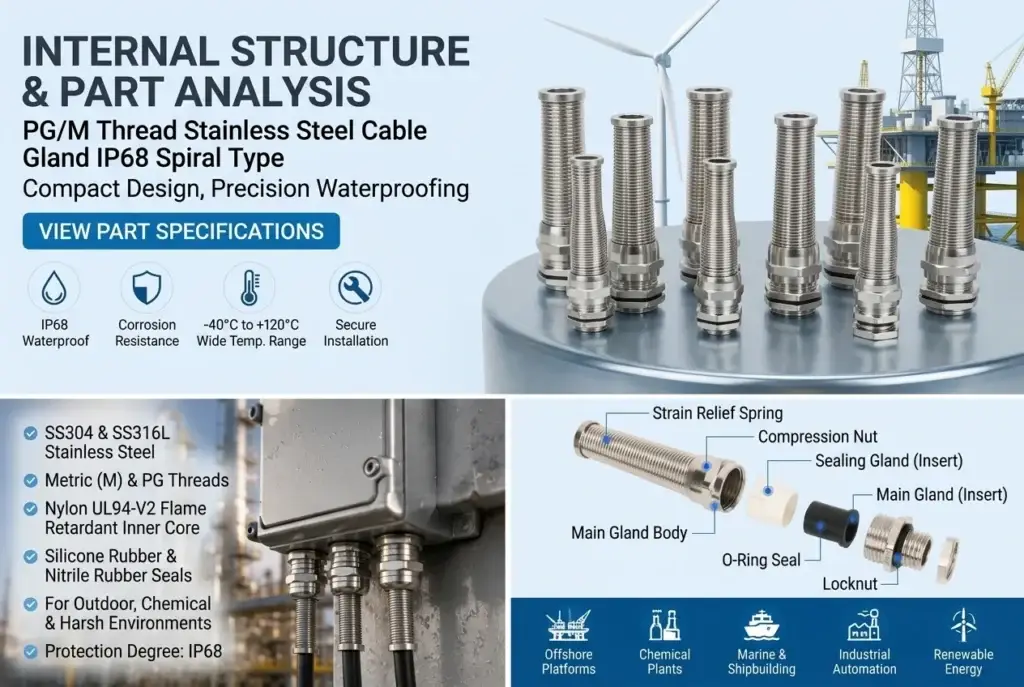
An anti-bending cable gland with spiral strain relief mitigates this issue through progressive bending control. The flexible spiral tail extends out from the main gland body, gradually decreasing in stiffness toward the tip.
This design delivers three distinct mechanical advantages:
- Expanded Minimum Bending Radius: The spiral extension forces the cable into a wider, smoother arc, preventing the wire from exceeding its recommended minimum dynamic bend radius.
- Vibration and Impact Dampening: Dynamic motion from robotic arms or drag chains generates high-frequency vibrations. The extended spiral sleeve absorbs these oscillations before they reach the internal terminal block.
- Strain Relief Mechanism: Integrated clamping claws grip the cable jacket across a wide surface area, transferring axial pull-out forces away from internal electrical terminations onto the gland structure.
Material Breakdown: Stainless Steel, Brass, or Nylon Spiral Glands?
Selecting the correct body material is critical for long-term survival in harsh industrial environments. While plastic glands suit lightweight indoor setups, heavy machinery demands metal construction to withstand impacts and thermal stresses.
1. 304 / 316L Stainless Steel
For extreme environments, a bend prevention cable gland IP68 stainless steel build offers maximum mechanical strength and chemical immunity. Stainless steel resists aggressive cleaning agents in food processing, marine salt spray, and extreme temperature fluctuations without embrittlement.
2. Nickel-Plated Brass
Nickel-plated brass provides an ideal balance of mechanical toughness, high clamping force, and cost efficiency. The nickel coating shields the underlying brass against atmospheric corrosion and oxidation while ensuring excellent electrical continuity for grounding.
Engineering Tip for Static Enclosure Entries:
While dynamic cable entry points require spiral necks to absorb motion, static panel entries on the same control box do not experience flexing. In those stationary pass-throughs, specifying a standard fitting like aNickel-Plated Brass Standard Cable Gland
maintains consistent IP68 ingress protection and metallic grounding without unnecessary spiral overhang.
3. Nylon (PA66 Polyamide)
Polyamide spiral glands are lightweight, non-conductive, and economical. They perform reliably in indoor automated machinery and handheld devices where weight reduction is prioritized over heavy impact resistance.
| Material Type | Mechanical Strength | UV & Chemical Resistance | Temperature Range | Best Application Scenario |
| 304/316L Stainless Steel | High | Excellent (Acid/Alkaline/Salt) | -40°C to +120°C | Marine, Off-Shore, Food & Chemical Processing |
| Nickel-Plated Brass | High | Very Good (Industrial Oils/Solvents) | -40°C to +110°C | Heavy Machinery, Automation Cabinets, Robotics |
| Nylon (PA66) | Medium | Good (Indoor UV/Mild Solvents) | -40°C to +85°C | Light Automation, Handheld Terminals, Test Units |
Key Technical Specs: Thread Types, Cable OD, and IP68 Waterproofing
Selecting an IP68 waterproof spiral cable gland M12 to M32 or its PG equivalent requires matching three critical dimensions: thread type, mounting hole diameter, and cable outer diameter (OD).
Thread Standards: Metric vs. PG
- Metric Threads (ISO 68-1): Designated as M12x1.5 up to M32x1.5. Metric thread specs dominate modern global automation standards and offer precise millimeter sizing.
- PG Threads (DIN 40430): Designated from PG7 to PG21. While widely superseded in Europe by Metric standards, a PG thread and Metric spiral cable connector setup remains essential for servicing legacy machinery and specific regional equipment imports.
Maintaining Dynamic IP68 Seals
A static IP68 rating means an entry fitting can survive continuous immersion under water at specified depths. However, dynamic applications place sideways pressure on the internal sealing insert. High-grade spiral glands use NBR or EPDM elastomeric grommets backed by interlocking clamping jaws, ensuring the seal remains watertight even when the cable is pulled at a 90-degree angle.
| Thread Size (Metric / PG) | Mounting Hole Dia. (mm) | Cable Clamping Range (mm) | Ingress Protection Rating |
| M12 x 1.5 / PG7 | 12.2 / 12.8 | 3.0 – 6.5 | IP68 (5 bar) |
| M16 x 1.5 / PG9 | 16.2 / 15.5 | 4.0 – 8.0 | IP68 (5 bar) |
| M20 x 1.5 / PG13.5 | 20.2 / 20.6 | 6.0 – 12.0 | IP68 (5 bar) |
| M25 x 1.5 / PG21 | 25.2 / 28.5 | 13.0 – 18.0 | IP68 (5 bar) |
| M32 x 1.5 / PG29 | 32.2 / 37.0 | 18.0 – 25.0 | IP68 (5 bar) |
High-Motion Applications: From Robotics to Mobile Industrial Equipment
Standard cable entries are prone to early fatigue in high-vibration and constant-flexing setups. Installing a heavy duty strain relief cable gland for moving equipment mitigates stress across several demanding industrial sectors:
Multi-Axis Robotic Arms & Drag Chains
Industrial articulated robots move across multiple axes simultaneously. Cables routed through articulated joints experience extreme torsional and bending forces. Spiral glands prevent the cable sheath from creasing or pinching against the rigid edge of control boxes.
Handheld Industrial Terminals & Control Boxes
Portable pendants, teaching units, and handheld scanners are regularly dropped, yanked, and pulled by operators. The extended spiral sleeve acts as a shock absorber, preventing wires from pulling free from internal terminal blocks.
Outdoor Mobile Power & Machinery
Mobile generators, outdoor lighting towers, and agricultural machinery endure harsh weather along with physical movement. Stainless steel or brass spiral glands keep moisture out while absorbing severe movement caused by machine vibration or wind drag.
Technical Assistance & Samples:
Designing moving machinery or upgrading flexible cable entry points? Contact the engineering team at Wenzhou Xingwei Electrical to request technical datasheets, CAD models, or sample evaluation kits tailored to your application requirements.
Common Cable Gland Selection Pitfalls and How to Avoid Them
Even high-quality fittings can fail if specified incorrectly. Avoid these four common engineering mistakes during product selection:
- Using Static Glands in Dynamic Entries: Installing standard short-body glands on moving equipment saves minimal initial cost but leads to premature cable failure and expensive field service calls.
- Ignoring Cable Outer Diameter Tolerances: Selecting a gland at the absolute maximum of its clamping range reduces seal compression. Always choose a size where your cable’s outer diameter sits comfortably in the middle of the recommended clamping spectrum.
- Mismatched O-Ring Materials in Oily Environments: Standard neoprene O-rings deteriorate quickly when exposed to synthetic hydraulic oils or cutting fluids. Ensure the internal sealing ring uses oil-resistant NBR or Fluororubber (FKM) for machine tool applications.
- Over-tightening the Dome Nut: Excessive torque on the outer cap can deform the internal spiral cage, pinching the internal conductors and weakening the progressive strain relief capability.
Frequently Asked Questions (FAQ)
What is the primary function of a spiral strain relief cable gland?
A spiral strain relief cable gland secures electrical cables entering an enclosure while extending the cable’s bending radius. The spiral neck distributes mechanical stress along an extended area, preventing sharp kinks, wire fatigue, and insulation damage caused by continuous motion or vibration.
How do I determine whether I need a Metric or PG spiral cable connector?
Metric threads (M-threads) follow international ISO standards and are standard on modern industrial equipment. PG threads follow older German standards and are typically found on legacy European machinery. Check your enclosure tap dimensions or panel cutout size to select the matching thread profile.
Can a spiral cable gland maintain an IP68 rating during continuous cable flexing?
Yes, provided the gland utilizes a high-grade elastomeric sealing insert (such as NBR or EPDM) combined with a multi-finger clamping claw. This structure maintains uniform 360-degree compression around the cable jacket even when sideways forces are applied during bending.
Why choose stainless steel or nickel-plated brass over nylon for anti-bending glands?
Metal glands provide superior mechanical strength, high impact resistance, broader operating temperature ranges, and long-term resistance to heavy UV and chemical exposure. While nylon works well for light indoor setups, metallic spiral glands are required for heavy industrial, outdoor, and high-vibration applications.
How does a strain relief mechanism prevent internal cable fatigue failure?
The internal clamping jaws grip the outer cable sheath tightly, transferring tensile (pulling) forces directly to the gland body and enclosure wall. This prevents physical forces from reaching delicate internal terminal block connections, eliminating conductor strain and fatigue failure.
Engineering Checklist: Making the Final Selection
When specifying a Spiral Strain Relief Cable Gland for your next build, follow this systematic evaluation path:
- Calculate Dynamic Load: Determine the frequency and angle of movement at the entry point to choose between Nylon, Nickel-Plated Brass, or 304/316L Stainless Steel.
- Measure Cable Diameter: Record the exact outer diameter (OD) of the cable using a caliper, ensuring it falls within the midpoint of the gland’s specified clamping range.
- Verify Thread & Panel Thickness: Confirm whether the enclosure requires Metric or PG threading, and ensure thread length provides full engagement through the panel wall or locknut.
- Check Environmental Exposure: Match internal sealing materials (NBR, EPDM, or Silicone) to ambient operating temperatures and potential chemical or oil contact.
By matching the body material, thread profile, and clamping range to your specific dynamic operating conditions, you ensure long-term cable integrity, preserve IP68 waterproof performance, and minimize unexpected equipment downtime.