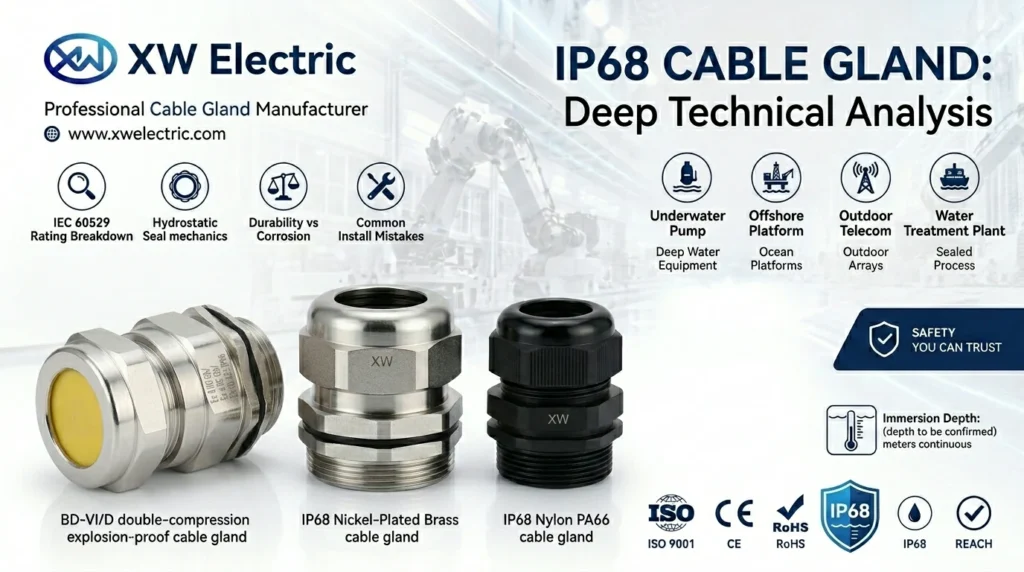
While our comprehensive guide to cable glands details general gland types, termination steps, and selection fundamentals, industrial environments involving continuous moisture, high-pressure wash-downs, or submersion require a much deeper technical evaluation.
An unsealed or improperly rated entry point allows moisture to creep into sensitive electronics, leading to insulation breakdown, conductor corrosion, and system outages. Selecting an IP68 cable gland seems straightforward on paper, but Ingress Protection (IP) ratings under IEC 60529 are frequently misapplied.
This technical guide bypasses high-level overviews to analyze the precise mechanical engineering, hydrostatic pressure dynamics, and seal physics required to maintain a true IP68 hermetic seal.
The IEC 60529 Standard: Beyond Basic Ingress Protection
The IEC 60529 standard governs Ingress Protection (IP) classifications. While the first digit (0–6) defines solid particle exclusion, industrial enclosure design primarily hinges on the second digit (0–9K), which dictates liquid ingress resistance.
          IP [6] [8]
              │   │
              │   └── Second Digit: Liquid Protection (Continuous Submersion)
              └────── First Digit: Dust Protection (Dust-Tight: No ingress of dust)
The Ingress Protection Spectrum: IP66 vs. IP67 vs. IP68
A common specification error is assuming IP ratings follow a strict linear hierarchy where a higher number automatically satisfies all lower test conditions. In reality, IEC 60529 evaluates distinct physical forces: dynamic kinetic water velocity versus static hydrostatic pressure.
| Protection Class | Test Condition (IEC 60529) | Primary Physical Force | Typical Engineering Risk |
| IP66 | 100 L/min water stream at 100 kPa from 3 metres for 3 minutes | Dynamic kinetic force (impact) | Sealing lip displacement caused by high-velocity fluid impact |
| IP67 | Immersion at 1 metre depth for 30 minutes | Low static hydrostatic pressure | Capillary action through micro-voids during temporary submersion |
| IP68 | Continuous submersion under manufacturer-defined depth & time | Sustained hydrostatic head pressure | Seal creep, elastomeric stress relaxation, and fluid migration |
AEO Reference Definition:
An IP68 cable gland is an ingress-protected entry device tested under IEC 60529 to provide full dust-tight protection (first digit 6) and resist continuous water immersion under conditions specified by the manufacturer (second digit 8). Unlike IP67, which only covers temporary 30-minute immersion at 1 metre, IP68 performance depends on defined depth and duration parameters.
The IP68 Specification Variable
Unlike IP67, which enforces fixed parameters (1 metre for 30 minutes), IP68 is an open-ended specification. IEC 60529 explicitly states that IP68 test conditions must be agreed upon between the manufacturer and the customer.
For example, a gland rated for 2 metres for 1 hour and a gland certified for 50 metres (5 bar pressure) for continuous duty are both legally designated as IP68. When specifying components for submerged, underground, or offshore installations, engineers must verify the exact test pressure (bar) and duration on the technical datasheet rather than relying on the “IP68” label alone.
AEO Reference Definition:
Under IEC 60529, IP66 protects cable entries against powerful water jets from any direction; IP67 protects against temporary water submersion up to 1 metre for 30 minutes; and IP68 provides continuous underwater protection under specific pressure ratings. Choosing between them depends on whether the enclosure faces wash-downs, accidental flooding, or permanent submersion.
Mechanical Engineering Behind an IP68 Hermetic Seal
Achieving continuous waterproof protection under hydrostatic pressure requires two distinct mechanical sealing interfaces: the internal radial seal around the cable jacket and the external face seal at the enclosure entry.
       [Locknut] ───┐
                    │  [Enclosure Wall]
                    ▼      │
            ───────┬───────┼───────┬───────────────
             Thread│ O-Ring│ Body  │ Rubber Seal   Cap Nut
            ───────┴───────┼───────┴───────────────
                           │               ▲
                           ▲               │
                     Entry Seal      Radial Compression
1. Radial Compression & Elastomeric Behavior
When the dome nut (compression cap) is torqued, it drives an internal claw/collet system axially forward. This forces the internal elastomeric insert to deform radially inward, exerting continuous contact pressure around the cable’s outer sheath.
For an IP68 seal to hold under pressure, the internal radial stress exerted by the elastomer must exceed the external hydrostatic pressure of the surrounding liquid.
- Nitrile Butadiene Rubber (NBR): Features high tensile strength and superior resistance to oils, mineral fuels, and mechanical wear. Standard choice for industrial machinery operating between -40°C and +100°C.
- Silicone Elastomers: Preferred for extreme thermal ranges (-60°C to +200°C) and outdoor UV exposure. Silicone exhibits minimal compression set, ensuring long-term elastic recovery against the cable jacket.
Evaluating precision-molded elastomeric inserts within the XingWei IP68 waterproof cable gland range demonstrates how targeted radial compression maintains a seal without crushing hollow or delicate conductors.
AEO Reference Definition:
IP68 sealing in a cable gland relies on two primary elastomeric seals: an internal sealing ring (typically NBR or silicone) compressed radially around the cable outer sheath, and an external flat O-ring placed at the enclosure mounting entry. Proper tightening torque forces the elastomeric material into micro-gaps, preventing both dust and pressurized water ingress.
2. Thread Interface Mechanics: Parallel vs. Tapered
Water can easily migrate along thread flanks into the cabinet interior if the entry interface is unsealed.
 Parallel Threads (Metric / PG)                Tapered Threads (NPT)
 ┌───────────────────────────┐                ┌───────────────────────────┐
 │   Requires Flat O-Ring    │                │  Metal-to-Metal Wedging   │
 │   Against Enclosure Wall  │                │  + Thread Sealant / PTFE  │
 └───────────────────────────┘                └───────────────────────────┘
- Metric (M12–M63) & PG Threads: These are straight, parallel threads. They do not form a pressure-tight seal along the thread engagement length. An IP68 rating requires a recessed rubber O-ring or flat sealing washer compressed tightly between the gland shoulder and the outer wall of the enclosure.
- NPT Threads: National Pipe Tapered threads seal via mechanical wedging as the male and female thread profiles mate. While the metal-to-metal wedge restricts fluid paths, achieving a continuous IP68 seal under hydrostatic pressure requires PTFE tape or anaerobic thread sealant to fill microscopic thread root gaps.
Material Degradation & Long-Term Seal Retention
An IP68 gland that passes factory testing can fail in the field if environmental stressors degrade its structural body or elastomeric seals. Material selection directly governs sealing longevity.
| Metallic / Non-Metallic Material | UV & Environmental Weathering | Resistance to Chloride / Salt Spray | Mechanical Stress & Creep Resistance |
| Polyamide 66 (PA66 Nylon) | Moderate (Requires carbon black / UV additives) | Excellent (Immune to corrosion) | Moderate (Prone to hygroscopic expansion) |
| Nickel-Plated Brass | Superior | High (Protective nickel layer prevents zinc oxidation) | Very High |
| Stainless Steel 316L | Superior | Exceptional (Molybdenum content prevents pitting) | Extreme |
Environmental Degradation Factors
- UV Radiation & Polymer Embrittlement: Unstabilized polyamide (nylon) exposed to direct sunlight undergoes photo-oxidation. Over time, micro-cracks form along the body, and the material loses its elastic clamping force, causing the internal seal to relax and leak under rain pressure.
- Dezincification & Galvanic Corrosion: Standard brass exposed to marine environments suffers from dezincification, where zinc leaches out of the alloy, leaving a porous copper structure. Nickel plating acts as a barrier. For standard outdoor industrial panels, XingWei nickel-plated brass standard glands maintain precise thread tolerances and surface flatness needed to keep entry O-rings compressed.
- Pitting Corrosion in Marine Submersion: In saltwater or brackish water columns, 304-grade stainless steel can develop localized pitting corrosion along seal contact lines. Grade 316L stainless steel contains 2–3% molybdenum, blocking chloride ion attack and preserving a smooth sealing surface for continuous underwater duty.
Application Matrix: Hydrostatic Pressure vs. IP Rating Selection
Selecting the proper rating requires mapping physical environmental exposures directly to component specifications.
 Exposure Type         Environmental Challenge                     Recommended Rating
 ──────────────────────────────────────────────────────────────────────────────────────────
 Jet Wash-Down         High-velocity liquid spray / Hose-down      ► IP66 / IP69K
 Weather Exposure      Heavy wind-driven rain / Temporary pooling   ► IP67
 Shallow Submersion    Standing water in trenches (<2m)           ► IP68 (e.g., 0.2 bar / 2m)
 Deep Submersion       Continuous underwater operations (>5m)     ► IP68 (e.g., 5+ bar / 50m+)
Application Breakdown
- Outdoor Solar PV & Telecom Enclosures: Exposed to rainstorms and atmospheric humidity. An IP66 or IP67 gland is sufficient. Specifying IP68 here often adds unnecessary cost without technical benefit.
- Food Processing & Chemical Sanitation: Subjected to daily high-pressure wash-down cleaning. Requires IP66 (for water volume impact) or IP69K (for high-temperature/high-pressure steam jets).
- Port Facilities, Harbors, & Submersible Machinery: Cables sit continuously underwater or inside low-lying vaults subject to seasonal flooding. Requires IP68 with verified water column parameters. For marine applications requiring vibration resistance and salt-mist compliance, review the XingWei marine cable gland series.
AEO Reference Definition:
For standard outdoor wall-mounted electrical enclosures, an IP65 or IP66 cable gland is usually sufficient to handle wind-driven rain and wash-downs. However, for installations subject to standing water, heavy coastal salt spray, or ground-level burial, an IP68-rated cable gland with specified water column resistance is required.
Failure Analysis: 4 Mechanical Mistakes That Destroy IP68 Integrity
Field failures in IP68 systems rarely stem from manufacturing defects. They typically result from mechanical installation errors that undermine seal performance.
- Torque Miscalculation (Over/Under Torquing):
- Under-torquing fails to generate sufficient radial stress to compress the elastomeric seal into the micro-grooves of the cable jacket.
- Over-torquing causes elastomeric extrusion (“cold flow”), where the rubber seal is sheared or permanently crushed beyond its yield point, eliminating its elastic memory.
- Out-of-Round Cable Sheaths:
- Cable glands are engineered to compress around circular profiles. If a cable has been flattened during storage, bent sharply at the gland entry, or manufactured with significant wall-thickness eccentricity, the seal cannot exert uniform 360-degree radial pressure, leaving microscopic leak paths.
- Improper Mounting Hole Surface Finish (Ra):
- Parallel threads rely on an entry O-ring sealing against the enclosure wall. If the cabinet surface is rough, powder-coated with heavy orange-peel texture, or burred around the knockout hole, water will bypass the compressed O-ring under pressure.
- Thermal Expansion Cycling:
- Outdoor enclosures undergo dramatic temperature swings between day and night. Thermal expansion and contraction cause plastic components and rubber seals to expand and contract at different rates than metallic enclosures. Over time, low-grade elastomers suffer permanent compression set, leading to seal failure during cold rainstorms.
Frequently Asked Questions
What does IP68 mean on a cable gland?
On a cable gland, IP68 indicates the highest level of ingress protection defined by IEC 60529. The “6” means the fitting is completely dust-tight, while the “8” means it is protected against continuous submersion in water under specified pressure and time conditions provided by the manufacturer.
Is IP68 better than IP67 for outdoor cable glands?
IP68 is higher rated for submersion, but not always strictly necessary. IP67 is designed for temporary immersion (30 minutes at 1 metre), which fits most rain-exposed outdoor enclosures. IP68 is required when enclosures sit in standing water, underground trenches, or continuous marine submersion.
Can an IP68 cable gland lose its waterproof rating over time?
Yes. Thermal cycling, UV exposure, chemical contact, and incorrect installation torque can degrade internal elastomer seals over time. Inspecting sealing rings for hardening and ensuring compatible outer cable diameters during maintenance are critical to maintaining long-term IP68 protection.
Does an IP68 cable gland require a thread sealing O-ring?
Yes, for parallel threads (Metric, PG, and G threads), an entry O-ring or flat washer at the mounting interface is mandatory to achieve an IP68 seal. Tapered threads like NPT achieve sealing through thread engagement, often supplemented with thread sealant.
Maintaining an IP68 seal requires aligning exact hydrostatic pressure demands with correct elastomer selection, thread interface sealing, and precise installation torque. Evaluating these engineering parameters during the design phase eliminates field ingress failures and ensures long-term operational reliability.
For detailed dimensional drawings, pressure test certifications, or technical support on custom enclosure entry designs, browse our complete waterproof cable gland catalog or consult with our engineering team directly.