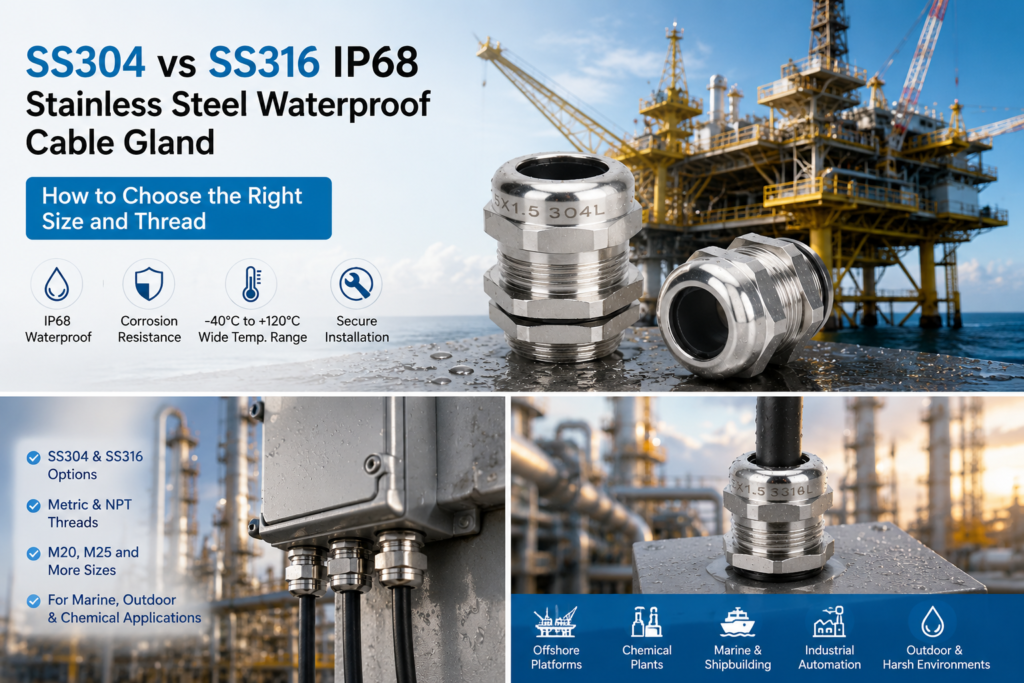
If you choose the wrong SS304/SS316 IP68 stainless steel waterproof cable gland, the problem usually does not show up on day one. It shows up months later as moisture inside the enclosure, rust on the fittings, or even cable failure in a marine or chemical plant environment. For OEMs, panel builders, and distributors, that means site visits, replacement work, and frustrated end users—especially when equipment is installed on offshore platforms, wastewater plants, or exposed coastal sites.
This guide walks you through how to choose between SS304 and SS316, how to select the right IP68 stainless steel cable gland metric thread (such as M20 and M25), and when a standard waterproof cable gland is not enough and you must move to explosion proof types. It is written for engineers, purchasers, manufacturers, distributors, and other B2B buyers who need clear, practical selection logic—not just a list of parameters.
What Is an IP68 Stainless Steel Waterproof Cable Gland?
An IP68 stainless steel waterproof cable gland is a mechanical device that secures and seals a cable where it enters an enclosure, junction box, or piece of equipment. It prevents water, dust, and contaminants from entering the housing while providing strain relief on the cable, which is critical for outdoor, marine, and industrial installations.
The “IP68” rating indicates complete protection against dust ingress and long-term immersion in water under manufacturer-defined conditions, making it suitable for harsh outdoor and wet environments when correctly installed. When the body is made from SS304 or SS316 stainless steel, the gland also resists corrosion from moisture, industrial pollutants, cleaning chemicals, and in the case of SS316, aggressive chloride-containing atmospheres.
A typical stainless steel waterproof cable gland includes:
- A threaded body that fits the enclosure or gland plate
- A sealing insert that compresses around the cable
- A cap or nut that tightens the seal and provides strain relief
If you want to see a complete stainless steel IP68 series with different metric thread sizes and clamping ranges, you can review XINGWEI’s stainless steel waterproof cable gland product page here: https://xingweielec.com/product/stainless-steel-waterproof/.
Material Basics: How SS304 and SS316 Actually Differ
Material Chemistry and Corrosion Resistance
SS304 and SS316 are both austenitic stainless steels, but their alloying elements make them behave very differently in tough environments.
- SS304 typically contains around 18% chromium and 8–10% nickel, giving it good corrosion resistance in general industrial and outdoor environments with moderate moisture and pollution.
- SS316 contains similar chromium and nickel levels but adds around 2% molybdenum, which significantly improves resistance to chlorides, saltwater, and many industrial chemicals.
As a result:
- SS304 performs well in indoor industrial settings, standard outdoor installations, and non-aggressive atmospheres where cost control is important.
- SS316 is preferred in marine, coastal, offshore, and chemical processing environments where chloride ions, salt spray, or aggressive chemicals would eventually attack SS304.
A practical way to think about it is: SS304 is the cost-effective generalist, while SS316 is the corrosion specialist for extreme conditions.
Typical Application Scenarios: When to Use SS304 vs SS316
You rarely select stainless steel grades in isolation; you select them for specific environments. For IP68 stainless steel cable glands, the following mapping works well in most projects:
- Use SS304 when:
- The enclosure is indoors or under a canopy, in a non-coastal industrial plant.
- The environment involves moisture and rain but not heavy salt spray or strong chemicals.
- You are installing distribution boards, control panels, or machinery in general factory areas with standard industrial atmospheres.
- Use SS316 when:
- Equipment is on offshore platforms, marine vessels, docks, or coastal structures exposed to salt spray and sea breeze.
- The installation is in chemical processing plants, wastewater treatment facilities, or environments with corrosive fumes, acids, or chloride-rich media.
- Food and beverage or pharmaceutical equipment is regularly cleaned with aggressive detergents or disinfectants.
For offshore platforms and chemical plants, SS316 IP68 stainless steel cable glands are not a “nice-to-have” but a practical necessity to avoid rapid corrosion and premature failure. In contrast, for general outdoor panels in industrial parks away from the sea, SS304 often gives a good balance between performance and price.
Thread Standards: Metric, NPT, PG and Why M20/M25 Matter
Understanding Thread Standards
The best stainless steel waterproof cable gland is useless if the thread does not match the enclosure. In B2B electrical projects, you will typically deal with three main thread standards:
- Metric (M) – Common in Europe and most of Asia, and widely used by global OEMs for export equipment.
- NPT – Tapered thread widely used in North America and in some process industries.
- PG – An older German standard, still found in legacy equipment and some lighting products.
Using a metric IP68 stainless steel cable gland in a PG threaded hole (or vice versa) can cause poor sealing, mechanical looseness, or damaged gland plates. Before you specify “IP68 stainless steel cable gland metric thread”, always confirm the enclosure drawing and your target market’s standard.
For Chinese manufacturers and exporters, metric M thread is usually the default for SS304/SS316 cable glands supplied to global markets, unless the buyer explicitly requests NPT or PG. This simplifies design for panel builders and equipment manufacturers selling into Europe, the Middle East, and Asia.
How to Size an IP68 Stainless Steel Cable Gland (M20, M25 and Others)
Getting the thread size right is only half of the job; you also need to match the clamping range to the cable outer diameter (OD). A practical three-step approach works well:
- Measure the cable OD accurately
- Check the clamping range of the gland
- For many metric IP68 cable glands, typical clamping ranges look roughly like this:
- M20: around 6–13 mm
- M25: around 8–17 mm
(Exact ranges vary by brand and design; always check the datasheet.)
- For many metric IP68 cable glands, typical clamping ranges look roughly like this:
- Confirm the enclosure thread and panel layout
In control panels, junction boxes, and distribution boards, M20 and M25 stainless steel waterproof cable glands are extremely common because they fit popular cable sizes used for power, motor feeds, and instrumentation bundles. When you specify “M20 M25 stainless steel waterproof cable gland” in a purchase order or RFQ, it helps the manufacturer or supplier quickly align size and thread with your enclosure design.
Standard IP68 vs Explosion Proof: When Waterproof Is Not Enough
Standard IP68 vs Explosion Proof Cable Glands
An IP68 stainless steel cable gland protects against water and dust, but it does not automatically mean the fitting is suitable for hazardous (Ex) areas. In zones with explosive gas or dust, such as chemical plants, oil and gas facilities, or grain handling sites, explosion proof cable glands with proper ATEX/IECEx or equivalent approvals are required.
The functional differences include:
- Standard IP68 stainless steel cable gland
- Focus: environmental sealing and strain relief.
- Typical areas: safe (non-classified) zones, outdoor panels, coastal installations not classified as hazardous areas.
- Explosion proof cable gland
- Focus: preventing flame propagation and containing internal explosions from traveling along the cable into hazardous zones.
- Typical areas: Zone 1/Zone 2 gas areas, Zone 21/Zone 22 dust areas, classified hazardous locations.
In offshore platforms and certain chemical plant areas, you often need both: IP68 sealing for environmental protection and explosion proof construction for safety compliance. The right combination depends on the zone classification and local standards.
When you need explosion proof solutions, you can look at XINGWEI’s related series, such as nickel plated brass explosion proof cable glands and stainless steel explosion proof cable glands, which are designed to complement standard IP68 stainless steel waterproof types in mixed projects:
- Nickel plated brass explosion proof cable gland: https://xingweielec.com/product/nickel-plated-brass-explosion-proof-cable-gland/
- Stainless steel explosion proof cable gland: https://xingweielec.com/product/stainless-steel-explosion-proof-cable-gland/
These can be used together with SS304/SS316 IP68 stainless steel cable glands in projects where some enclosures are in safe zones and others are in hazardous areas.
Typical Scenarios: Outdoor IP68 vs Hazardous Zone Ex
To decide whether IP68 is enough or explosion proof is mandatory, start from the site classification, not from the product catalog.
- IP68 stainless steel waterproof cable glands are typically enough for:
- Outdoor pump stations, water treatment plants, and general plant areas that are not classified as hazardous zones.
- Coastal and marine equipment where the key risks are saltwater, rain, and spray—not explosive atmospheres.
- Rooftop HVAC units, solar PV combiner boxes, and wind turbine towers outside classified gas or dust areas.
- Explosion proof cable glands are required for:
- Offshore oil and gas platforms, refineries, chemical reactors, and tank farms classified as Zone 1/Zone 2.
- Bulk solids handling with combustible dust (grain silos, some food processing plants), where Zone 21/22 apply.
- Fuel handling areas, loading stations, and hazardous process skids where standards explicitly require Ex-certified glands.
In many offshore and chemical projects, engineering teams will combine SS316 IP68 stainless steel cable glands for non-classified outdoor equipment and explosion proof cable glands for classified zones within the same platform or plant. This mixed approach balances safety, performance, and budget.
Common Mistakes in Selecting SS304/SS316 IP68 Cable Glands
Even experienced engineers and procurement teams make recurring mistakes with stainless steel cable glands, especially when projects are fast-moving or multi-country.
- Choosing SS304 only by unit price in harsh environments
- In marine, coastal, or chloride-rich chemical environments, SS304 can show corrosion over time, leading to staining, pitting, and eventually compromised sealing.
- The short-term saving on material can be offset by higher maintenance and replacement costs.
- Ignoring cable OD and clamping range
- Mixing thread standards
- Using metric glands in PG or NPT holes (or the reverse) results in poor mechanical fit and compromised sealing.
- This sometimes happens when equipment from different countries is combined on one project without clear standards coordination.
- Using only IP68 glands in hazardous zones
- Some specifiers mistakenly assume IP68 equals “safe everywhere”, but it does not replace explosion proof requirements in classified areas.
- This can create serious safety and compliance issues in audits or inspections.
Working with an experienced manufacturer or supplier who reviews your cable schedule, enclosure drawings, and zone classification can eliminate many of these issues before they reach the site. For distributors and wholesalers, this also reduces returns and after-sales troubleshooting.
B2B Sourcing Guide: Working with a China Manufacturer or Exporter
For manufacturers, distributors, and wholesalers, technical selection is only part of the story; the other part is finding a reliable supplier who can support bulk purchasing, custom labeling, and OEM/ODM projects. China has become a major base for SS304/SS316 IP68 stainless steel waterproof cable gland production, but not all factories operate at the same level.
When you evaluate a China manufacturer, supplier, or factory for stainless steel cable glands, consider:
- Material and IP68 capability
- Ask for material certificates or test reports confirming SS304/SS316 grades.
- Check IP68 test reports and ask how the manufacturer validates sealing performance.
- Thread and size coverage
- Confirm which metric sizes (e.g., M12–M63) and thread standards (metric, NPT, PG) are available.
- Make sure they can support the M20 and M25 ranges you need for your main product lines.
- OEM, ODM, and private label options
- Many Chinese factories can customize laser marking, packaging, labels, and even minor design details under OEM/ODM or white label agreements.
- Clarify your brand requirements, artwork format, and volumes for private label stainless steel cable glands.
- Bulk purchase, pricing, and MOQ
- For distributors, wholesalers, and large manufacturers, negotiate MOQ and price based on an annual or project-based forecast rather than one shipment.
- A good exporter or trading-oriented factory will be open to staged shipments and stocking models that support your local inventory.
- Technical support and documentation
- Check whether the supplier can provide dimensional drawings, 3D models, and data sheets in English.
- For chemical plants and offshore platforms, you may need additional documentation around corrosion performance or explosion proof approvals.
A manufacturer like XINGWEI, based in China, can support SS304/SS316 IP68 stainless steel waterproof cable glands together with nickel plated brass and stainless steel explosion proof cable glands, allowing OEMs, panel builders, and distributors to source a complete cable entry solution set from one supplier. This simplifies engineering, purchasing, and long-term supply for bulk orders and export projects.
Practical Selection Checklist for Your Next Project
To turn all of this into something you can act on quickly, use the following checklist when you select SS304/SS316 IP68 stainless steel waterproof cable glands:
- Define the environment
- General indoor or outdoor industrial → SS304 usually sufficient.
- Coastal, offshore platform, marine, chemical, or aggressive cleaning → SS316 strongly recommended.
- Confirm zone classification
- Safe (non-hazardous) areas → IP68 stainless steel waterproof cable gland is usually enough.
- Zone 1/Zone 2 or Zone 21/22 → explosion proof cable glands with relevant approvals are required.
- Match thread standard and size
- Confirm whether your enclosures use metric, NPT, or PG threads.
- For metric, determine if M20 or M25 stainless steel waterproof cable glands cover your cable OD and panel design.
- Check cable OD and clamping range
- Evaluate suppliers from a B2B perspective
- Confirm material grades, IP68 test data, and, where needed, explosion proof certificates.
- Review OEM/ODM, private label capability, MOQ, price structure, and lead time.
If you have a cable list, enclosure drawings, and information about whether your equipment is installed in general outdoor, offshore, or chemical environments, you can share those details with a China factory or exporter like XINGWEI. Their engineering and sales teams can help you confirm whether SS304 or SS316 IP68 stainless steel waterproof cable glands are appropriate, and suggest matching explosion proof cable glands where hazardous zones are involved.
FAQ: SS304/SS316 IP68 Stainless Steel Waterproof Cable Glands
1. What is the main difference between SS304 and SS316 IP68 stainless steel waterproof cable glands?
SS304 offers good corrosion resistance for general indoor and outdoor industrial environments at a relatively lower cost. SS316 adds molybdenum, giving it superior resistance to chlorides, saltwater, and many chemicals, which makes it more suitable for marine, coastal, and chemical plant applications.
2. When should I choose SS316 IP68 stainless steel cable glands instead of SS304 for outdoor use?
You should choose SS316 when the equipment is installed near the sea, on offshore platforms, in ports, or in chemical and wastewater plants where chloride-rich or aggressive media are present. In these conditions, SS316 maintains its integrity and appearance much longer than SS304, reducing long-term maintenance and replacement work.
3. How do I select the right metric thread size, such as M20 or M25, for a stainless steel waterproof cable gland?
Start by measuring the cable outer diameter accurately, then select a gland whose clamping range comfortably covers that diameter, and finally match the thread to the enclosure opening (for example, M20 × 1.5 or M25 × 1.5). M20 and M25 are widely used in control panels and junction boxes because they match the cable sizes commonly used for power and control circuits.
4. Do I need an explosion proof cable gland or is an IP68 stainless steel cable gland enough for my project?
If your installation is in a safe, non-classified area, an IP68 stainless steel cable gland is generally enough for environmental protection. If the equipment is in a classified hazardous zone (such as Zone 1/2 or 21/22), you must use explosion proof cable glands with the appropriate Ex approvals, even if you also require IP68 sealing.
5. Can I get OEM or private label SS304/SS316 IP68 stainless steel waterproof cable glands from a China manufacturer?
Yes, many China-based manufacturers and factories offer OEM, ODM, and private label services for stainless steel cable glands, including custom branding, packaging, and labeling. This is common for distributors, wholesalers, and equipment companies that want to build their own brand while sourcing from a specialized cable gland supplier.
6. What information should I prepare before requesting a bulk purchase quotation?
You should prepare the required material (SS304 or SS316), IP rating, thread type and size (for example, M20/M25 metric), cable OD ranges, quantities by size, and whether any explosion proof versions are needed. Sharing your target markets, branding requirements, and expected annual volume also helps the manufacturer or exporter propose suitable OEM/ODM options and pricing tiers.
Would you like the final article also adapted into a shorter landing-page version focused on OEM/ODM and bulk purchasing for your stainless steel cable gland category?