Field engineers often face an entry-hole bottleneck on distribution panels: an enclosure features a factory-drilled M20 entry, but bringing power to upgraded machinery requires an M25 cable gland. Drilling out an existing hole on a certified enclosure is risky. It voids compliance ratings, damages protective coatings, and risks metal shavings falling into sensitive electronics.
Deploying a precision-engineered Metal Enlarger or Thread Enlarger Adapter eliminates the need for box modifications. This technical guide examines how to select the right Cable Gland Enlarger, navigate thread conversion pathways, and preserve IP68 waterproof integrity in demanding industrial environments.
The Small Entry Hole Dilemma: What is a Cable Gland Enlarger?
Industrial enclosures are typically manufactured with standard entry hole dimensions. However, as power requirements scale up, field installations often demand thicker, armored cables that require larger gland bodies.
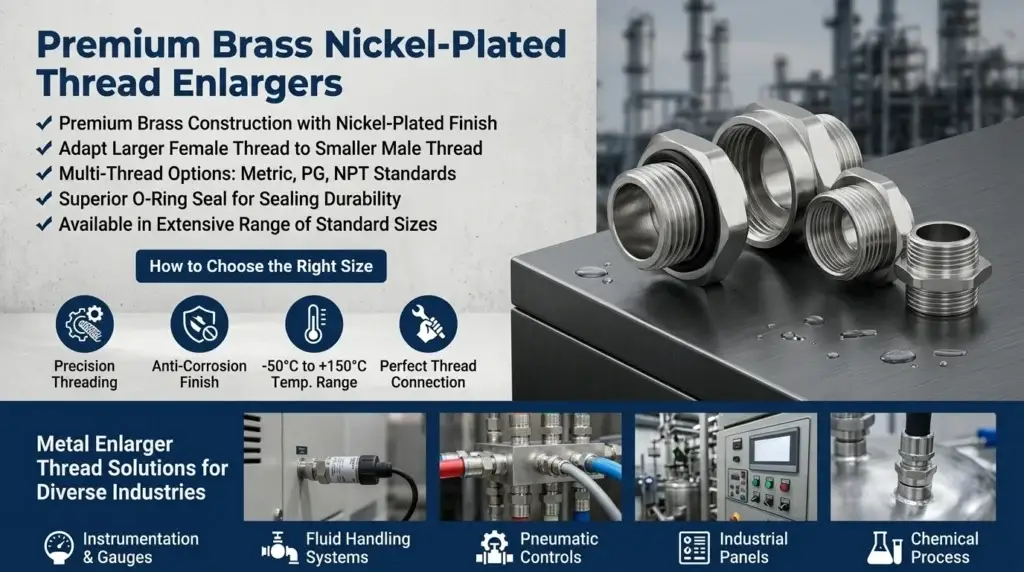
A Cable Gland Enlarger acts as a step-up interface. It features a smaller male thread on the outside (which screws into the smaller enclosure hole) and a larger female thread on the inside (which accepts the larger cable gland).
By using a Brass Thread Enlarger, engineers can upgrade cable capacities without modifying factory-finished panel walls. This preserves structural rigidity, maintains certified explosion-proof boundaries, and prevents structural corrosion caused by raw metal exposed during field drilling.
Metal Enlarger vs. Metal Reducer: Understanding the Structural Difference
Choosing between an enlarger and a reducer depends entirely on the direction of thread step-down or step-up relative to the enclosure wall. Mixing up these components results in backwards connections that fail during installation.
- Metal Enlarger (Step-Up): Male thread is smaller than female thread. Used when the enclosure opening is too small for the required cable gland.
- Metal Reducer (Step-Down): Male thread is larger than female thread. Used when the enclosure opening is too large for the required cable gland.
| Feature / Selection Parameter | Metal Enlarger (Step-Up) | Metal Reducer (Step-Down) |
| Male Thread (Outside) | Smaller diameter | Larger diameter |
| Female Thread (Inside) | Larger diameter | Smaller diameter |
| Primary Problem Solved | Enclosure hole is too small for cable | Enclosure hole is too large for cable |
| External Wall Projection | Extends outward from the box wall | Sits mostly flush with the box wall |
| Mechanical Consideration | Increases leverage/torque on entry wall | Keeps center of gravity close to wall |
Heavy-Duty Performance: Why Nickel-Plated Brass Outperforms Nylon
While plastic fittings exist for commercial building automation, heavy industrial setups require high mechanical strength and thermal resilience. An industrial brass thread enlarger adapter built from Premium Brass with Nickel Plated provides distinct operational advantages over nylon or plastic alternatives.
Key Material Advantages
- Broad Operating Temperature: Premium nickel-plated brass maintains mechanical stability across continuous temperatures ranging from -40°C to +100°C, with short-term heat resistance up to +120°C. Plastic fittings soften and deform near hot machinery, causing seal failure.
- Corrosion & Salt-Spray Resistance: Nickel plating acts as a barrier against oxidation, atmospheric moisture, and chemical washdowns, preventing galvanic corrosion on marine vessel decks and processing plants.
- Grounding Continuity: Metal-to-metal contact ensures an uninterrupted earthing path across the enclosure wall, preventing static buildup in hazardous areas.
Free Thread Conversion: Navigating Metric, PG, and NPT Pathways
Converting thread sizes often involves switching between international thread standards. Because pitch profiles and thread angles differ across standards, selecting the correct conversion pathway is critical to prevent thread galling or stripped entries.
Common Conversion Standards
- Metric (M): Parallel threads with a 60° thread angle and a standard 1.5 mm pitch (e.g., M20 to M25).
- Panzergewinde (PG): Legacy German standard with an 80° thread angle, widely found on European machinery (e.g., PG13.5 to PG21).
- National Pipe Taper (NPT): American tapered thread with a 60° angle that seals via thread crush (e.g., NPT 1/2″ to NPT 3/4″).
When selecting a Metric to PG thread enlarger for cable glands or an NPT to Metric brass cable gland enlarger, confirm both the male entry thread type and the female gland connection thread type before torque is applied.
| Male Entry (Enclosure Side) | Female Output (Gland Side) | Conversion Type | Typical Industrial Application |
| M20 x 1.5 | M25 x 1.5 | Metric to Metric Step-Up | Upgrading sensor wiring to power supply cable on control panels. |
| PG13.5 | PG21 | PG to PG Step-Up | Retrofitting legacy machinery with larger multi-core control cables. |
| M20 x 1.5 | PG21 | Metric to PG Conversion | Fitting European legacy cable glands into modern Metric enclosures. |
| NPT 1/2″ | M25 x 1.5 | NPT to Metric Conversion | Connecting Metric glands to North American cast-junction boxes. |
Achieving IP68 Protection on Heavy-Duty Enclosures
Connecting a larger cable gland to a smaller enclosure hole creates an offset shoulder that requires careful sealing. Achieving a waterproof metal thread enlarger IP68 connection requires a complete assembly setup:
- Interface Sealing Washer: Placed between the enlarger’s male thread shoulder and the outer wall of the enclosure. High-grade Neoprene (NBR) or silicone washers compensate for wall surface irregularities.
- Locknut Attachment: On thin-walled sheet metal enclosures, an internal brass locknut secures the male thread from inside the box to maintain clamping pressure under vibration.
                  [ Enclosure Wall ]
                         ||
     +-------------------||-------------------+
     |   FEMALE THREAD   ||    MALE THREAD    |
==== |     (Larger)      ||     (Smaller)     | ==== (Enclosure Hole)
     |                   ||                   |
     +-------------------||-------------------+
                         ||
                  [ Sealing Washer ]
Addressing Thick Walls & Non-Standard Installations
Standard male threads on conversion fittings are designed for thin enclosure walls (typically 2 mm to 4 mm thick). Cast iron junction boxes, explosion-proof enclosures, and thick marine bulkheads require extended thread engagement to achieve full thread-lock security.
When off-the-shelf adapters lack the reach needed for thick walls, sourcing a custom thread length metal enlarger becomes necessary. In these specialized applications, XINGWEIDIANQI’s Cable Gland Enlargers provide an engineered solution with tailor-made thread reaches, supplied complete with matching locknuts and sealing washers to secure an IP68 connection.
Critical Pitfalls to Avoid During Thread Enlarger Installation
- Ignoring Cantilever Stress: Because an enlarger steps up to a larger cable gland, the extended body creates a longer lever arm. Avoid hanging heavy, unsupported armored cables directly from an enlarger without secondary cable cleat support.
- Cross-Threading Pitch Variations: Forcing an NPT male thread into a Metric parallel hole will strip the wall threads. Always verify thread angle (60° vs 80°) and pitch before applying wrench torque.
- Reusing Damaged Sealing Washers: Reusing old rubber washers during panel maintenance can cause micro-gaps. Replace sealing washers whenever an enlarger is uninstalled or repositioned.
Frequently Asked Questions (FAQ)
What is the primary difference between a cable gland enlarger and a reducer?
An enlarger adapts a smaller enclosure hole to accept a larger cable gland (male thread is smaller than female thread). A reducer adapts a larger enclosure hole to accept a smaller cable gland (male thread is larger than female thread).
Can a nickel-plated brass cable gland enlarger handle extreme outdoor temperatures?
Yes. Quality nickel-plated brass enlargers operate reliably between -40°C and +100°C under continuous exposure, with short-term heat resistance up to +120°C, making them suitable for harsh outdoor conditions.
How do I ensure an IP68 seal when using a Thread Enlarger Adapter?
Combine the enlarger with a compatible elastomeric seating washer (NBR or silicone) placed against the outer enclosure wall, and tighten it securely using a matching locknut or by fully engaging the threaded entry hole.
Are custom thread lengths available for cast-iron or thick-walled boxes?
Yes. For heavy-duty enclosures exceeding standard sheet-metal thickness, source factories can machine custom male thread lengths to guarantee complete thread engagement and structural stability.
Conclusion & Next Steps
Adapting smaller entry holes for larger cable glands requires balancing mechanical strength, thread compatibility, and environmental sealing. Selecting a Nickel-plated brass cable gland enlarger provides the structural stiffness and corrosion resistance necessary to protect internal control electronics while avoiding destructive field drilling.
For complex project installations, verifying thread pitch, wall thickness, and IP rating requirements early prevents installation delays.
Need technical drawings for custom thread lengths, specialized thread conversion matrices, or bulk pricing for an upcoming project? Contact XINGWEIDIANQI’s technical engineering team via WhatsApp at +86 15658735373 or email at cnxwelectric@gmail.com for direct factory assistance and quotes.