In marine engineering and shipbuilding, electrical systems are subjected to some of the most unforgiving environments on earth. Constant vibration from engine rooms, intense salt spray on weather decks, ambient temperature swings, and high-pressure water washdowns demand cable termination components engineered specifically for maritime use.
While standard industrial cable glands work well in land-based factories, commercial vessels and offshore platforms require specialized fittings. This is where the JIS marine cable gland becomes the industry benchmark, particularly across Asian shipyards, Japanese vessel designs, and global marine refit projects.
In this guide, we will break down the JIS F 8801 standard, explain the technical features of PF threads, analyze material selection criteria (Nickel-Plated Brass vs. SS304 vs. SS316), and provide a step-by-step selection checklist for marine electrical engineers and procurement managers.
What Is a JIS Marine Cable Gland?
Definition and Role in Marine Electrical Systems
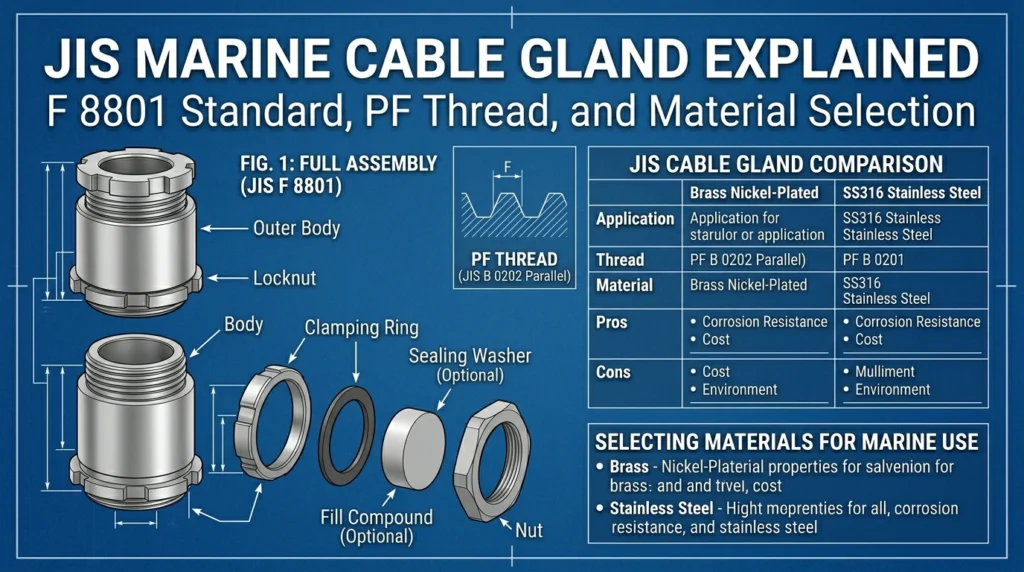
A JIS marine cable gland is a mechanical cable entry device manufactured according to Japanese Industrial Standards (JIS). It is designed to secure, seal, and route electrical cables into marine junction boxes, distribution panels, motor control centers, and bulkhead penetrations aboard ships and offshore installations.
Unlike general industrial cable glands (to understand fundamental cable gland functions, read our foundational guide on what is a cable gland
), JIS marine cable glands feature heavy-duty wall thicknesses, specialized strain relief assemblies, and precise parallel thread profiles tailored to withstand the dynamic stress of sea vessels.
Key functions of a JIS marine cable gland include:
- Ingress Protection (IP68): Preventing sea spray, bilge water, and moisture from penetrating electrical enclosures.
- Mechanical Strain Relief: Locking cables firmly in place to prevent dynamic strain on electrical terminals caused by vessel pitching, rolling, and hull vibration.
- Corrosion Resistance: Utilizing high-grade alloys designed to endure prolonged marine atmosphere and chemical exposure.
The JIS F 8801 Standard Explained
Key Requirements of JIS F 8801
The Japanese Industrial Standard JIS F 8801 specifies the design, dimensions, testing methods, and performance requirements for marine electrical cable glands.
Shipbuilders and marine electrical contractors adhere to JIS F 8801 because it establishes strict engineering benchmarks:
- Heavy-Duty Mechanical Integrity: The standard mandates robust body geometry and wall thickness to withstand physical impact and heavy mechanical stress in tight shipboard compartments.
- Anti-Vibration Strain Relief: Marine engine rooms and thruster compartments experience continuous high-frequency vibration. JIS F 8801 glands incorporate locking rings and elastomeric inserts engineered to prevent loosening over years of continuous operation.
- Standardized Sizing (20 to 50+ Series): JIS F 8801 categorizes gland sizes systematically, making it easy for naval architects and cable installers to match specific cable outer diameters (OD) with corresponding enclosure knockouts.
PF Thread Specification in Shipbuilding
Why PF Thread (JIS B 0202) Is Used in Marine Glands
One of the defining characteristics of a JIS marine cable gland is its thread profile: the PF Thread (defined under JIS B 0202).
What Is a PF Thread?
PF stands for Parallel Pipe Thread (equivalent in profile to ISO G / BSP-P threads). Unlike tapered threads like NPT, which create a seal along the tapered mating threads, PF threads maintain a uniform parallel diameter along the entire engagement length.
| Thread Feature | PF Thread (JIS B 0202) | Tapered Thread (NPT) |
| Thread Form | Parallel (Straight) | Tapered (1:16 Taper) |
| Sealing Method | Flat Gasket / O-Ring on Enclosure Face | Thread Sealant / Tape on Mating Threads |
| Re-usability | Excellent (Easy maintenance) | Fair (Risk of thread galling or over-tightening) |
| Marine Suitability | High vibration tolerance with face gasket | Prone to loosening under intense hull vibration |
For a broader breakdown of global thread standards, explore our guide on cable gland thread types comparison
.
Why Shipbuilders Prefer PF Threads
In marine installations, parallel threads combined with an O-ring or flat sealing washer against the enclosure face provide a far superior watertight seal. Even under severe vibration or slight thermal expansion, the face gasket maintains constant compression, ensuring long-term IP68 protection without relying on thread tape that can degrade in marine environments.
Material Selection: Brass vs. SS304 vs. SS316
Selecting the correct material for your marine cable gland specification directly impacts the operational lifespan of the installation and overall project budgeting.
       +--------------------------------------------------------+
       |             JIS Marine Cable Gland Materials           |
       +--------------------------------------------------------+
                                   |
         +-------------------------+-------------------------+
         |                                                   |
         v                                                   v
+------------------+                               +------------------+
|  Marine Brass    |                               | Stainless Steel  |
|  (Nickel-Plated) |                               | (SS304 / SS316)  |
+------------------+                               +------------------+
         |                                                   |
         |--> Indoor Cabins                                  |--> SS304: Dry Decks & Splash
         |--> Dry Engine Control Rooms                       |--> SS316: Exposed Weather Decks
         |--> Cost-Effective Solution                        |--> Ultimate Saltwater Corrosion Resistance
1. Nickel-Plated Brass
High-grade brass (such as HPb59-1) treated with a heavy nickel plating layer is the standard workhorse material for marine electrical installations.
- Best For: Shipboard interior spaces, dry engine control rooms, accommodation cabins, and general junction boxes.
- Advantages: High mechanical strength, excellent thermal conductivity, cost-effective, and protected against atmospheric oxidation by the nickel plating layer.
2. SS304 Stainless Steel
SS304 offers elevated mechanical strength and solid atmospheric corrosion resistance.
- Best For: Sheltered deck areas, superstructure interior spaces, and machinery spaces with occasional washdowns.
- Advantages: Tougher than brass, resistant to moderate moisture exposure.
3. SS316 Marine-Grade Stainless Steel
For harsh offshore and weather deck environments, SS316 is the gold standard material.
- Best For: Open weather decks, anchor winch control stations, offshore oil platforms, and vessel exterior lighting.
- Advantages: Contains 2–3% Molybdenum, providing exceptional resistance against chloride pitting and crevice corrosion caused by continuous saltwater immersion and ocean spray.
Looking for certified marine fittings? Browse the fullXingWei JIS marine cable gland range
to explore custom sizes, nickel-plated brass, and marine-grade stainless steel options.
IP Rating and Sealing Principles for Shipboards
Achieving Reliable IP68 Waterproofing at Sea
Marine cable glands face two severe fluid challenges: high-pressure sea spray (green water) and temporary deck submergence. Achieving an IP68 ingress protection rating requires careful engineering of internal seals and outer gaskets.
+-------------------------------------------------------------------------+
|                  JIS Marine Cable Gland Anatomy                         |
+-------------------------------------------------------------------------+
  [Cap Nut] ---> [Clamping Claw] ---> [Sealing Ring] ---> [Gland Body] ---> [O-Ring / Washer]
                                            |                                      |
                                  Inner Cable Seal                        Enclosure Face Seal
Sealing Elastomers: NBR vs. FKM
- NBR (Nitrile Rubber): Standard inner sealing insert providing excellent oil resistance, flexibility, and operational temperatures from -40°C to +100°C.
- FKM (Viton): Recommended for engine rooms, fuel pump skids, and high-temperature zones where thermal resistance (up to +200°C) and resistance to heavy fuel oils or chemicals are required.
How to Choose the Right JIS Marine Cable Gland
To simplify procurement and avoid costly delays on the shipyard floor, follow this 5-step engineering checklist:
+-----------------------------------------------------------------------+
|                5-Step Marine Cable Gland Selection                    |
+-----------------------------------------------------------------------+
|  Step 1: Identify Installation Zone (Cabin vs. Weather Deck)          |
|  Step 2: Measure Exact Cable Outer Diameter (OD Range)                |
|  Step 3: Confirm Thread Standard & Pitch (PF / JIS B 0202)            |
|  Step 4: Select Material Grade (Nickel-Plated Brass / SS304 / SS316)  |
|  Step 5: Verify Ingress Rating & Marine Certifications (IP68)         |
+-----------------------------------------------------------------------+
- Identify the Installation Zone: Determine whether the installation is located in an indoor accommodation space (Nickel-Plated Brass) or an exposed weather deck (SS316 Stainless Steel).
- Measure Cable Outer Diameter (OD): Measure the exact outside diameter of the marine cable. Choose a gland size whose sealing range places your cable diameter comfortably in the middle of its clamping envelope.
- Verify Thread Size (PF Thread): Check your junction box or marine panel entry port to confirm the required PF thread size (e.g., PF 1/2″, PF 3/4″, PF 1″, PF 1-1/4″, etc.).
- Determine Environmental Factors: Check for high heat, chemical, or fuel exposure to select between standard NBR seals or high-temp FKM seals.
- Check Certifications: Ensure the glands comply with JIS F 8801 manufacturing metrics and hold relevant IP68 test reports.
Frequently Asked Questions (FAQ)
What does JIS stand for in marine cable glands?
JIS stands for Japanese Industrial Standards. In marine electrical fitting specifications, standards such as JIS F 8801 define specific dimensions, mechanical strength criteria, and PF thread tolerances tailored for shipbuilding and marine engineering.
Can I substitute Metric or NPT threads for PF threads?
Direct substitution is not recommended without proper thread adapters. PF threads (JIS B 0202) are parallel pipe threads designed to seal using a face washer or O-ring. Metric threads have different pitch profiles, and NPT threads are tapered. Forcing mismatched threads damages enclosure ports and compromises IP68 sealing.
What is the main difference between SS304 and SS316 marine cable glands?
While both are stainless steel, SS316 contains 2–3% molybdenum, which dramatically increases its resistance to chloride pitting and saltwater corrosion. SS304 is suitable for dry interior ship spaces or sheltered decks, whereas SS316 is essential for open weather decks and offshore marine platforms.
Are JIS marine cable glands IP68 rated?
Yes. When properly installed with the correct outer diameter cable and tightened to recommended torque specifications, JIS marine cable glands achieve an IP68 waterproof and dust-tight rating, capable of withstanding continuous submersion and heavy sea spray.
Conclusion
A JIS marine cable gland is an essential safeguard for shipboard electrical integrity. By understanding the JIS F 8801 specification, matching the correct PF thread size, and selecting between Nickel-Plated Brass and SS316 Stainless Steel, marine engineers can guarantee long-term operational safety at sea.
At Wenzhou Xingwei Electric Co., Ltd., we manufacture precision-engineered marine electrical components built to rigorous international standards. Explore our full catalog of high-performance XingWei marine cable glands
or contact our technical engineering team for custom thread configurations, material advice, and bulk OEM quotes.
Structured Data (JSON-LD FAQ Schema)
JSON
{
  "@context": "https://schema.org",
  "@type": "FAQPage",
  "mainEntity": [
    {
      "@type": "Question",
      "name": "What does JIS stand for in marine cable glands?",
      "acceptedAnswer": {
        "@type": "Answer",
        "text": "JIS stands for Japanese Industrial Standards. In marine electrical fitting specifications, standards such as JIS F 8801 define specific dimensions, mechanical strength criteria, and PF thread tolerances tailored for shipbuilding and marine engineering."
      }
    },
    {
      "@type": "Question",
      "name": "Can I substitute Metric or NPT threads for PF threads?",
      "acceptedAnswer": {
        "@type": "Answer",
        "text": "Direct substitution is not recommended without proper thread adapters. PF threads (JIS B 0202) are parallel pipe threads designed to seal using a face washer or O-ring. Forcing mismatched threads damages enclosure ports and compromises IP68 sealing."
      }
    },
    {
      "@type": "Question",
      "name": "What is the main difference between SS304 and SS316 marine cable glands?",
      "acceptedAnswer": {
        "@type": "Answer",
        "text": "While both are stainless steel, SS316 contains 2–3% molybdenum, which dramatically increases its resistance to chloride pitting and saltwater corrosion. SS304 is suitable for dry interior ship spaces, whereas SS316 is essential for open weather decks and offshore platforms."
      }
    },
    {
      "@type": "Question",
      "name": "Are JIS marine cable glands IP68 rated?",
      "acceptedAnswer": {
        "@type": "Answer",
        "text": "Yes. When properly installed with the correct outer diameter cable and tightened to recommended torque specifications, JIS marine cable glands achieve an IP68 waterproof and dust-tight rating."
      }
    }
  ]
}