IP68 is printed on more cable gland datasheets than any other rating, and it is the one buyers most often specify without reading what it actually commits them to. An IP68 cable gland is dust-tight and rated for continuous water immersion beyond one metre — but the depth and the duration are set by the manufacturer, not fixed by the standard. That single clause is where most specification arguments begin, and it is why two glands both stamped “IP68” can carry genuinely different capability.
For an engineer or a buyer working through an outdoor panel, a wash-down line, or a submerged junction box, the useful question is not whether IP68 is the highest number available. It is which rating on the chart actually covers the worst week of the year at that installation. The answer very often costs less than the default.
What follows works through the two digits, the full IEC 60529 chart, how gland material changes whether the rating survives a service life, the real difference between IP66, IP67, IP68 and IP69K, how to match a rating to an environment, how to verify a seal once it is fitted, and the mistakes that put otherwise correctly specified glands into the maintenance log.
What Does IP68 Mean on a Cable Gland?
A cable gland is the fitting that seals a cable where it enters an enclosure — sealing against dust and water, gripping the cable so pull and twist cannot work a termination loose, bonding the screen to ground on EMC variants, and carrying the compliance marks the installation requires. The IP code on its datasheet describes the first of those jobs and a little of the second, and it describes them more narrowly than most buyers assume.
IP stands for Ingress Protection, and the code is defined in IEC 60529, the international standard that grades how well an enclosure resists solids and liquids. Two digits follow the letters. The first grades solid objects, the second grades water. Neither digit says anything about corrosion, UV stability, mechanical strength, or how long the gland lasts — which is precisely the set of things that decide whether a gland still holds its rating five years after commissioning.
The First Digit (Solids Protection: 0–6)
The first digit runs from 0 to 6 and describes what size of solid object the gland keeps out. A 0 means no protection at all; a 6 means dust-tight, with no ingress permitted under the test.
On industrial cable glands this digit is almost always 5 or 6. A 5 — dust-protected, limited ingress permitted provided no harmful deposit forms — shows up on entry-level nylon parts and on glands sold for instrument housings that never see grit. A 6 is the working standard for brass, stainless, and properly rated nylon glands.
The distinction matters more than it looks. A cement plant, a quarry conveyor, a grain handling facility, a mining tunnel — these are environments where fine particulate works its way into anything that is merely dust-protected. A gland rated 5 in those locations will pass a commissioning-day inspection and then let conductive dust accumulate on the termination side, which is a failure that presents as an intermittent fault rather than as an obvious leak.
The Second Digit (Liquid Protection: 0–9K)
The second digit is the one that drives gland cost, gland material, and the difference between a gland a panel builder fits without a second thought and a gland a dockside installer fits with a torque wrench and a test log. It runs from 0 through 9K, and each step is a different test rather than a stronger version of the previous one.
A 4 covers splashing water from any direction — enough for an indoor panel in a humid plant room. A 5 covers low-pressure jets. A 6 covers powerful jets and heavy seas, which is the rating that matters on exposed coastal equipment and on wash-down walls. A 7 covers temporary immersion. An 8 covers continuous immersion. A 9K covers close-range high-pressure, high-temperature spray, which is a cleaning test rather than a depth test.
The progression reads like a ladder, and it is not one. Each digit certifies a specific test condition, and passing one does not imply passing another.
What “Manufacturer-Defined” Means for IP68
Here is the clause that separates IP68 from every other rating on the chart, and the one that costs buyers the most trouble.
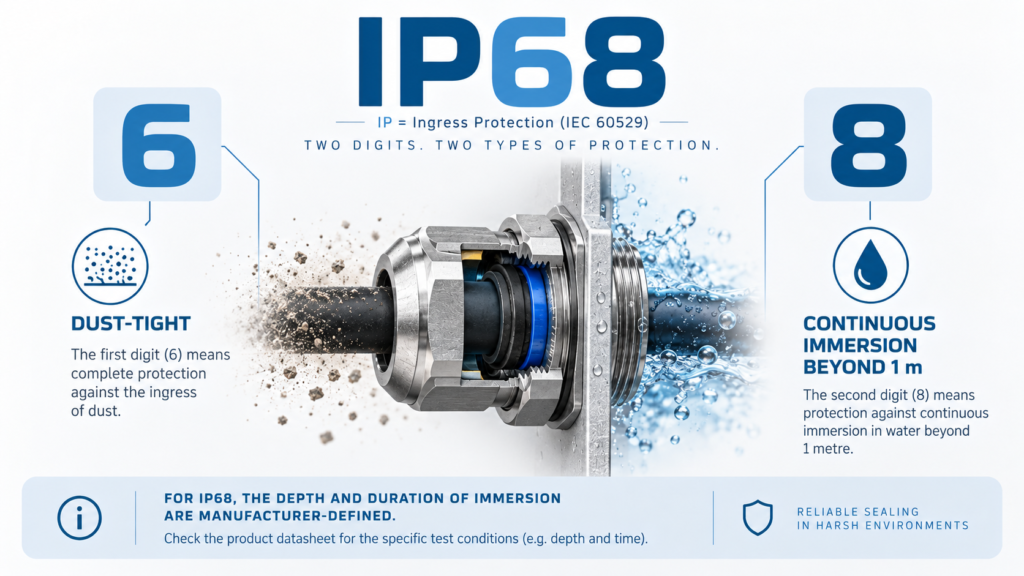
IP67 has a fixed test: immersion to 1 metre for 30 minutes under the IEC 60529 baseline. IP68 has no such fixed condition. The standard requires only that the gland withstand continuous immersion under conditions more severe than IP67, and leaves the actual depth and duration to the manufacturer to declare.
So “IP68” on a datasheet is a claim that must be read alongside the small print. One gland may be tested at 1.5 metres for 24 hours. Another may be tested at 10 metres for 30 days. Both are legitimately IP68. Neither datasheet is lying, and the two parts are not interchangeable.
The practical consequence is simple: when IP68 is specified for a submerged or buried application, ask the supplier for the declared depth and duration in writing, and match that number against the worst condition the installation will actually see. A gland rated to 1.5 metres is not the right part for a pump hanging at 8 metres, even though both applications are “IP68.”
IP68 on a cable gland means the fitting is dust-tight (first digit 6) and protects against continuous water immersion beyond 1 metre, with depth and duration specified by the manufacturer. The rating is defined by IEC 60529, the international standard for ingress protection.
The IEC 60529 IP Rating Chart for Cable Glands
Specifiers who read three or four gland datasheets in a row end up wanting the whole chart in front of them rather than the individual digits. Both tables below are the IEC 60529 grades, with the cable gland reading added.
First Digit (Solids) — Full Reference Table
| Digit | Protection against solids | Relevance to cable glands |
| 0 | No protection | Not used on industrial glands |
| 1 | Objects ≥ 50 mm | Not used on industrial glands |
| 2 | Objects ≥ 12.5 mm | Not used on industrial glands |
| 3 | Objects ≥ 2.5 mm | Not used on industrial glands |
| 4 | Objects ≥ 1 mm — wires, tools, small screws | Entry-level instrument housings |
| 5 | Dust-protected — limited ingress permitted, no harmful deposit | Light-duty nylon glands, sheltered indoor use |
| 6 | Dust-tight — no ingress at all | Standard for industrial brass, stainless, and IP-rated nylon glands |
Second Digit (Liquids) — Full Reference Table
| Digit | Test condition | Typical cable gland application |
| 0 | No protection | Not used on cable glands |
| 1 | Vertically falling water drops | Not used on cable glands |
| 2 | Drips, enclosure tilted to 15° | Not used on cable glands |
| 3 | Spraying water up to 60° from vertical | Not used on cable glands |
| 4 | Splashing water from any direction | Indoor panels in humid plant rooms |
| 5 | Low-pressure water jets from any direction | Sheltered outdoor enclosures, light wash-down |
| 6 | Powerful water jets and heavy seas | Exposed outdoor panels, coastal equipment, wash-down walls |
| 7 | Temporary immersion — 1 m for 30 min | Flood-prone pits, shallow burial, tidal splash zones |
| 8 | Continuous immersion beyond 1 m — depth and duration set by manufacturer | Pump pits, marine installations, underground cabling, subsea skids |
| 9K | High-pressure, high-temperature close-range jets | Food, beverage, pharmaceutical and vehicle wash-down lines |
One note that catches people out: IP69K is defined in ISO 20653 (originally DIN 40050-9), not in IEC 60529. It is a surface-cleaning test, not a depth test. A gland can pass IP68 and fail IP69K, and the reverse — they measure different things, so “IP68 or IP69K” is not the question. The question is whether the gland faces standing water or a steam lance.
Does the Cable Gland Material Affect the IP Rating?
No, and yes — and the gap between those two answers is where a lot of field failures live.
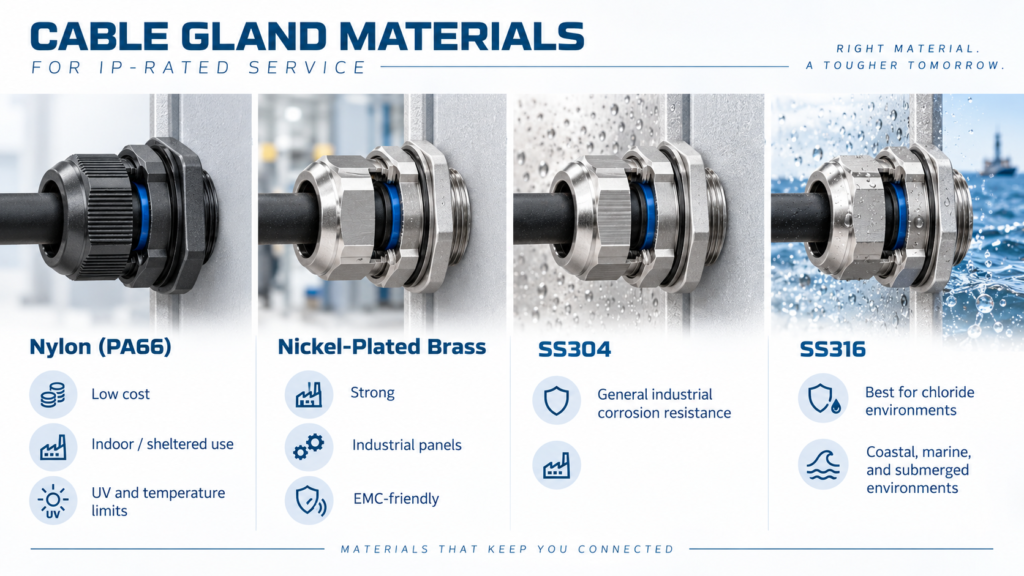
Material does not change the digits printed on the datasheet. A nylon gland and a stainless gland of the same design can both legitimately carry IP68, because the rating describes what the gland does on the day it is tested, not what it is made of. What material changes is whether the gland still holds that rating after two summers, two winters, and a few hundred thermal cycles.
Nylon (PA66) — UV, Temperature, and Aging
Nylon sits at the bottom of the price scale, typically a quarter to a fifth of the cost of an equivalent brass gland, and it is what most lightweight enclosures ship with from the factory. For indoor distribution boards, sheltered junction boxes, and OEM skid wiring where cost per termination matters, it is the right call.
The two limits to design around are UV and temperature. Standard PA66 does not survive sustained sunlight; it goes soft, then brittle, and the sealing insert loses the compression that made the rating true. Its usable temperature window also sits well below what a metal gland tolerates.
A rooftop solar combiner box in Southeast Asia is the case that shows this clearly. The enclosure is rated IP65, the installer fits IP68 nylon glands because the spec says IP68, and two seasons later the inserts have taken enough UV and enough midday heat that the seal has drifted. The digits on the datasheet were never wrong — they just described a gland in a different environment. If the gland is outdoors and in the sun, either specify a UV-stabilised grade or move to metal.
Nickel-Plated Brass — Mechanical Strength and EMC
Brass is the default for industrial control panels, factory automation, and indoor distribution boards, and the reasoning is mostly mechanical. It holds a thread well, takes a torque cycle without splitting, and costs less than the labour to install it. The nickel plating resists the tarnishing that makes a raw brass gland hard to undo the second time someone opens the panel.
Brass also brings something nylon cannot: on EMC variants, the metal body carries the 360° screen contact that keeps a variable-frequency drive cable from turning the enclosure into an antenna. That is a separate function from the IP rating, but it is often what decides the material.
A wash-down control panel on a European dairy line is the typical fit. The line gets hot water and caustic detergent daily, the gland needs IP66 or better, and brass handles the mechanical side while the sealing insert handles the water. XingWei’s nickel-plated brass standard cable glands cover Metric, PG, NPT, G and PF threads across the common sizes for this class of work.
Stainless Steel 304 vs 316 — Chloride and Marine
Stainless comes in where the environment would punish brass. The decision between 304 and 316 turns almost entirely on chloride.
304 is the general-purpose grade and is right for most industrial settings. 316 adds roughly two percent molybdenum to the alloy, and that addition buys real resistance to pitting in chloride-rich or acidic conditions. The cost difference is meaningful — stainless runs two to three times brass in the same size, and the gap widens at larger threads — so it is worth being precise about when it is actually needed.
A dock-side control box on the North Sea is the case where the distinction stops being academic. A 304 gland in salt-laden air will pit, the thread seizes, and the next panel access involves a hacksaw rather than a spanner. That is where 316 stops being an upgrade and becomes the specification. The same logic applies to a coastal food plant, an offshore platform, a chemical works handling chloride-bearing process streams, and any installation below the splash line. XingWei’s IP68 waterproof cable gland range covers the SS304 and SS316 combination, along with the brass and nylon variants, for the marine and submerged applications this section describes.
The cable gland material does not change the IP digits printed on the datasheet, but it determines whether the gland holds that rating over years of service. Nylon suits indoor and UV-sheltered use, brass suits industrial panels and wash-down areas, and SS316 is required for chloride-bearing or marine environments.
IP66 vs IP67 vs IP68: What’s the Real Difference?
Three datasheets land on the same desk — IP66, IP67, IP68 — and they look like a graduated scale of the same property. They are not. Each one describes a different test regime, and the specification error this causes is common enough to be worth stating plainly: buying IP68 when the application needs IP66 wastes money, and buying IP67 when the application needs IP68 produces a leak.
The Three Test Regimes Side by Side
| Rating | Water test | Depth / duration | Typical use case | Relative cost |
| IP66 | Powerful water jets from any direction | No immersion test | Exposed outdoor panels, wash-down walls, coastal cabinets | $ |
| IP67 | Temporary immersion | 1 m for 30 min (IEC 60529 baseline) | Flood-prone service pits, shallow burial, tidal splash zones | $$ |
| IP68 | Continuous immersion | Beyond 1 m — depth and duration declared by manufacturer | Pump pits, marine, underground cabling, subsea skids | $$$ |
| IP69K | High-pressure, high-temperature close-range jets (ISO 20653) | Not a depth test | Food, beverage, pharmaceutical and vehicle wash-down | $$$ |
Why IP68 Is Not Just “Higher” Than IP67
The IP67 test is fixed and repeatable: one metre, thirty minutes, and the part either passes or it does not. That makes IP67 easy to compare across suppliers, because every IP67 gland on the market has cleared the same bar.
IP68 has no such common bar. The standard requires conditions more severe than IP67 and hands the specifics to the manufacturer. This is why the number on the box is the beginning of the enquiry rather than the end of it.
There is a second asymmetry worth knowing. An IP67 gland that passed a 30-minute immersion test is not certified to sit at three metres for thirty days — the two ratings describe different conditions, and passing one says nothing about the other unless the manufacturer tested for both. Some glands carry a dual IP67/IP68 marking precisely because the maker ran both tests; when a gland shows only IP68, it is worth asking whether the IP67 condition was also verified, particularly for an installation that alternates between wet and dry.
IP66, IP67, and IP68 describe three different test regimes, not a stepped strength ladder. IP66 certifies powerful water jets, IP67 certifies temporary immersion to 1 metre for 30 minutes, and IP68 certifies continuous immersion at a manufacturer-specified depth. The correct rating is set by the enclosure’s worst-case exposure.
Which IP Rating Do You Actually Need? Matching Rating to Environment
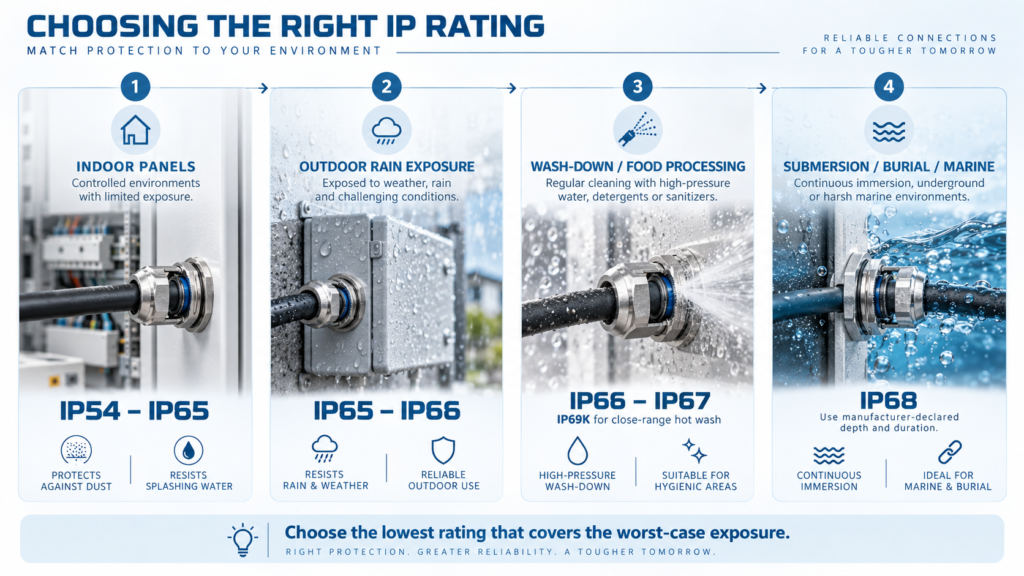
Once the test regimes are clear, selection stops being a comparison and becomes a matching exercise. Work backward from the harshest condition the enclosure will meet over a service year, then pick the lowest rating that still covers it. Over-specifying is not a safety margin — it is money spent on a test the gland will never be asked to pass.
The other rule that governs all four sections below: the system is rated at the lower of the gland and the enclosure. An IP68 gland on an IP66 box gives you an IP66 system. An IP66 gland on an IP68 box gives you an IP66 system that leaks.
Indoor Panels and Sheltered Enclosures (IP54–IP65)
Factory floors, climate-controlled manufacturing halls, indoor distribution boards, and instrumentation cabinets in dry plant rooms sit at the bottom of the range. IP54 is often enough where the risk is dust and the occasional damp mop; IP65 covers the enclosures that see a wash or a humid atmosphere.
The failure to avoid here is not under-rating — it is fitting a gland whose sealing insert was never sized for the cable, which is a problem at any IP level. An indoor panel that fails usually fails on strain relief or on cable-diameter mismatch, not on the digits.
Outdoor Wall-Mount and Rain Exposure (IP65–IP66)
A vertically mounted enclosure on a wall that sees sun and rain but no jets and no pooling is the classic IP65 application. Move to IP66 where the panel is exposed on all sides, where it sits on a rooftop or a skid that takes weather from any direction, or where it is near a coast.
A generator skid sitting outside a pumping station is a representative case: no immersion risk, but driving rain from whatever direction the wind takes, plus the vibration of the set. IP66 is the rating that fits, and IP68 would be spending money on a condition the skid will never meet.
Wash-Down and Food Processing (IP66–IP67)
Food and beverage plants — dairy, brewing, meat processing — hose equipment down with hot water and detergent, often daily. The gland on a wash-down wall is one of the more common sources of panel returns, and an IP65 gland in that position is a known failure.
IP66 handles the jets. IP67 adds margin where water pools at the base of the panel or where the floor floods during cleaning. Where the cleaning regime uses a steam lance at close range, the relevant test is IP69K under ISO 20653, which is a different certificate from anything IEC 60529 covers — worth confirming with the supplier rather than assuming the IP68 mark extends to it.
Submersion, Burial, and Marine (IP68)
This is where IP68 stops being optional. Pump pits, underground junction boxes, dock-side control cabinets, water-treatment skids, subsea equipment, anything below the low-water line or below grade where water sits rather than drains.
Two things to settle at specification time, both of which were raised earlier and both of which are easy to skip. First, get the declared depth and duration in writing, since IP68 does not fix them. Second, settle the material — SS316 in chloride-bearing or seawater exposure, brass where the water is fresh and the mechanical load is high. The rating and the material are separate decisions that both have to be right.
The correct IP rating for a cable gland is the lowest one that covers the enclosure’s worst-case water exposure over a full service year. Rain on a vertical wall needs IP65 or IP66. Temporary flooding needs IP67. Continuous submersion, burial, or marine use needs IP68 with the manufacturer’s stated depth.
How to Verify and Test IP68 Sealing in the Field
A rating on a datasheet describes a part tested in a lab. Whether the installed gland holds that rating depends on the install, and four checks catch most of the gap.
Start with the visual and mechanical check that takes thirty seconds. The compression nut should be seated, the sealing insert should not be visible extruding past the body, the locknut should be tight against the enclosure wall, and the cable should not move when pulled by hand. A cable that pulls is a cable whose insert is not gripping, and no amount of IP68 marking rescues it.
The second check is the pull test, and it is the one most installers already do without naming it. Grip the cable and pull firmly along its axis. Movement means under-compression. The gland needs the right size for that cable, not the nearest size in the kit.
For anything critical, the compressed air test is the practical field method. Seal the enclosure, apply a low pressure internally, submerge the gland entry in water, and look for bubbles. The method catches a bad seal that looks perfect on inspection, and it is cheap enough to run on every gland in a pump pit. Pressure values and test durations should be taken from the installation’s own commissioning procedure rather than improvised on site.
Where the specification is contractual — a subsea skid, a classified marine installation, anything with a certificate package — the gland has to go to a purpose-built IP test rig and be tested to its full declared depth and duration. This is the only check that actually verifies the manufacturer’s IP68 declaration, and it is the one that settles disputes.
One maintenance note that belongs with the testing section: do not reuse a sealing insert that has been removed. Elastomer takes a compression set from its first installation and will not compress to the same integrity a second time. If a gland comes apart for cable replacement or panel modification, fit a new insert on reassembly.
Common IP68 Cable Gland Mistakes and How to Avoid Them
Five errors account for most of the IP68 failures that reach a maintenance log. Each one passes a commissioning-day check.
(1) Specifying IP68 without asking the depth. The rating does not fix depth or duration. A gland declared at 1.5 metres is not the right part for equipment sitting at 8 metres, and both are correctly marked IP68. Get the number in writing before the order.
(2) Treating the rating as a system rating. The gland and the enclosure are rated separately, and the installation takes the lower of the two. An IP68 gland on an IP66 cabinet is an IP66 cabinet. Conversely, an IP68 box with an IP67 gland is the failure pattern that shows up the first time the pit floods — the water finds the lower number.
(3) Sizing the gland to the wrong cable diameter. The clamping range has to land on the cable’s actual outer diameter, not on the widest number printed on the catalogue page. A gland ranged 20–32 mm will physically accept a 22 mm cable and will not seal it the way a gland ranged 18–25 mm does. This mistake is material-independent and rating-independent; it defeats both.
(4) Over-tightening, or tightening by feel. Under- and over-tightening produce different seal failures. Under-tightened, the gland leaks. Over-tightened, the insert extrudes through the body, and the gland either fails to seal or locks the cable so firmly that thermal expansion moves cable and gland together. The torque figure on the datasheet exists because the window is real, and an install team without a torque wrench will not produce the same result twice.
(5) Choosing the material for the purchase price rather than the environment. A nylon gland in tropical sun, a brass gland in a chloride atmosphere, a 304 gland in seawater — each of these carries a valid IP68 marking on day one, and each loses the seal long before the enclosure does. The rating describes the part as tested; the material decides whether the part still tests the same way in year three.
Frequently Asked Questions
Is IP68 always better than IP67 for a cable gland?
No. They certify different conditions rather than different strengths. IP67 is a fixed test — immersion to 1 metre for 30 minutes under the IEC 60529 baseline. IP68 is continuous immersion beyond 1 metre at a depth and duration the manufacturer declares. Choose by what the enclosure actually faces: temporary flooding suits IP67, permanent submersion suits IP68.
Does the thread type (Metric, NPT, PG) affect the IP rating?
No. The thread governs how the gland mates to the enclosure, not how it seals. The water seal comes from two places — the internal compression of the sealing insert onto the cable jacket, and the external seal between the gland and the panel face. Metric, NPT, PG, G and PF glands can all achieve IP68 when correctly sized and fitted.
Can I use an IP68 cable gland outdoors if it only rains?
Yes, but it is usually over-specified. IP65 is the practical floor for rain on a vertical wall-mounted enclosure, and IP66 is the safer choice where the panel is exposed on all sides or sits near a coast. IP68 is warranted when the gland may be submerged, buried, or left standing in water — conditions IP65 and IP66 were not tested for.
How long does an IP68 cable gland stay waterproof?
It depends on the elastomer, the UV load, the thermal cycling, and any chemical contact, rather than on the rating itself. NBR inserts are the default and typically need inspection earlier in outdoor service; silicone and EPDM hold compression longer. Any gland that has been disassembled should get a new insert, because the first compression set is permanent.
An IP68 cable gland is a dust-tight fitting rated for continuous water immersion beyond one metre, at a depth and duration the manufacturer declares. Everything else on this page is context for that one sentence: how to read the two digits, where IP66 and IP67 sit either side of it, why material decides whether the rating survives a service life, and how to check the seal once the gland is fitted. Once those are settled, the specification usually narrows to a material, a thread, and a declared immersion figure — and those three are what a supplier needs in order to quote. For an overview of IP68-rated options across brass, stainless 304 and 316, and nylon, the XingWei waterproof cable gland category is the entry point; declared immersion depth and duration, and any certification scope beyond CE and RoHS, should be confirmed directly with the supplier against the certificate document.
XingWei’s manufacturing operations run under an ISO 9001 quality management system, and CE marking and RoHS compliance apply to the relevant cable gland product families. Specific hazardous-area certification scope — ATEX, IECEx, UL or CSA — remains a per-part-number check.