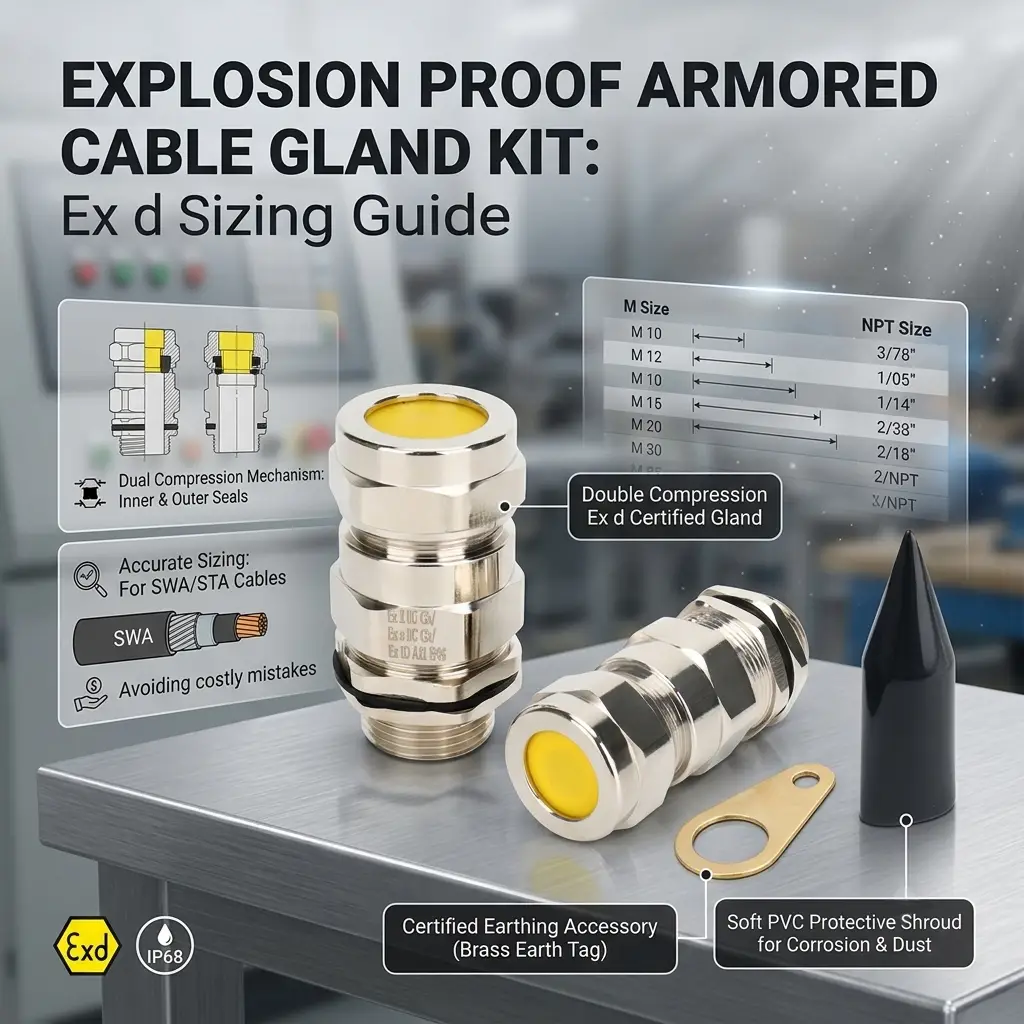
Installing electrical cabling in Zone 1 or Zone 2 hazardous areas leaves zero margin for error. A single improperly sealed cable entry point can allow flammable gases to migrate into Ex d flameproof enclosures, resulting in catastrophic ignition risks or immediate inspection failure. Choosing a complete Explosion Proof Armored Cable Gland Kit resolves critical compliance issues by providing dual-layer sealing, mechanical armor clamping, and certified earthing accessories in a single package.
In this technical selection guide, you will learn how the dual compression mechanism works, how to evaluate double compression vs single compression cable gland selection options, how to accurately size glands for SWA/STA cables, and how to avoid costly field installation mistakes.
What Is an Explosion Proof Armored Cable Gland Kit?
An Explosion Proof Armored Cable Gland Kit is an engineered cable termination assembly designed for hazardous locations (Ex d / Ex e environments). Unlike standard non-armored glands, a hazardous area armored kit secures steel wire armored (SWA), steel tape armored (STA), or aluminum wire armored (AWA) cables while creating a certified flameproof barrier.
Dual Sealing Mechanism (Inner and Outer Seals)
The hallmark of a high-specification explosion-proof gland is its dual compression sealing layout:
- Inner Sealing Ring: Compresses directly onto the cable’s inner bedding (underneath the armor layer). This inner seal creates an Ex d flameproof explosion containment zone, preventing gas or flame migration along internal cable cores.
- Outer Sealing Ring: Compresses onto the cable’s external sheath, delivering IP68 ingress protection against dust, moisture, and aggressive washdowns.
Ex d IIC Flameproof Protection Logic
In Ex db IIC Gb applications, internal sparking or arcing from control equipment must be contained inside the enclosure without igniting the surrounding explosive atmosphere. The gland’s inner seal and precision metric or NPT entry threads act as a flame path, cooling expanding gases below their ignition point before they reach the external environment.
Essential Accessories: Shroud and Earth Tag
A fully compliant kit includes two vital non-negotiable accessories:
- Brass Earth Tag: Maintains electrical earth continuity between the cable’s metallic armor and the enclosure body, safely discharging fault currents or static electricity.
- Soft PVC Protective Shroud: Encases the gland body and entry threads. It shields nickel-plated brass threads from corrosive marine salt spray, acid rain, and environmental debris, ensuring long-term IP68 sealing performance.
Double Compression vs Single Compression Cable Glands
Choosing between single and double compression glands is a critical safety and compliance decision for hazardous area projects. Using a single compression gland on an armored cable in a Zone 1 Ex d environment frequently violates IEC/EN 60079-14 installation standards.
| Feature / Selection Criterion | Single Compression Cable Gland | Double Compression Cable Gland Kit |
| Inner Bedding Sealing | None (Outer Sheath Only) | High-compression elastomer seal on inner bedding |
| Outer Sheath Sealing | Single elastomer seal | High-compression elastomer seal (IP68) |
| Armor Clamping | Basic mechanical grip / optional | Dual-cone clamping ring for SWA/STA armor wire |
| Ex d IIC Hazardous Zone | Limited to non-armored / specific Ex e | Certified Ex db IIC Gb for Zone 1, Zone 2, 21 & 22 |
| Gas Migration Prevention | Poor (Gases travel along internal fillers) | Excellent (Inner seal seals directly around cores) |
When Armor Clamping and Inner Sealing Are Mandatory
Single compression glands only clamp the outer jacket of a cable. If used on armored cables in Ex d enclosures, explosive gases can enter the cable’s internal fiber fillers, bypassing the outer seal entirely and creating an unsealed gas migration pathway.
Double compression gland kits feature a dedicated armor clamping cone and clamping ring that mechanically lock the SWA/STA wire shield. This design absorbs high mechanical pulling tension while allowing the inner elastomer ring to compress tightly onto the inner bedding without cold flow deformation.
How to Size an Explosion Proof Armored Cable Gland Kit
Proper gland sizing requires precise measurement of cable construction layers rather than relying solely on nominal cable cross-sectional area.
Measuring Inner Bedding, Armor Wire, and Outer Sheath
Before selecting a gland size, obtain the dimensional drawing for your SWA or STA cable and verify three core dimensions:
- Inner Bedding Diameter: The outer diameter of the internal sheath underneath the metal armor. The gland’s inner seal must compress within this exact range.
- Armor Wire / Tape Thickness: The diameter of the steel armor wire (SWA) or thickness of the steel tape (STA). The armor cone clamping range must accommodate this gauge.
- Outer Sheath Diameter: The overall outside diameter of the cable. The outer sealing nut must seal tightly onto this dimension.
Double Seal Cable Gland Size Chart for SWA / STA Cable
Refer to the standard sizing matrix below to match metric entry threads with cable dimensions:
| Gland Size | Entry Thread (Metric) | Inner Bedding Range (mm) | Outer Sheath Range (mm) | Armor Wire Thickness (mm) |
| M20s | M20 × 1.5 | 6.1 – 11.6 | 10.2 – 15.8 | 0.9 – 1.25 |
| M20 | M20 × 1.5 | 8.5 – 13.8 | 13.5 – 20.0 | 0.9 – 1.25 |
| M25 | M25 × 1.5 | 13.0 – 19.8 | 18.0 – 26.5 | 1.25 – 1.6 |
| M32 | M32 × 1.5 | 19.0 – 26.4 | 25.0 – 33.5 | 1.6 – 2.0 |
| M40 | M40 × 1.5 | 25.0 – 32.5 | 32.0 – 41.0 | 1.6 – 2.0 |
| M50 | M50 × 1.5 | 31.5 – 42.0 | 40.0 – 52.5 | 2.0 – 2.5 |
| M63 | M63 × 1.5 | 41.5 – 53.0 | 51.0 – 64.0 | 2.0 – 2.5 |
Metric vs NPT Thread Considerations
While ISO Metric threads (M20 to M63) dominate European, Asian, and IECEx projects, NPT threads (NPT 1/2″ to NPT 2-1/2″) are widely specified across North American and Middle Eastern oilfield projects.
When sourcing from an Ex db IIC Gb armored cable gland manufacturer China, ensure the factory provides precision-machined threads in high-tensile nickel-plated brass. For high-corrosion or hazardous industrial installations, choosing a standardized unit like the Nickel-Plated Brass Double Compression Explosion-Proof Cable Gland (BDM-VII/D Series) guarantees pre-matched PVC shrouds, brass earth tags, and IP68 sealing components in a single factory-inspected kit.
Common Installation Errors in Hazardous Areas
Field inspection failures during hazardous area audits are often caused by minor installation oversights rather than equipment defects.
| Installation Mistake | Safety & Inspection Risk | Preventive Kit Solution |
| Omitting the Earth Tag | Loss of earth continuity; static discharge risks | Install brass earth tag directly under locknut inside or outside enclosure |
| Discarding the PVC Shroud | Thread corrosion, salt spray degradation, seized threads | Slip soft PVC shroud over cable outer jacket prior to gland assembly |
| Incorrect Armor Cone Orientation | Insufficient armor clamping; cable pull-out failure | Reverse armor clamping ring according to SWA vs STA wire profile |
| Over-tightening Inner Seal | Cold flow damage to inner cable bedding | Torque inner sealing nut to manufacturer’s specified limits |
Overcoming Corrosion and Earth Bonding Failures
In offshore platforms and chemical processing plants, untreated brass glands quickly oxidize, leading to galvanic corrosion and thread seizure. Nickel-plated brass provides superior corrosion resistance while maintaining low contact resistance across the brass earth tag. Always ensure the protective PVC shroud is properly pulled over the fully tightened gland body to prevent water pooling around entry threads.
Frequently Asked Questions
What is included in a standard Explosion Proof Armored Cable Gland Kit?
A complete kit includes the nickel-plated brass gland body, inner and outer elastomer sealing rings, armor clamping cone and ring, a brass locknut, a brass earth tag for earth continuity, and a soft PVC protective shroud to shield against environmental corrosion.
Why is double compression required for armored cables in Ex d hazardous areas?
Double compression glands seal both the inner bedding beneath the armor and the outer sheath over the armor. The inner seal is essential in Ex d applications to prevent explosive gas migration through internal gaps between cable cores.
How do I choose between Metric and NPT threads for Ex db IIC Gb glands?
Metric threads (e.g., M20×1.5) feature parallel threads and require an O-ring or sealing washer against the enclosure wall. NPT threads are tapered and achieve sealing via thread engagement, widely required in American and Middle Eastern oil and gas specifications.
Can I install an Ex d armored cable gland without a PVC protective shroud?
While the gland may maintain its Ex d rating without a shroud, omitting the soft PVC protective shroud exposes entry threads and armor clamping joints to salt spray, moisture, and chemical exposure, leading to premature corrosion and IP rating degradation.
What is the difference between Ex d and Ex e cable gland certification?
Ex d (flameproof) glands contain internal explosions without allowing flames to propagate outward. Ex e (increased safety) glands focus on preventing sparks and excess heat generation. Double compression Ex db IIC Gb glands are rated for flameproof Ex d enclosures.
Technical Selection Summary and Engineering Support
Selecting the correct Explosion Proof Armored Cable Gland Kit requires verifying cable inner bedding diameters, selecting double compression sealing for Ex d compliance, and insisting on complete kit packaging with earth tags and shrouds. Standardizing on dual compression nickel-plated brass construction ensures long-term IP68 sealing, galvanic corrosion resistance, and total site safety compliance.
If you need technical datasheets, CAD drawings, or assistance matching your SWA/STA cable dimensions to certified Ex db IIC Gb cable gland kits, reach out to our engineering technical support team for project-based quotations and custom sizing guidance.