In modern industrial electrical engineering, signal integrity is often threatened by invisible forces. As automated processing plants deploy higher frequencies, faster data switching speeds, and precision electronic controls, electromagnetic interference (EMI) has emerged as a frequent driver of mysterious field failures. While electrical engineers invest heavily in specifying shielded cables and high-end industrial enclosures, the critical interface where these lines penetrate the panel housing is frequently overlooked.
Ignoring proper termination at the enclosure wall turns an expensive shielded cable into an accidental antenna, channeling environmental high-frequency noise directly into sensitive printed circuit boards. Establishing an absolute, low-resistance connection between the cable shield and the metallic enclosure frame is mandatory to eliminate these interference vectors. Achieving this specialized grounding requirement depends on selecting a high-performance EMC cable gland engineered for high-frequency industrial environments.
The Hidden Risks of Poor Shielded Cable Termination
Traditional industrial wiring practices often fail when confronting modern high-frequency interference. A common, flawed field method involves stripping the outer jacket of a shielded cable, twisting the braided shield into a tight wire strand—commonly called a “pigtail”—和 routing it to an internal ground terminal block. While a pigtail provides adequate electrical continuity for low-frequency DC grounding, it introduces a severe impedance bottleneck at higher frequencies.
At high operational frequencies, the narrow, inductive pathway of a pigtail loop restricts noise currents from dispersing smoothly to ground. Instead of escaping harmlessly, this high-frequency electrical noise leaks across neighboring circuits, distorting analog telemetry data and causing random control system reboots. This interference can trigger sudden production line shutdowns, making diagnostic troubleshooting notoriously difficult for plant maintenance teams.
Furthermore, incomplete shielding allows dynamic factory noise—emitted by large variable frequency drives (VFDs) and heavy switching equipment—to bypass the cabinet wall. True mitigation requires an entry component capable of enclosing the cable circumference completely, capturing unwanted current fields before they pass through the panel boundaries.
What is an EMC Cable Gland and How Does It Ensure 360° Grounding?
An EMC cable gland is a highly specialized mechanical entry component designed specifically to terminate shielded cables while maintaining complete electromagnetic protection across the enclosure partition. Unlike a standard cord grip that only secures the exterior jacket, this component integrates an internal mechanism designed to interface directly with the cable’s embedded shield layer.
[Cable Outer Jacket] ──► [360° Copper Shielding Spring] ──► [Nickel-Plated Brass Body] ──► [Enclosure Ground Frame]
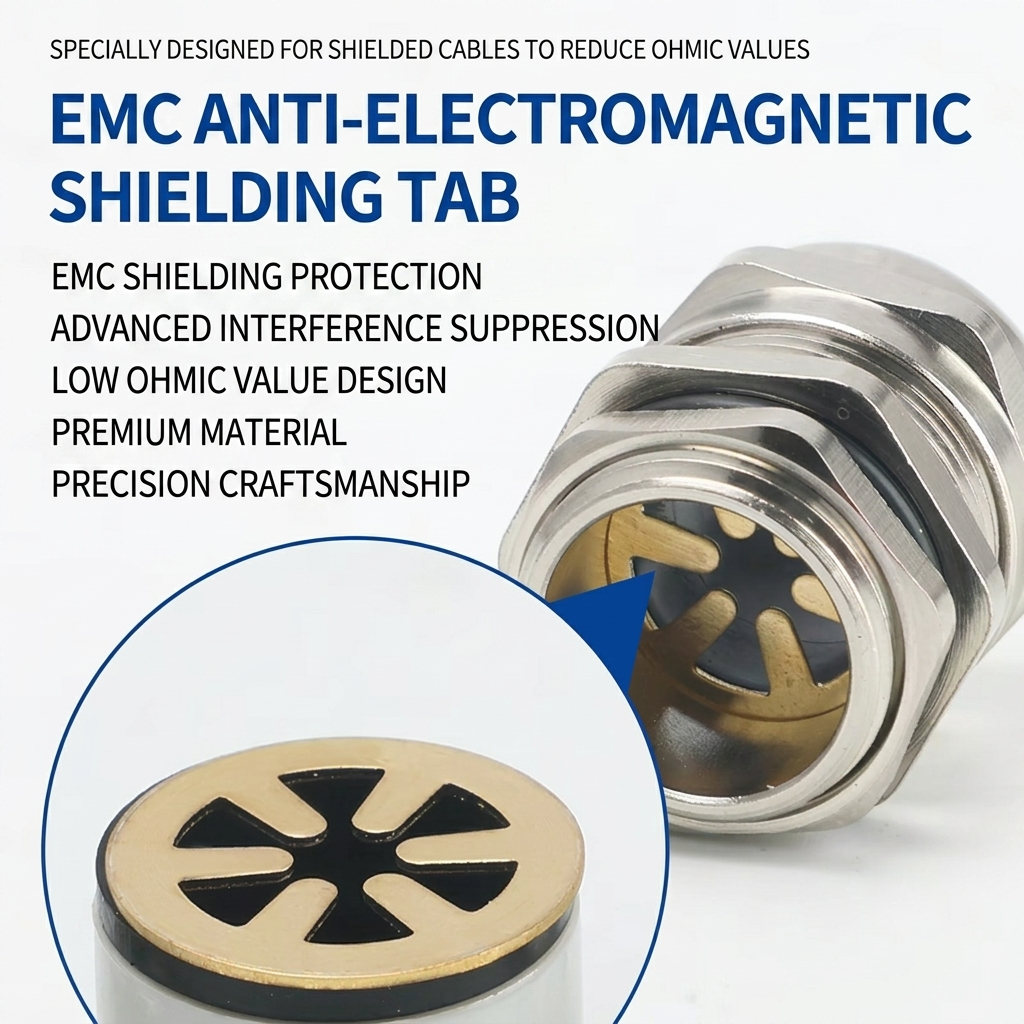
The core of this system is an integrated copper shielding spring nestled within the metallic gland body. During installation, the technician strips back a small segment of the cable’s outer jacket to expose the underlying wire braid. As the dome nut is tightened, it compresses an internal claw mechanism, forcing the flexible fingers of the copper spring to wrap uniformly around the exposed shielding braid.
This action achieves an uniform, low-impedance 360° ring contact around the entire circumference of the cable. Because the inner spring directly contacts the robust, nickel-plated brass body, high-frequency noise fields are intercepted at the entry plane and routed directly into the grounded enclosure frame, preventing EMI from penetrating the internal electronics.
Material Matters: Why Choose a Brass EMC Cable Gland Over Plastic?
Procurement departments must weigh the cost benefits of lightweight nylon options against heavy-duty metal alternatives. While generic synthetic plastics function adequately for standard wiring layouts, they lack the material properties necessary to sustain long-term EMI protection under harsh industrial stress.
The Limits of Nylon Under Vibration and Stress
Synthetic polymers are highly vulnerable to material creep, which causes plastic threads to gradually deform and back out under sustained machine vibration. When a gland loses its tight physical grip, the grounding connection breaks down, rendering the shield useless against EMI. Furthermore, outdoor solar UV radiation degrades plastic structures over time, making them brittle and prone to structural cracking during routine maintenance.
The Advantages of Brass Nickel-Plated Stop Plugs
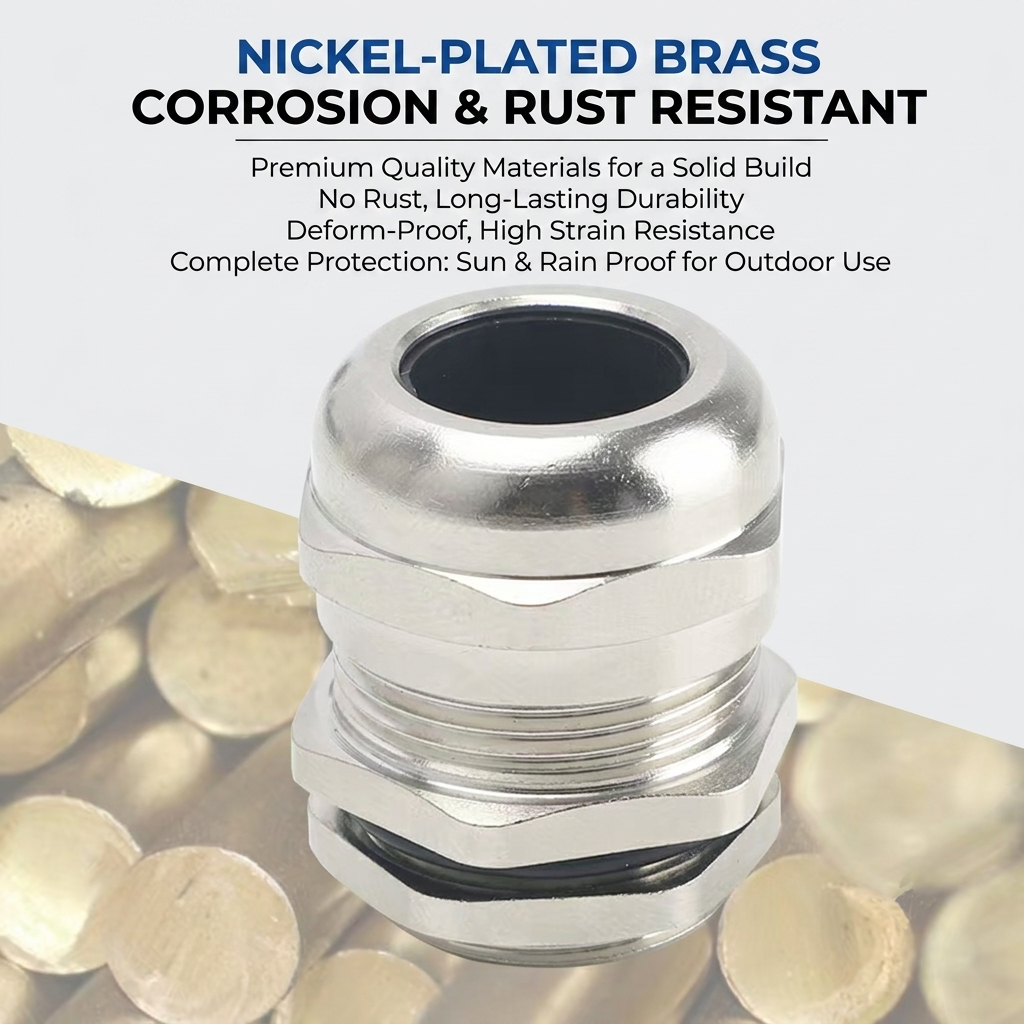
Opting for a premium brass emc cable gland ensures long-term operational stability. The heavy metallic body provides robust mechanical defense against physical impact, maintaining thread alignment even during rigorous handling.
| Engineering Feature | Brass Nickel-Plated EMC Glands | Standard Industrial Nylon Glands |
| Mechanical Impact Resistance | High (IK10-rated rigid protection) | Low (Susceptible to cracking) |
| Grounding Continuity | Continuous 360° electrical pathway | None (Non-conductive polymer) |
| UV & Environmental Aging | Immune (Zero structural breakdown) | Severe (Becomes brittle and yellowed) |
| Operating Temperature Range | Stable from -40°C to 100°C | Narrow range; deforms under heat |
| Shielding Performance (dB) | Excellent across high-frequency bands | Zero EMI attenuation capability |
The specialized electroplated nickel layer forms a dense barrier that protects the inner brass body from aggressive chemical washdowns and coastal salt-spray conditions. This plating layer maintains low surface contact resistance over decades, preventing the oxidation that otherwise undermines electrical grounding pathways over time.
Achieving an IP68 Leak-Proof Barrier in Harsh Environments
Industrial connectivity demands reliable environmental sealing alongside effective electrical shielding. High-performance grounding cable glands must safeguard sensitive control hubs against aggressive liquids and atmospheric contaminants.
An advanced ip68 emc cable gland uses high-density elastomeric inserts to achieve an absolute water and dust-tight seal. When the outer dome nut is torqued down, these internal rubber sleeves collapse uniformly around the cable sleeve, sealing any microscopic gaps. This ensures the assembly safely resists sustained water submersion and aggressive dust penetration.
For standard plant floor conditions, Nitrile Butadiene Rubber (NBR) inserts provide outstanding resistance against cutting oils, synthetic coolants, and petroleum-based lubricants. When installations encounter extreme thermal shifts, such as outdoor heavy solar structures or localized engine manifolds, integrating specialized silicone seals extends the operational thermal threshold from -60°C up to 220°C without losing elasticity or compromising seal pressure.
Thread Sizing and Compatibility: Metric, PG, and NPT
Preventing installation errors in high-density layout boxes requires careful attention to thread geometry. For parallel Metric (M) threads, such as M20 × 1.5, the straight profile does not form a mechanical seal within the thread path itself. Instead, it relies on a flat elastomeric O-ring compressed against the outer cabinet face to block external liquids. Precision CNC-machined threads ensure smooth engagement, preventing thread galling during rapid field assembly.
Parallel Threads (Metric / PG) ──► Requires Interface O-Ring ──► Compresses Against Flat Enclosure Wall
Tapered Threads (NPT)         ──► Wedges Threads Together   ──► Forms Rigid Metal-to-Metal Seal
For legacy configurations or international regional standards, sourcing lines must accommodate specific thread styles, including:
- Metric (M): The current global baseline for modern automation machinery.
- National Pipe Tapered (NPT): Standard for North American industrial facilities, using a 1° 47′ taper angle to wedge threads together into a tight mechanical seal.
- Panzergewinde (PG): Frequently encountered during retrofits or maintenance on European heavy industrial machinery.
Compliance Check: Sourcing Certified Hardware for B2B Projects
B2B procurement managers must look past low initial purchase costs when sourcing componentry for complex project bids. Cheap alternative products often feature uneven, thin electroplating. When tightened, this thin coating can flake away, exposing the raw brass to ambient humidity, accelerating galvanic corrosion, and eventually destroying the vital grounding connection.
Thin Electroplating ──► Flaking Under Torque ──► Raw Brass Exposure ──► Galvanic Corrosion ──► Shielding Loss
To safeguard infrastructure investments and ensure seamless regulatory approval during final system audits, engineering firms should verify that all incoming hardware carries transparent, independent certifications:
- ISO9001: Validates precision tolerances and strict material traceability throughout manufacturing.
- CE & RoHS Compliance: Guarantees that parts meet European health, safety, and environmental protection standards.
A reliable blueprint for these high-standard manufacturing metrics is found in the XW-EMC Cable Gland Series from Xing Wei. This line uses high-tolerance CNC brass machining and durable copper spring contacts to provide a dependable reference for projects requiring certified compliance.
Frequently Asked Questions (FAQ)
What is the primary difference between a standard cable gland and an EMC cable gland?
A standard gland only provides mechanical cord grip retention and environmental sealing. An EMC-style gland incorporates an internal conductive copper spring that establishes a continuous 360° electrical grounding ring around the cable shield, protecting internal circuits from electromagnetic noise.
How does an emi shielded cable gland achieve reliable electrical continuity?
When the gland nut is tightened, it compresses an internal copper shielding ring directly against the exposed cable braid. This creates a low-resistance path that routes high-frequency interference through the brass body and directly into the grounded enclosure panel.
Can a brass emc cable gland be deployed safely in outdoor environments?
Yes, high-grade brass bodies finished with a durable nickel electroplating layer are highly resistant to corrosion, salt spray, and extreme weather. They maintain their structural integrity across an expansive thermal range from -40°C to 100°C.
Why should engineers avoid nylon blanking or entry options for shielded wires?
Nylon and plastic are non-conductive materials that cannot provide an electrical grounding path for cable shields. Additionally, plastic suffers from material creep and UV degradation, which can loosen the assembly over time and compromise both the seal and shielding continuity.
What thread standards are typically supported for industrial enclosures?
Industrial-grade entries support a variety of global configurations, including straight Metric (M) threads, European PG profiles, and tapered North American NPT thread geometries.
Conclusion: Reinforcing Your Signal Infrastructure
Protecting automated systems from unexpected downtime requires consistent attention to detail across your entire layout. Leaving shielded lines poorly terminated creates vulnerabilities that expose high-value control components to EMI noise, signal dropouts, and costly operational delays.
Using precision-engineered emi shielded cable glands made from nickel-plated brass ensures consistent 360° grounding continuity, rugged mechanical durability, and reliable IP68 environmental defense. Investing in high-quality entry hardware protects your control systems and ensures stable, long-term equipment operation.
Engineering Resource Support: If you are finalizing system specifications, coordinating a complex panel build, or require exact certified drawings, technical support is available. Contact our engineering team at cnxwelectric@gmail.com to discuss your project parameters, review detailed CAD schematics, or request free product samples for verification.