Selecting the right PG7 cable gland for an industrial panel or electrical enclosure is more than picking a part number from a catalog. A well-chosen gland protects cables from dust, water, and mechanical strain while maintaining the enclosure’s IP rating. A poorly chosen one leaks, loosens, or fails to grip the cable, compromising the whole installation. For B2B buyers sourcing in volume, the decision carries cost, reliability, and compliance consequences beyond the unit price. This guide walks through the seven factors that matter when evaluating PG7 cable gland suppliers and specifications.
What Is PG7 and How Does It Compare to M20?
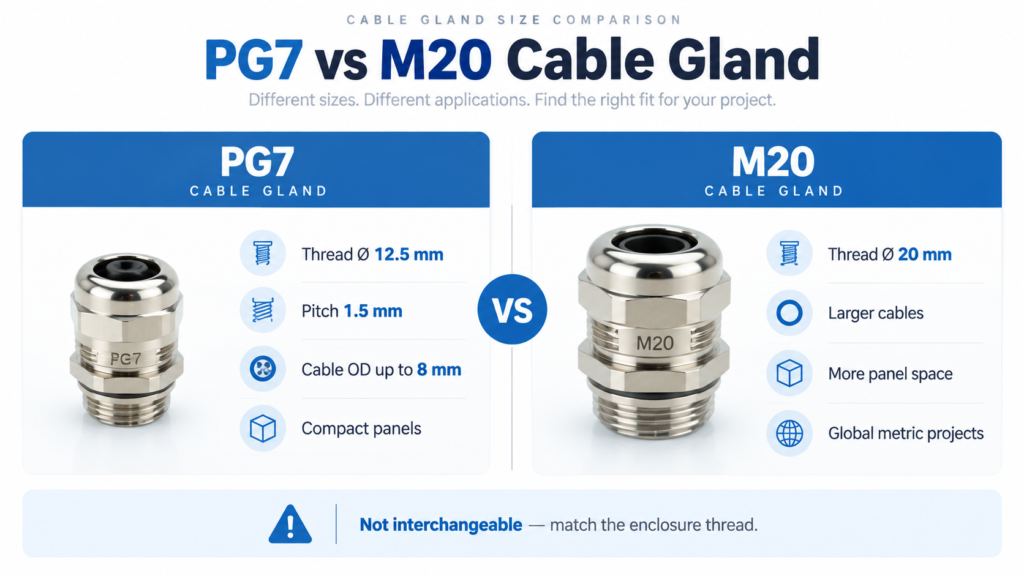
PG stands for “Panzer-Gewinde” (German for “armored thread”), a thread standard widely used across Europe and Asia for cable glands entering electrical enclosures. The number after “PG” indicates the thread size: PG7 has a 12.5mm thread diameter with 1.5mm pitch, designed for cables up to 8mm outer diameter.
PG Thread Standard Overview
PG threads follow DIN 40430 (metric) but are not identical to standard metric threads. A PG7 thread mates with a PG7 tapped hole in an enclosure—attempting to force an M12 or M16 bolt into that hole strips the threads. The confusion arises because both systems measure in millimeters, but the pitch and flank angle differ. For procurement teams, this means specifying “PG7” rather than “12.5mm thread” prevents compatibility errors in international projects.
PG7 vs M20: Key Differences for Buyers
M20 is the competing metric-thread cable gland standard, with a 20mm thread diameter. The choice between PG7 and M20 is not arbitrary: PG7 suits compact panels and smaller cable bundles, while M20 handles thicker cables or multiple cables per gland. A European-built control panel typically uses PG glands; a North American or ISO-heavy project may default to M20. If your equipment ships globally, stocking both thread types avoids last-minute adapter orders. The cost difference is marginal—the larger factor is panel real estate and regional specification preferences.
Cable Gland Materials: Brass, Nylon, or Stainless Steel?
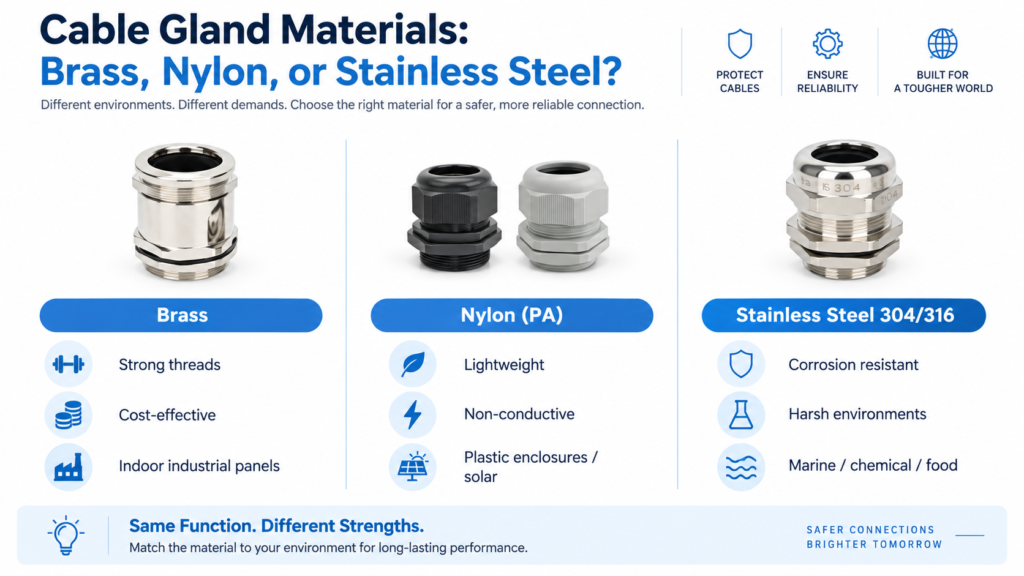
Material selection balances corrosion resistance, mechanical strength, cost, and electromagnetic compatibility. Each option serves a distinct set of applications.
Brass Cable Glands: When to Choose Them
Brass holds a thread well, takes a torque cycle without splitting, and is cheap enough that the gland costs less than the labour to install it. Most procurement calls for indoor panels land on this material without a second thought, and it is usually the right call. Brass is conductive, so it provides no EMI shielding, but in a grounded metal enclosure, that rarely matters. For general industrial use—factory automation cabinets, machinery control panels, HVAC control boxes—brass PG7 glands from a trusted supplier like our brass cable gland category deliver reliability without over-engineering.
Nylon (PA) Cable Glands: Applications and Limitations
Nylon—specifically PA6 or PA66—is non-conductive, lightweight, and resistant to many chemicals. In solar installations, where DC strings run at high voltage and the enclosure is often plastic, nylon glands prevent galvanic corrosion and eliminate the risk of shorting through the gland body. They are also the default for plastic enclosures because threading metal into plastic risks cracking the housing. The trade-off is lower tensile strength: over‑tightening a nylon gland can crack the hex flats. For solar combiner boxes, telecom outdoor cabinets, or any non‑metallic enclosure, our nylon PG7 cable glands are engineered for that environment.
Stainless Steel 304/316: Harsh Environment Solution
Stainless steel glands cost three to five times more than brass, but in coastal, chemical‑processing, or food‑grade applications, they are the only option that lasts. Grade 304 handles general corrosion; grade 316 adds molybdenum for chloride resistance (seawater, de‑icing salts). The higher material cost is justified by avoiding downtime and replacement labour in a corrosive atmosphere. For offshore platforms, marine control panels, or wash‑down areas in food plants, stainless steel PG7 glands from our stainless steel cable gland range meet the specification without compromise.
IP Rating Decoded: From IP67 to IP68 and Beyond
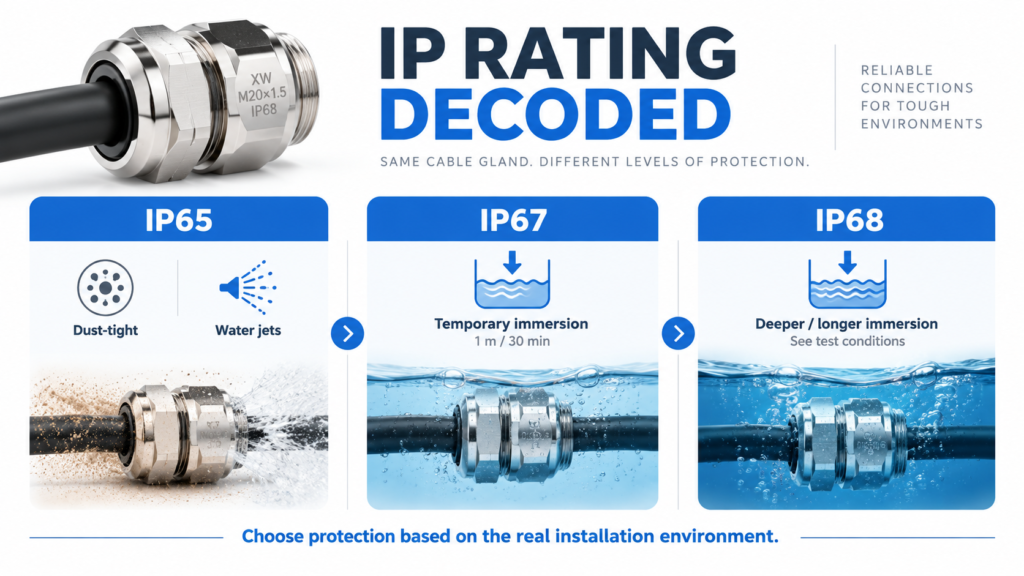
The IP (Ingress Protection) code, defined in IEC 60529, tells you what the gland seals against. The first digit is dust protection (0‑6), the second is liquid protection (0‑9). For outdoor or harsh‑environment applications, the second digit matters most.
Understanding IP68 Certification Testing
IP67 means the gland survives immersion in 1 meter of water for 30 minutes. IP68 means the manufacturer defines a deeper/longer immersion test—often 1.5 m for 24 hours—and the gland passes it. There is no universal IP68 depth; the test parameters are declared in the product documentation. A serious supplier provides the test report or a declaration of conformity. For submerged pumps, offshore equipment, or flood‑zone installations, insisting on IP68 with documented test conditions eliminates guessing.
Industry‑Specific IP Requirements
In solar farms, IP67 is often sufficient because the enclosure is elevated and drained. In wastewater treatment plants, IP68 is non‑negotiable—splashing and occasional submersion happen. For indoor industrial panels, IP65 (dust‑tight and protected against water jets) covers most scenarios. Knowing the difference prevents over‑specifying (paying for IP68 when IP67 works) or under‑specifying (field failures). Our IP68-rated PG7 glands come with test reports that specify the immersion depth and duration, so engineers can match them to the project’s real conditions.
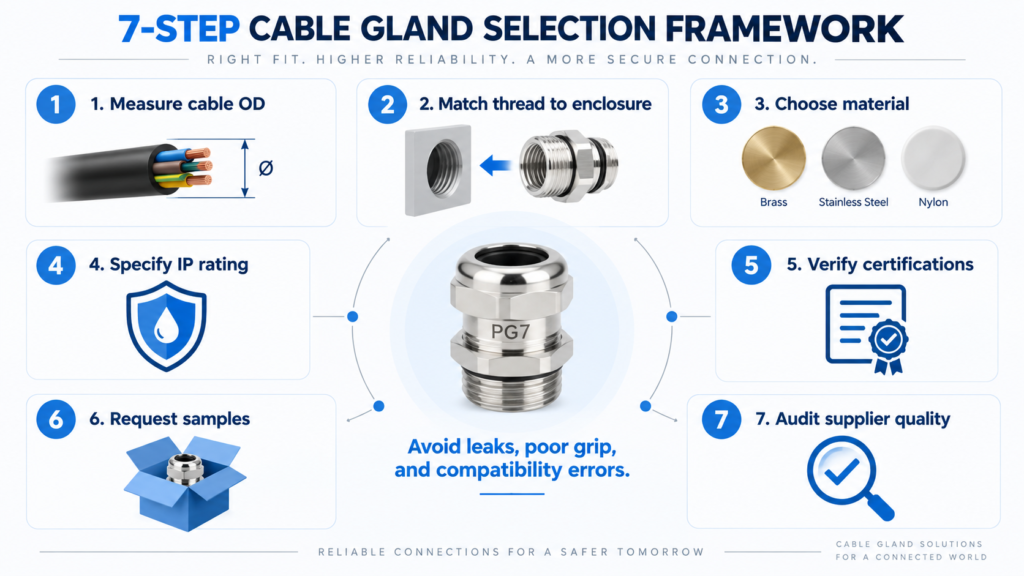
7‑Step Cable Gland Selection Framework
Use this framework each time you specify a cable gland. Skipping steps leads to leaks, poor grip, or incompatible threads.
Step 1: Measure Cable Outer Diameter Accurately
Not the conductor size, not the nominal diameter—the actual outer diameter of the cable with its insulation. A 4 mm² cable might be 6 mm OD; a shielded version of the same cable could be 8 mm. Use calipers, not a ruler. PG7 glands typically accommodate cables from 3 mm to 8 mm OD. If your cable is 9 mm, step up to PG9.
Step 2: Match Thread to Enclosure
Check the enclosure drawing: does it call for PG7, M20, or NPT? If you are replacing an existing gland, measure the thread with a thread‑gauge or compare it to a known sample. Mixing thread standards wastes time and risks cross‑threading.
Step 3: Choose Material Based on Environment
Indoor, dry, non‑corrosive → brass. Outdoor, UV‑exposed, plastic enclosure → nylon. Coastal, chemical, food‑grade → stainless steel. Refer to the material sections above for detailed guidance.
Step 4: Specify IP Rating from Actual Risk
Will the enclosure see rain? IP65. Occasional hose‑down? IP67. Permanent submersion? IP68. Do not default to the highest rating “to be safe”—it adds cost without benefit if the environment does not demand it.
Step 5: Verify Certifications and Compliance
If the project requires CE marking, RoHS compliance, UL listing, or ATEX/IECEx for hazardous areas, confirm the supplier holds those certificates for the exact product you are buying. A general factory certification is not enough—ask for the product‑specific test report.
Step 6: Request Samples for Fit‑Check
Before placing a bulk order, get three to five samples. Test them on your cable, in your enclosure, with your torque wrench. A five‑dollar sample can reveal a mismatch that would cost thousands in rework.
Step 7: Audit the Supplier’s Quality Process
For orders above 5,000 pieces, visit the factory or request a virtual audit. Look for ISO 9001 certification, in‑house thread‑gauging equipment, immersion‑test tanks, and batch‑traceability records. A gland that passes initial inspection but varies batch‑to‑batch causes production‑line stoppages.
Common Installation Mistakes and How to Avoid Them
Even a well‑specified gland fails if installed incorrectly. These are the most frequent errors field technicians make.
Torque Application Guidelines
Overtightening deforms the sealing ring, cracks nylon bodies, or strips brass threads. Undertightening leaves a gap for water ingress. Use a torque wrench calibrated to the manufacturer’s recommendation—typically 1.5–2.5 N·m for PG7 glands. Hand‑tight plus a quarter‑turn with a spanner is the field shortcut, but for critical applications, torque control is non‑negotiable.
Sealing Ring Placement Errors
The rubber or EPDM sealing ring must sit evenly around the cable, not twisted or pinched. If the ring is missing, the gland leaks even at correct torque. During assembly, feed the cable through the gland body, slide the ring onto the cable, then insert the ring into the gland’s groove before tightening. Skipping this sequence guarantees a leak.
Supplier Evaluation: Beyond Price Comparison
Unit price is the first filter, but total cost includes reliability, documentation, and support. These factors separate catalog vendors from strategic suppliers.
Certification Verification Checklist
- CE Marking: Is there a Declaration of Conformity referencing the EMC and Low‑Voltage Directives?
- RoHS: Does the supplier provide test reports showing absence of restricted substances?
- IP Rating: Are test reports available for the claimed IP67/IP68 rating?
- Material Certificates: Can they provide mill certificates for brass or stainless‑steel stock?
- Batch Traceability: Does each box have a lot number that traces back to production records?
Factory Audit Questions
When visiting a potential supplier, ask:
- “Show me your thread‑inspection process.”
- “How do you test IP68 glands before shipment?”
- “What is your procedure if a customer reports a defective batch?”
- “Can I see your raw‑material storage and traceability system?”
- “What is your typical lead time for a 10,000‑piece order with custom packaging?”
The answers reveal whether you are dealing with a trading company or a manufacturer with process control.
PG7 Cable Gland Applications by Industry
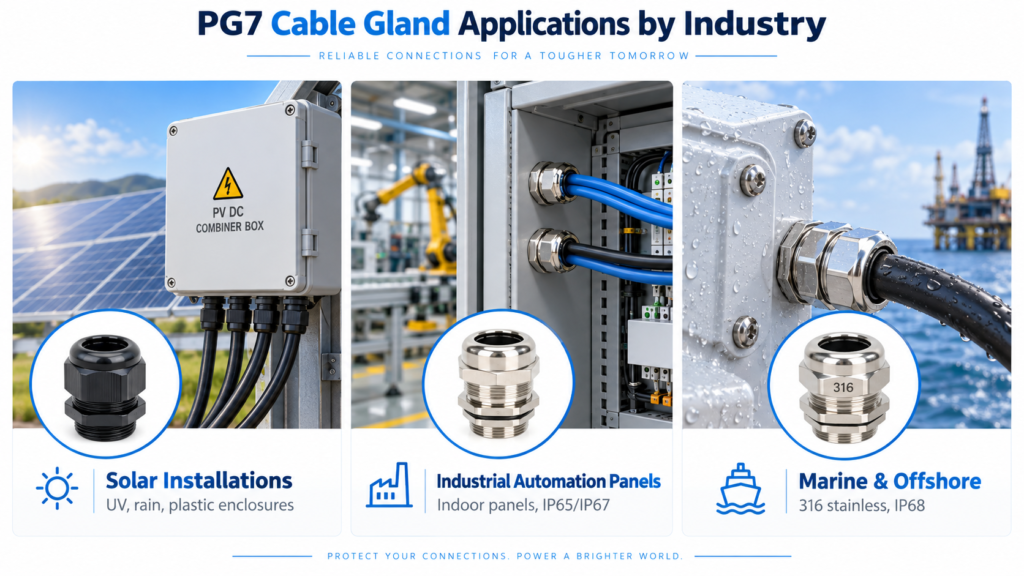
Different industries prioritize different gland features. Understanding these priorities helps match the product to the application.
Solar Panel Installations
Solar combiner boxes live outdoors, exposed to UV, rain, and temperature cycling. Nylon glands are preferred because they are non‑conductive (avoiding DC‑side shorts) and UV‑stabilized. IP67 is adequate because the boxes are mounted at an angle and drain. Cable diameters are relatively small (4–10 mm² PV strings), so PG7 is the common size. For large‑scale solar farms, consistency across thousands of glands matters more than unit‑price savings—a single leak can disable a whole string.
Industrial Automation Panels
Factory control panels are indoors but may see coolants, oils, or wash‑downs. Brass PG7 glands with IP65 or IP67 are standard. The critical factor is thread compatibility with the enclosure brand (e.g., Rittal, Hoffmann, Eldon). Panel builders often stock both PG and M20 versions to accommodate global clients. Just‑in‑time delivery and bulk packaging (reel‑pack, not individual bags) reduce handling time on the assembly line.
Marine and Offshore Equipment
Saltwater spray, constant humidity, and vibration demand stainless steel (316 grade) with IP68 rating. The thread must be cleanly cut and deburred to prevent crevice corrosion. Glands are often potted or supplemented with secondary sealing compounds. Lead times are longer because 316 material is not always in stock, and testing is more extensive. For marine projects, early engagement with the gland supplier avoids last‑minute substitutions that compromise the specification.
FAQ: PG7 Cable Gland Buyer Questions
What is the difference between PG7 and M20 cable glands?
PG7 has a 12.5mm thread diameter with 1.5mm pitch, following the PG (Panzer‑Gewinde) standard common in Europe. M20 has a 20mm metric thread. They are not interchangeable—each requires a matching tapped hole in the enclosure. PG7 suits cables up to 8mm OD; M20 handles thicker cables or multiple cables per gland.
What IP rating do I need for outdoor cable glands?
For outdoor applications exposed to rain, IP67 is the minimum. For submerged or high‑moisture environments (wastewater plants, offshore platforms), IP68 is required. The exact IP68 test conditions (depth, duration) should be documented in the supplier’s test report. Indoor panels in dry environments can use IP65.
How do I verify a cable gland supplier’s certifications?
Request product‑specific test reports, not just factory certificates. A valid CE Declaration of Conformity should list the applied directives (EMC, LVD) and reference the test standards. For IP ratings, ask for the immersion‑test report showing the gland passed the claimed conditions. Reputable suppliers provide these documents without hesitation.
What is the typical lead time for bulk cable gland orders?
For standard brass PG7 glands in IP67, lead time is 2–4 weeks for quantities up to 10,000 pieces. Stainless steel or custom‑marked glands may take 6–8 weeks. Always confirm lead time before finalizing the design timeline, and consider ordering samples well ahead of production.