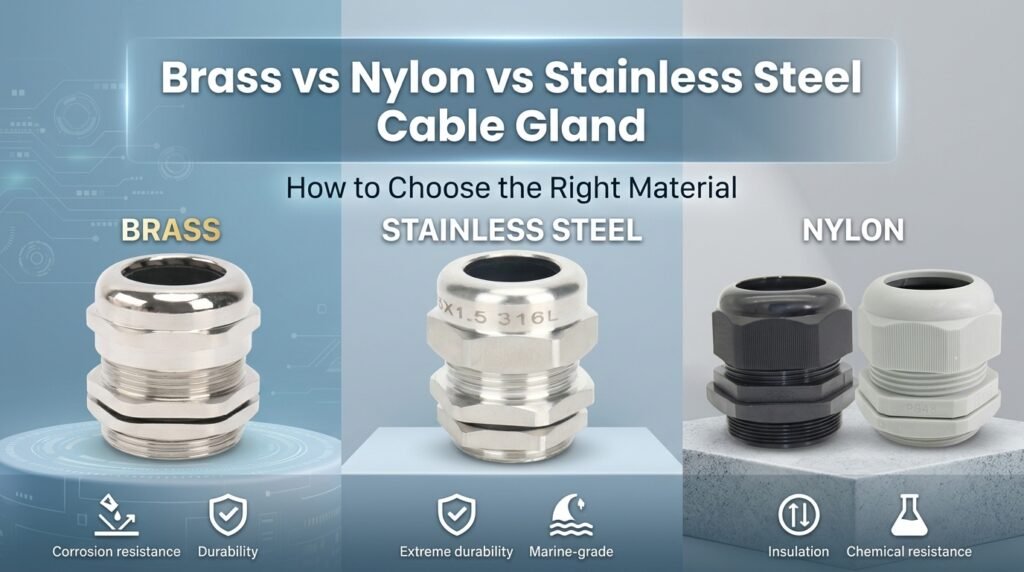
Selecting the right enclosure for an industrial electrical system often takes center stage, yet system integrity depends equally on the entry point. A cable gland—also known as a cord grip or cable fitting—serves as the primary barrier preventing dust, moisture, corrosive gases, and mechanical strain from compromising the enclosure interior. While specifying the correct thread type and Ingress Protection (IP) rating is essential, material selection remains the single most critical decision dictating long-term reliability and total cost of ownership.
Engineers and procurement specialists frequently weigh three primary material families: nickel-plated brass, stainless steel (AISI 304 and 316), and synthetic polymers such as polyamide nylon (PA66). Each material class presents distinct trade-offs across mechanical strength, chemical resistance, thermal endurance, electromagnetic shielding, and upfront unit cost. Specifying an over-engineered stainless steel gland for a mild indoor panel unnecessarily inflates project expenses, whereas deploying a nylon fitting in a salt-spray marine environment invites premature seal degradation, structural cracking, and ingress failure.
This technical guide evaluates nickel-plated brass, stainless steel, and nylon cable glands across structural performance, environmental resistance, compliance frameworks, and economic factors. It provides a clear decision matrix to assist engineering teams in specifying the optimal gland material for industrial automation, offshore platforms, photovoltaic installations, and hazardous operating environments.
1. Material Fundamentals & Metallurgy
Understanding the mechanical and metallurgical characteristics of each material provides the baseline for predicting field performance under mechanical stress, thermal cycling, and environmental exposure.
1.1 Nickel-Plated Brass
Brass is a copper-zinc alloy widely favored for industrial cable glands due to its excellent machinability, high tensile strength, and intrinsic electrical conductivity. Standard raw brass, however, is susceptible to surface oxidation and tarnishing when exposed to atmospheric moisture. To mitigate this, high-grade industrial cable glands—such as XingWei nickel-plated brass standard cable glands—undergo electroplating with a continuous nickel layer (typically 3–5 microns thick).
The electroplated nickel surface layer performs three distinct engineering functions:
- Passivation: Prevents direct atmospheric oxidation and delays chemical attack from mild ambient sulfur or ammonia.
- Galling Prevention: Reduces friction coefficient across male and female entry threads during high-torque installation.
- Contact Shielding: Preserves surface conductivity required for low-impedance 360° grounding in Electromagnetic Compatibility (EMC) applications.
1.2 Stainless Steel (AISI 304 vs. AISI 316 / 316L)
Stainless steel cable glands are specified for extreme environments where mechanical impact resistance and chemical immunity cannot be compromised. Austenitic stainless steels achieve corrosion resistance via a self-healing chromium oxide passive film.
- AISI 304 (EN 1.4301): Contains 18% chromium and 8% nickel. Provides robust protection against fresh water, atmospheric weathering, and standard organic chemicals. Excellent choice for commercial outdoor installations and general manufacturing plants.
- AISI 316 / 316L (EN 1.4401 / 1.4404): Formulated with 16–18% chromium, 10–14% nickel, and 2–3% molybdenum. The addition of molybdenum dramatically enhances resistance to localized pitting and crevice corrosion in high-chloride environments, such as offshore oil platforms, coastal shipyards, and marine propulsion systems. Specifying XingWei stainless steel cable gland range in 316-grade ensures long-term compliance in severe chemical wash-down zones.
1.3 Polyamide Nylon (PA66 / Polyamide 6)
Polymeric cable glands are constructed from thermoplastic Polyamide 66 (PA66), frequently reinforced with glass fiber (15–30%) to increase tensile modulus and dimensional stability under thermal load. Nylon cable glands are completely non-metallic, eliminating galvanic corrosion and electrical shock hazards. They feature molded neoprene or NBR sealing inserts to achieve ingress protection up to IP68 without requiring metallic locknuts or external sealing washers in standard knockouts.
2. Environmental & Chemical Resistance Performance
Environmental failure of a cable gland generally stems from chemical attack on the metal body, UV degradation of the plastic body, or hardening/cracking of the elastomeric sealing ring.
Citable Engineering Summary: Cable gland material selection dictates chemical and environmental longevity: Nickel-plated brass offers high mechanical strength and EMC protection for standard industrial automation; AISI 316 stainless steel is mandatory for marine chloride exposure and acid wash-downs; Polyamide PA66 nylon provides cost-effective, non-corrosive, double-insulated performance for indoor panels, commercial buildings, and UV-stabilized outdoor PV combiner boxes.
2.1 Corrosion Mechanisms: Marine, Salt Spray, and Acidic Wash-Downs
In coastal, marine deck, and offshore applications, airborne sodium chloride (NaCl) accelerates galvanic and pitting corrosion. Under standardized salt spray testing (ASTM B117 / ISO 9227):
- Raw Brass: Exhibits green copper carbonate patina formation within 24–48 hours; thread seizure occurs rapidly.
- Nickel-Plated Brass: Resists neutral salt spray for 96 to 240 hours depending on plating thickness and uniformity. Suitable for general coastal environments but not continuous saltwater immersion.
- AISI 304 Stainless Steel: Resists neutral salt spray exceeding 500 hours; may exhibit light surface staining (“tea staining”) in warm marine atmospheres.
- AISI 316 Stainless Steel: Exceeds 1,000 hours of continuous salt spray testing without pitting or crevice corrosion, satisfying DNV and Lloyd’s Register offshore marine standards.
- Nylon PA66: Totally immune to metallic rust, salt corrosion, and electrochemical oxidation.
2.2 Chemical and Solvent Compatibility
Industrial processing facilities expose cable entries to aggressive cleaning agents, hydrocarbons, and synthetic lubricants. Table 1 outlines material compatibility across common chemical classes.
Table 1: Chemical Compatibility Matrix for Cable Gland Body Materials
| Chemical Agent / Environment | Nickel-Plated Brass | Stainless Steel 304 | Stainless Steel 316 | Polyamide Nylon PA66 |
|---|---|---|---|---|
| Fresh Water & High Humidity | Excellent | Excellent | Excellent | Excellent |
| Marine Air / Salt Spray (NaCl) | Good (Moderate) | Good (Tea Staining Risk) | Excellent (Pitting Immune) | Excellent |
| Strong Acids (HCl, H₂SO₄) | Poor (Unsuitable) | Fair | Good / Moderate | Poor (Acid Attack) |
| Strong Caustic / Alkaline (NaOH) | Fair | Excellent | Excellent | Good |
| Organic Solvents (Acetone, Alcohol) | Excellent | Excellent | Excellent | Fair / Good |
| Oils, Diesel & Hydrocarbons | Excellent | Excellent | Excellent | Excellent |
| Nitric Acid / Chlorine Wash-down | Unsuitable | Poor | Good | Unsuitable |
2.3 UV Aging and Outdoor Thermal Degradation
When exposed to solar radiation, non-stabilized polymers undergo photo-oxidation, leading to embrittlement, color fading, and stress cracking along the compression cap. Premium outdoor nylon cable glands utilize carbon-black additive packages to satisfy UV stabilization tests (UL 746C f1 rating). Metallic cable glands (brass and stainless steel) are completely impervious to UV radiation and retain 100% structural integrity over decades of intense sun exposure.
3. Mechanical Strength, Thermal Limits, and Electrical Shielding
A cable gland must maintain structural integrity under mechanical impact, thermal expansion, and electrical fault conditions.
3.1 Mechanical Strain Relief and Impact Resistance
Under International Standard IEC 62444 (Cable glands for electrical installations), fittings are classified by impact resistance (Category 1 through 8, tested up to 20 Joules) and cable retention strength (Class A, B, or C).
- Metallic Glands (Brass & Stainless): Achieve Category 7 and 8 impact resistance (up to 20J impact at low temperature). Recommended for heavy industrial machinery, mining equipment, and public infrastructure subject to vandalism or heavy mechanical impact.
- Nylon Glands: Typically achieve Category 3 to 5 impact resistance (up to 5J impact). Excellent for indoor control cabinets, light commercial boxes, and protected junction enclosures.
3.2 Continuous Operating Temperature Ranges
Temperature limitations are governed by both the gland body material and the internal elastomeric seal (typically NBR, Neoprene, or Silicone).
Table 2: Operational Temperature Thresholds by Material Combination
| Gland Body Material | Standard Seal (NBR / Neoprene) | High-Temp Seal (Silicone / FKM) | Thermal Limit Drivers |
|---|---|---|---|
| Nylon PA66 | -20°C to +80°C (-4°F to 176°F) | -40°C to +100°C (-40°F to 212°F) | Polymer heat deflection limit |
| Nickel-Plated Brass | -40°C to +100°C (-40°F to 212°F) | -60°C to +200°C (-76°F to 392°F) | Elastomeric seal limit |
| Stainless Steel 304/316 | -40°C to +100°C (-40°F to 212°F) | -60°C to +250°C (-76°F to 482°F) | Elastomeric seal limit |
3.3 EMC Grounding and Electrical Shielding
Variable Frequency Drives (VFDs), sensitive instrumentation, and telecommunication systems require shielded cables to suppress Electromagnetic Interference (EMI). To maintain 360° grounding continuity across the shield braid and enclosure metalwork, a metallic cable gland is mandatory. Brass and stainless steel EMC glands feature internal conductive spring rings or claw mechanisms that clamp directly onto the cable shield braid. Nylon glands, being dielectrics, cannot provide electrical continuity or EMC shielding.
4. Industry Applications & Selection Decision Matrix
Selecting the correct material requires aligning environmental exposure with regulatory mandates and total project budget.
4.1 Industrial Automation and Machine Building
Standard indoor factory automation, motor terminal boxes, and switchgear enclosures operate in controlled environments with low chemical exposure. Nickel-plated brass cable glands serve as the global industry standard, balancing cost efficiency, robust mechanical thread engagement, and clean aesthetics.
4.2 Marine, Offshore, and Heavy Chemical Processing
Marine vessel decks, offshore oil & gas rigs, and chemical refining facilities demand maximum resistance to salt spray, standing sea water, and acidic fumes. AISI 316 stainless steel cable glands are recommended. Marine engineers specifying PF-threaded fittings per Japanese standards can reference the XingWei marine cable gland category (JIS F 8801) for specialized brass and stainless options.
4.3 Outdoor Solar PV and Commercial Infrastructure
Rooftop photovoltaic combiner boxes, commercial EV charging stations, and outdoor HVAC panels require reliable IP68 sealing against rainwater and UV radiation. UV-stabilized Nylon PA66 cable glands provide a cost-effective, non-conductive solution that speeds installation while ensuring total resistance to atmospheric weathering. For heavy industrial PV installations, nickel-plated brass remains a premium alternative.
Table 3: Comprehensive Cable Gland Material Decision Matrix
| Application Environment | Primary Material Choice | Secondary Material Choice | Key Selection Drivers |
|---|---|---|---|
| Indoor Control Panels & Factory Automation | Nickel-Plated Brass | Nylon PA66 | Cost efficiency, mechanical strength, thread durability |
| VFD Motors & EMC Shielded Systems | EMC Nickel-Plated Brass | EMC Stainless Steel 304 | 360° low-impedance shield grounding continuity |
| Solar PV Combiner Boxes & Outdoor Buildings | UV-Stabilized Nylon PA66 | Nickel-Plated Brass | Cost, electrical insulation, rain/UV resistance |
| Food & Beverage / Sanitary Wash-Down | Stainless Steel 304 | Stainless Steel 316 | Corrosion resistance to caustic wash-down chemicals |
| Offshore Oil Rigs & Coastal Marine Decks | Stainless Steel 316 | JIS Brass Marine Gland | Pitting corrosion immunity against sea water (NaCl) |
| Hazardous Area (Ex d / Ex e Zone 1 & 2) | Nickel-Plated Brass (Ex) | Stainless Steel 316 (Ex) | Flameproof containment & mechanical impact strength |
5. Standards, Compliance Marks & Cost Analysis
Selecting cable gland materials requires navigating international product standards, compliance marks, and long-term economic calculations.
5.1 International Governing Standards
Quality cable glands are designed and manufactured in accordance with strict international performance standards:
- IEC 62444 / EN 62444: Specifies mechanical, thermal, and sealing requirements for cable glands in electrical installations.
- IEC 60529: Defines Ingress Protection (IP) rating classifications (e.g., IP66, IP67, IP68).
- UL 514B: North American standard for conduit, tubing, and cable fittings.
- JIS F 8801: Japanese Industrial Standard for marine cable glands used on commercial shipping vessels.
5.2 Product Compliance and Quality Marks
Compliance documentation verifies that raw materials and manufacturing processes meet safety standards. Basic regulatory marks include CE (European Conformity) and RoHS (Restriction of Hazardous Substances), which certify that metallic plating and synthetic rubber seals are free from lead, cadmium, and hexavalent chromium. Facilities operating under ISO 9001:2015 quality management systems ensure consistent thread tolerances and sealing ring density across high-volume production runs.
Regulatory & Certification Note: Product compliance requirements vary by region and industry sector. While CE and RoHS serve as foundational compliance marks for global trade, hazardous-area certifications (such as ATEX and IECEx for Zone 1 and Zone 2 environments) or UL listing marks depend on specific product series. Project engineers should verify certificate scopes and test documentation directly with their supplier prior to procurement.
5.3 Total Cost of Ownership (TCO) & Procurement Analysis
When evaluating material costs, procurement teams should look beyond unit price to consider long-term operating costs (TCO):
- Relative Unit Cost Baseline: If Nylon PA66 represents a baseline cost of 1.0x, Nickel-Plated Brass typically ranges from 2.0x to 3.5x, Stainless Steel 304 ranges from 6.0x to 8.0x, and Stainless Steel 316 ranges from 9.0x to 12.0x.
- Installation Labor: Nylon glands offer lightweight handling and easy hand-tightening for quick installation. Metallic glands require precise torque application using calibrated spanners to avoid thread damage or over-compression.
- Replacement Cost: Installing nylon in an environment exposed to high heat or harsh chemicals can result in seal breakdown and costly downtime. Conversely, using stainless steel 316 in mild indoor panels inflates initial capital expenditure without operational benefit.
6. Frequently Asked Questions (FAQ)
Q1: Can I use nickel-plated brass cable glands in direct marine or saltwater environments?
Nickel-plated brass provides moderate resistance to coastal air and humidity, but it is not recommended for continuous immersion in salt water or direct exposure to heavy ocean spray. Over time, salt air can penetrate micro-pores in the nickel plating, leading to base metal corrosion and thread binding. For marine decks and offshore platforms, AISI 316 stainless steel or specialized JIS marine brass glands are recommended.
Q2: Are nylon cable glands strong enough for heavy-duty industrial machinery?
Nylon (PA66) cable glands provide robust performance for general industrial applications, outdoor junction boxes, and commercial wiring. However, for heavy-duty industrial machinery subjected to physical impacts, mechanical abuse, or high vibration, metallic glands (brass or stainless steel) are preferred due to their superior tensile strength, Category 8 impact rating, and high thread shear strength.
Q3: What is the main operational difference between 304 and 316 stainless steel cable glands?
The primary difference lies in chemical composition and corrosion resistance. AISI 316 contains 2–3% molybdenum, which grants exceptional immunity to pitting and crevice corrosion in high-chloride environments (such as sea water and coastal mist) and acidic wash-downs. AISI 304 lacks molybdenum and is suitable for fresh water, food processing wash-downs, and standard outdoor atmospheric exposure.
Q4: How do I choose between brass and nylon cable glands for an outdoor solar installation?
For standard commercial rooftop PV combiner boxes, UV-stabilized Nylon PA66 cable glands are usually preferred because they are non-conductive, lightweight, cost-effective, and fully resistant to rain and UV degradation. If the installation is located in a high-temperature industrial solar park or requires armored cable glanding (SWA), nickel-plated brass should be specified for its higher thermal tolerance and mechanical clamping force.
Summary & Engineering Next Steps
Choosing the optimal cable gland material requires matching environmental conditions, mechanical demands, thermal limits, and regulatory standards against your project budget. Nickel-plated brass remains the versatile workhorse for general industrial automation and EMC applications; stainless steel (304/316) delivers non-negotiable longevity in corrosive, marine, and sanitary wash-down environments; and polyamide nylon provides an economical, non-conductive, weather-resistant solution for outdoor commercial and PV installations.
Explore the complete range of industrial, waterproof, marine, and explosion-proof fittings by visiting the XingWei cable gland overview category, or contact our engineering technical sales team to request custom CAD drawings, material datasheets, and factory-direct quotation support for your upcoming project.