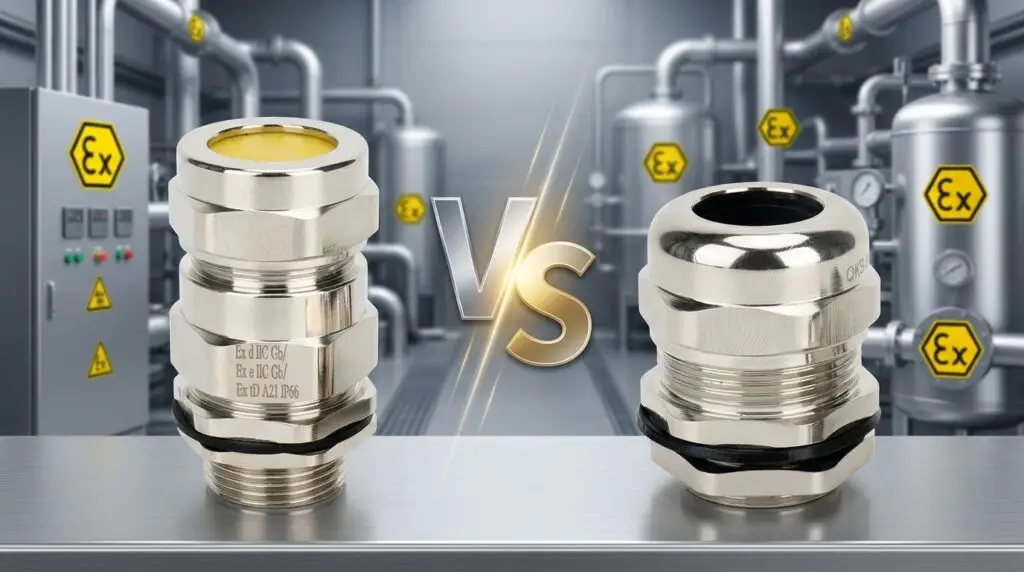
Selecting cable termination hardware for hazardous area installations requires a strict understanding of protection concepts. Specifying the wrong gland type between Flameproof (Ex d) and Increased Safety (Ex e) equipment compromises ATEX and IECEx compliance, exposing facility infrastructure to catastrophic explosion risks.
While both Ex d and Ex e cable glands operate within hazardous gas and vapor atmospheres, their internal protection mechanics, structural flamepath tolerances, and enclosure compatibility rules differ fundamentally. This engineering guide breaks down the core mechanical differences between Ex d and Ex e cable glands, explains direct entry rules for enclosures, and provides a clear selection matrix for Zone 1 and Zone 2 hazardous locations.
Understanding Explosion Protection Concepts: Flameproof vs. Increased Safety
The fundamental difference between Ex d and Ex e protection lies in their approach to handling potential internal explosions: Containment versus Prevention.
Ex d (Flameproof / Explosion-Proof)
The Ex d protection concept acknowledges that an internal explosion can occur inside an enclosure during operation due to arcing contacts, high-voltage switching, or electrical fault conditions.
Ex d equipment and their associated cable glands are engineered to withstand the maximum internal explosion pressure without rupturing. Furthermore, Ex d glands incorporate a precision-machined flamepath (a narrow, controlled gap or thread engagement) that cools and quenches escaping hot gases before they reach the surrounding explosive atmosphere.
Ex e (Increased Safety)
The Ex e protection concept operates on complete explosion prevention. Ex e apparatus (such as junction boxes, terminal enclosures, and lighting fixtures) are designed so that internal components do not produce sparks, arcs, or surface temperatures capable of igniting an explosive gas-air mixture under normal operating conditions.
Because an internal explosion is never expected within an Ex e enclosure, Ex e cable glands do not require flame-quenching mechanics. Instead, they focus on robust mechanical impact resistance, high ingress protection (typically IP66 or IP68), and preventing creepage and clearance arc-overs.
[ Ex d Philosophy ] ---> Contain Internal Explosion + Quench Escaping Gas via Flamepath
[ Ex e Philosophy ] ---> Prevent Sparks, Arcs, and Extreme Heat Entirely
Key Structural Differences: Ex d Flameproof vs Ex e Increased Safety Glands
The structural engineering of a cable gland reflects its underlying protection philosophy.
Thread Engagement & Flamepath Geometry in Ex d Glands
Ex d cable glands feature long, high-precision entry threads (Metric or NPT) designed to act as a threaded flamepath. During an internal enclosure explosion, expanding hot gases are forced through the tight spiraled helical path of these threads. As the gas travels along the thread engagement length, thermal energy transfers rapidly into the metallic body of the gland, cooling the gas below the auto-ignition temperature of surrounding hazardous gases.
- Thread Fit: Requires strict pitch and depth machining tolerances complying with IEC 60079-1 standards.
- Minimum Engagement: Must maintain at least 5 full threads engaged in tapped enclosure entries.
High-IP Seals and Mechanical Impact Resistance in Ex e Glands
Because Ex e cable glands do not rely on metal-to-metal flamepaths, their primary structural focus is maintaining an unbroken barrier against dust, moisture, and mechanical impact per IEC 60079-7.
- Impact Resistance: Tested to withstand heavy industrial impacts (typically 7 Joules at low temperatures).
- Elastomeric Sealing: Utilizes high-grade Neoprene, Silicone, or EPDM sealing rings that maintain elastic memory under extreme thermal stress (-60°C to +130°C) without cracking.
Double Compression & Armor Termination for Ex d/e Dual-Certified Glands
Heavy-duty industrial applications involving Steel Wire Armored (SWA) or Steel Tape Armored (STA) cables require glands that secure the armor layer while sealing both internal and external cable sheaths.
- Inner Sheath Seal: Clamps onto the inner bedded cable layer to isolate gas pathways.
- Armor Clamping Cone & Ring: Provides $360^circ$ low-resistance earth continuity to safely discharge fault currents.
- Outer Sheath Seal: Compresses around the outer cable jacket to provide environmental IP66/IP68 protection.
| Technical Feature | Ex d (Flameproof) Cable Glands | Ex e (Increased Safety) Cable Glands |
| Protection Philosophy | Containment & Flame Quenching | Spark & Arc Prevention |
| Primary Flamepath | Precision Threaded / Cylindrical Flamepath | Not Required (Relies on high IP seal integrity) |
| Enclosure Compatibility | Ex d, Ex e, Ex NR, Ex p enclosures | Ex e, Ex NR, Ex p enclosures ONLY (Not Ex d) |
| Ingress Protection (IP) | Typically IP66 / IP68 (via entry washer) | IP66 / IP68 Mandatory |
| Gas Group Suitability | Group IIA, IIB, IIC (Barrier glands for specific IIC) | Group IIA, IIB, IIC |
| Typical Equipment | Switchgear, Motors, Ex d Control Panels | Junction Boxes, Terminal Cabinets, Lighting |
Matching Cable Glands to Enclosure Types (Direct Entry Rules)
Installing a cable gland with a protection rating lower or incompatible with the enclosure invalidates the entire certified assembly.
Rule 1: Ex d Enclosures Require Ex d Cable Glands
When entering a heavy-walled Ex d flameproof enclosure (Direct Entry), the cable entry device must be an Ex d certified flameproof gland. Installing an Ex e gland into an Ex d enclosure violates hazardous area regulations because an Ex e gland body cannot withstand the structural pressure spikes or quench hot gas escaping through its entry threads during an internal blast.
Rule 2: Ex e Enclosures Accept Ex d or Ex e Cable Glands
An Ex e terminal box or junction box does not experience internal explosion pressure. Therefore, you can safely install either an Ex e cable gland OR an Ex d cable gland into an Ex e enclosure wall, provided the entry point maintains the required IP66/IP68 sealing integrity via a flat sealing washer.
Rule 3: Gas Group IIC and Barrier Gland Mandates
In hazardous environments containing Group IIC gases (such as Hydrogen or Acetylene), standard elastomeric Ex d glands may not be sufficient if internal volume and gas flow paths create a risk of “pressure piling.”
Under IEC 60079-14 installation standards, a Compound Barrier Gland (utilizing an epoxy resin compound to seal individual insulated conductors) is required when connecting to Ex d enclosures under any of the following conditions:
- The enclosure volume exceeds $2.0text{ liters}$ and contains an internal ignition source.
- The installation location requires Group IIC compliance with unarmored cable or non-rigid filler cores.
[ Ex d Heavy Enclosure ] <=== Must Use ===> Ex d Flameproof / Barrier Gland ONLY
[ Ex e Junction Box   ] <=== Accepts  ===> Ex e Gland OR Ex d Gland (with IP Sealing Washer)
Selection Matrix: Choosing the Right Gland for Zone 1 and Zone 2
To streamline engineering design and procurement for project Bill of Quantities (BOQs), use this decision hierarchy based on hazardous zone classifications, cable types, and enclosure protection modes:
Start Selection: Hazardous Area Cable Termination
 ├── Is the cable Armored (SWA / STA) or Unarmored?
 │    ├── Armored   ---> Requires Double Compression Gland (Armor Clamping + Outer/Inner Seal)
 │    └── Unarmored ---> Requires Single Compression Gland
 ├── What is the Enclosure Type?
 │    ├── Ex d Flameproof Enclosure ---> Select Ex d / Ex db Certified Gland
 │    └── Ex e Terminal Box          ---> Select Ex e / Ex eb OR Ex d / Ex db Certified Gland
 └── Is the application in a Group IIC Environment with Ex d Direct Entry?
      ├── Yes (Volume > 2L or high-risk IIC gas) ---> Select Barrier Cable Gland (Resin Compound)
      └── No  ---> Select Standard Elastomeric Ex d / Ex e Gland
Standardizing site hardware on dual-certified Ex db / Ex eb cable glands simplifies inventory management for EPC contractors. Specifying heavy-duty nickel-plated brass or SS316 stainless steel glands—such as Explosion Proof Cable Glands—ensures seamless compliance across both Ex d control panels and Ex e junction boxes in Zone 1 and Zone 2 offshore platforms or petrochemical facilities.
Frequently Asked Questions (FAQ)
Can I use an Ex d cable gland on an Ex e junction box?
Yes. Ex d cable glands exceed the mechanical and flame-containment requirements of Ex e enclosures. Installing an Ex d gland into an Ex e box maintains complete safety compliance, provided a suitable IP sealing washer is installed on the entry thread to guarantee IP66/IP68 weatherproofing.
Can an Ex e cable gland be installed directly into an Ex d enclosure?
No. An Ex e cable gland must never be installed directly into an Ex d flameproof enclosure. Ex e glands lack the threaded flamepath geometry and structural wall thickness required to quench escaping hot flames or withstand internal explosion pressures generated inside an Ex d enclosure.
What is the difference between an Ex d gland and a Barrier Cable Gland?
A standard Ex d gland uses an elastomeric rubber ring to compress against the outer or inner cable jacket. A Barrier Cable Gland uses a two-part liquid epoxy or putty compound poured around individual unsheathed conductors. Barrier glands completely eliminate internal gas migration through multi-core cable filler voids in Group IIC hazardous areas.
Are Ex d and Ex e cable glands suitable for Zone 1 and Zone 2 hazardous areas?
Yes. Both Ex d (Ex db) and Ex e (Ex eb) certified cable glands are fully approved for use in Zone 1 and Zone 2 hazardous gas atmospheres under ATEX and IECEx directives, provided they are matched correctly to the enclosure type and cable specification.
Technical Support & Compliance Verification
Navigating ATEX/IECEx compliance standards across complex industrial infrastructure requires exact mechanical specs and certified hardware. Whether you are reviewing project BOQs, specifying cable glands for Group IIC hazardous environments, or auditing field installations for EPC compliance, selecting certified cable entry components prevents costly project delays and safety audit failures.
Contact XW Electric’s engineering team to request detailed technical datasheets, CAD drawings, or ATEX/IECEx test reports for custom explosion-proof cable glands and thread adapters.