Selecting the right cable entry hardware for electrical installations in hazardous areas involves balancing two critical safety requirements: maintaining explosion-proof seal integrity and protecting cables from mechanical damage. In Zone 1, Zone 2, Zone 21, and Zone 22 environments—such as oil refineries, chemical processing units, and offshore platforms—cables are rarely left exposed. Engineers routinely enclose vulnerable wiring inside flexible conduits to guard against impact, abrasion, and intense vibration.
However, terminating an armored or non-armored cable directly into an explosion-proof enclosure while seamlessly attaching a protective flexible pipe creates an engineering bottleneck. Using standard cable glands often forces field technicians to assemble a cluster of third-party adapters, creating potential leak paths and risking non-compliance.
This guide breaks down how to select integrated conduit entry explosion proof cable glands, evaluate male versus female entry threads, ensure proper Ex d/Ex e protection, and size your glands accurately for smooth field installation.
What Is a Conduit Entry Explosion Proof Cable Gland and Why Is It Needed?
A conduit entry explosion proof cable gland is a specialized cable termination fitting engineered with a dual-function design. Unlike a standard cable gland—which only grips and seals the cable passing into an junction box or control cabinet—a conduit entry gland features an integrated outer thread on its rear tail housing. This entry thread allows a flexible conduit pipe or conduit fitting to thread directly onto the back of the gland body.
+------------------+     +-------------------+     +------------------------+
| Enclosure / Hub  |<--->|  Ex Cable Gland   |<--->| Flexible Conduit Pipe  |
| (Ex d / Ex e)    |     | (Conduit Entry)   |     | (Mechanical Protection)|
+------------------+     +-------------------+     +------------------------+
In hazardous industrial facilities, cables face severe environmental stress:
- High-Frequency Vibration: Nearby pumps, compressors, and heavy motors loosen standard gland connections over time.
- Mechanical Impact: Heavy tools, transport equipment, or falling debris can pinch or sever unarmored and armored cables alike.
- Chemical Exposure & UV Degradation: Corrosive vapors and sunlight break down outer cable jackets, leading to insulation breakdown.
Enclosing cables in flexible conduit addresses these hazards. Using a dedicated conduit entry gland ensures the flexible pipe attaches securely without compromising the gland’s internal explosion-proof sealing mechanism or flameproof path.
Thread Coupling Logic: Male vs. Female Entry Threads for Flexible Pipe Fittings
Selecting the correct thread orientation (gender) on the rear tail of the gland is crucial for establishing a gas-tight, mechanical coupling with your conduit system. Choosing the wrong thread gender introduces unnecessary adapters, extending the overall fitting length and creating extra potential leak points.
Male Entry Tail:   [Gland Body] =====( Outer Male Thread )====> [Female Conduit Adapter]
Female Entry Tail: [Gland Body] =====( Inner Female Thread )<===[Male Conduit Fitting]
Male Entry Threads (Outer Male Thread)
Glands with male threads on the conduit entry side feature external threading on the rear tail section.
- Primary Application: Connecting directly to flexible conduit end-fittings that feature internal (female) threads or standard conduit union couplers.
- Installation Advantage: Provides a rigid connection point where the flexible pipe sleeve glides over or screws onto the outer body, reducing the overall footprint inside tight terminal boxes.
Female Entry Threads (Outer Female Thread)
Glands with female entry threads feature an internally threaded rear interface.
- Primary Application: Accepting rigid conduit pipes or flexible conduit connectors configured with external (male) threaded ends.
- Installation Advantage: Allows field teams to run male-threaded rigid or flexible pipe directly into the gland tailpiece without requiring separate female-to-female thread couplers.
| Selection Metric | Male Entry Thread Tail | Female Entry Thread Tail |
| Gland Tail Design | External threads extending outward | Internal threads recessed inside tail |
| Mating Component | Female-threaded conduit fittings / unions | Male-threaded flexible conduit ends / rigid pipes |
| Component Count | Eliminates external couplers on female pipes | Eliminates female sleeves on male pipe ends |
| Best Used For | Direct flexible sleeve connection | Rigid-to-flexible transition points |
Critical Safety Standards: Ex d, Ex e, and Double Compression Protection
When specifying cable glands for hazardous zones, thread mechanical fit is only half the equation. The fitting must maintain strict explosion-proof compliance under IECEx and ATEX directives.
Ex d (Flameproof) vs. Ex e (Increased Safety)
- Ex d (Flameproof): Designed for heavy-duty enclosures where an internal explosion must be contained without igniting the surrounding explosive atmosphere. The gland must withstand internal pressure and cool escaping gases along its flamepath.
- Ex e (Increased Safety): Engineered to prevent arcs, sparks, or excessive temperatures from occurring during normal operation. The gland focuses on robust ingress protection (IP66/IP68) and high pull-out resistance.
Double Compression Design for Armored Cables
Armored cables (featuring Steel Wire Armor / SWA or Steel Tape Armor / STA) used in hazardous areas require double compression glands to isolate electrical cores from strain and gas migration.
[Outer Cap] --> (Outer Seal on Cable Jacket)
                     |
[Clamping Ring] --> (Armor Wire Clamping / Grounding)
                     |
[Inner Body] --> (Inner Flameproof Seal on Inner Sheath)
- Inner Compression Seal: Compresses around the cable’s inner bedding sheath directly behind the armor, creating an Ex d gas-tight seal and preventing gas migration through the cable inner core.
- Armor Clamping Mechanism: Secures the armor wires between internal cone rings, providing mechanical retention and an earth-bonding pathway.
- Outer Compression Seal: Seals around the outer cable jacket to prevent moisture, dust, and corrosive chemicals from entering the armor layer (achieving IP66/IP68 ratings).
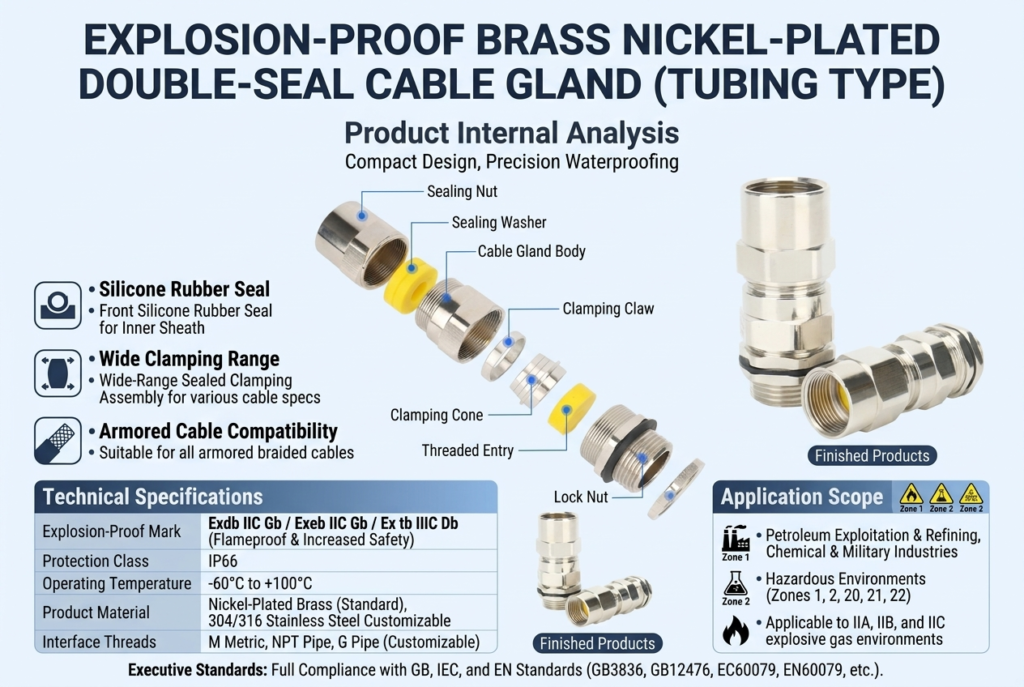
For demanding industrial applications requiring this dual-protection setup, engineering specifications often call for robust solutions like the Nickel-Plated Brass Double Compression Explosion Proof Armored Cable Gland (BDM-VII/D Series)
. This type of gland combines certified Ex d / Ex e / Ex tb protection with extreme temperature resilience (-60°C to +100°C) and an integrated rear thread interface for seamless flexible conduit attachment.
Key Specifications & Sizing Guide (M20 to M40)
To avoid installation delays, cross-reference your cable outer diameter (OD) and armor thickness with standard metric thread sizes before finalizing a Bill of Quantities (BOQ).
Cable Gland Matrix & Accessory Sizing
| Gland Size | Thread Pitch (Metric) | Cable Inner Sheath OD (mm) | Cable Outer Sheath OD (mm) | Required Accessories |
| M20 x 1.5 | 1.5 mm | 6.5 – 12.0 | 8.5 – 16.0 | Earth Tag, Locknut, PVC Shroud, Sealing Washer |
| M25 x 1.5 | 1.5 mm | 11.5 – 17.5 | 14.0 – 22.0 | Earth Tag, Locknut, PVC Shroud, Sealing Washer |
| M32 x 1.5 | 1.5 mm | 16.0 – 24.5 | 20.0 – 30.0 | Earth Tag, Locknut, PVC Shroud, Sealing Washer |
| M40 x 1.5 | 1.5 mm | 22.0 – 32.0 | 27.0 – 40.0 | Earth Tag, Locknut, PVC Shroud, Sealing Washer |
Essential Fitting Accessories
- Earth Tag: Installed between the gland and enclosure wall to provide low-resistance earth continuity for armored cabling systems.
- Locknut: Secures clearance-hole entries on thin-walled terminal boxes to maintain mechanical stability.
- PVC Shroud: Encases the exposed metallic gland body to protect against heavy atmospheric salt spray, acid vapors, and ice buildup.
- IP Sealing Washer: Fitted at the entry thread shoulder to secure an IP68 ingress seal against the enclosure wall.
Common Selection Errors in Conduit Entry Ex Gland Installations
Field failures and compliance audits often trace back to avoidable selection oversights during procurement.
1. Mismatched Thread Pitch and Standards
Forcing a Metric entry gland (e.g., M20x1.5) into an NPT threaded hub (e.g., 1/2″ NPT) damages threads and destroys the flameproof joint path required for Ex d certification. Always verify whether the terminal box entry uses Metric, NPT, or PG threads, and select matching gland adaptors where necessary.
2. Stacked Adapters vs. Integrated Conduit Entry Glands
Attempting to build a conduit connection using a standard cable gland combined with a series of male-to-female thread adaptors increases hardware costs, installation labor, and overall fitting length.
POOR PRACTICE:
[Enclosure] <--> [Gland Adapter] <--> [Standard Gland] <--> [Pipe Connector] <--> [Conduit]
(4 Threaded Joints = Higher Failure & Leak Risk)

BEST PRACTICE:
[Enclosure] <--> [Integrated Conduit Entry Ex Gland] <--> [Flexible Conduit]
(2 Threaded Joints = Compact & Higher Flameproof Reliability)
Integrating the conduit coupling directly into the gland body minimizes weight on the box wall and reduces potential leak paths from four down to two.
3. Galvanic Corrosion in Offshore Environments
Installing plain unplated brass cable glands alongside stainless steel junction boxes in marine environments triggers rapid galvanic corrosion. Ensure material compatibility by specifying heavy-duty nickel-plated brass or marine-grade 316L stainless steel for coastal, offshore, or chemical plant installations.
Frequently Asked Questions (FAQ)
What is the difference between a standard cable gland and a conduit entry cable gland?
A standard cable gland seals and clamps a cable entering an enclosure, leaving the cable rear exposed. A conduit entry cable gland incorporates an extra male or female thread on its rear tail end, allowing a flexible conduit sleeve or pipe fitting to screw directly onto the gland body for mechanical cable shielding.
Can I connect a flexible conduit directly to an Ex d explosion proof cable gland?
Yes, provided the cable gland is explicitly designed with a conduit entry tailpiece. You must ensure the thread pitch matches the conduit fitting and that the gland holds appropriate Ex d certifications for the target hazardous zone.
How do I choose between Male and Female threads on a flexible conduit gland?
Select a male entry tail if your flexible conduit fitting has an internally threaded (female) collar. Select a female entry tail if your conduit or rigid pipe terminates in a external male thread, eliminating the need for an intermediate female coupler.
Why is double compression required for armored cable conduit entries in Zone 1?
Double compression glands isolate both the inner cable sheath and outer jacket. The inner seal maintains an Ex d explosion-proof gas seal along the inner bedding, the middle clamping ring anchors the armor wires for pull-out resistance and grounding, and the outer seal achieves IP68 weatherproofing.
What accessories are required when installing nickel-plated brass Ex cable glands?
Standard installations in hazardous zones require an IP sealing washer (to seal against the enclosure wall), an Earth Tag (for armor ground continuity), a metallic Locknut (for unthreaded clearance holes), and a fitted PVC Shroud to guard against external environmental corrosion.
Next Steps for Project Selection
Choosing the correct conduit entry explosion-proof cable gland comes down to confirming four technical variables: your zone explosion-proof certification (Ex d/Ex e), exact cable outer/inner sheath dimensions, entry/conduit thread standards (Metric/NPT), and desired tail thread gender.
If you are currently evaluating an engineering Bill of Quantities (BOQ), preparing a project bid, or need to verify thread compatibility for an upcoming plant installation, submit your cable schedule and conduit specifications to our engineering team for technical verification and an itemized quotation.