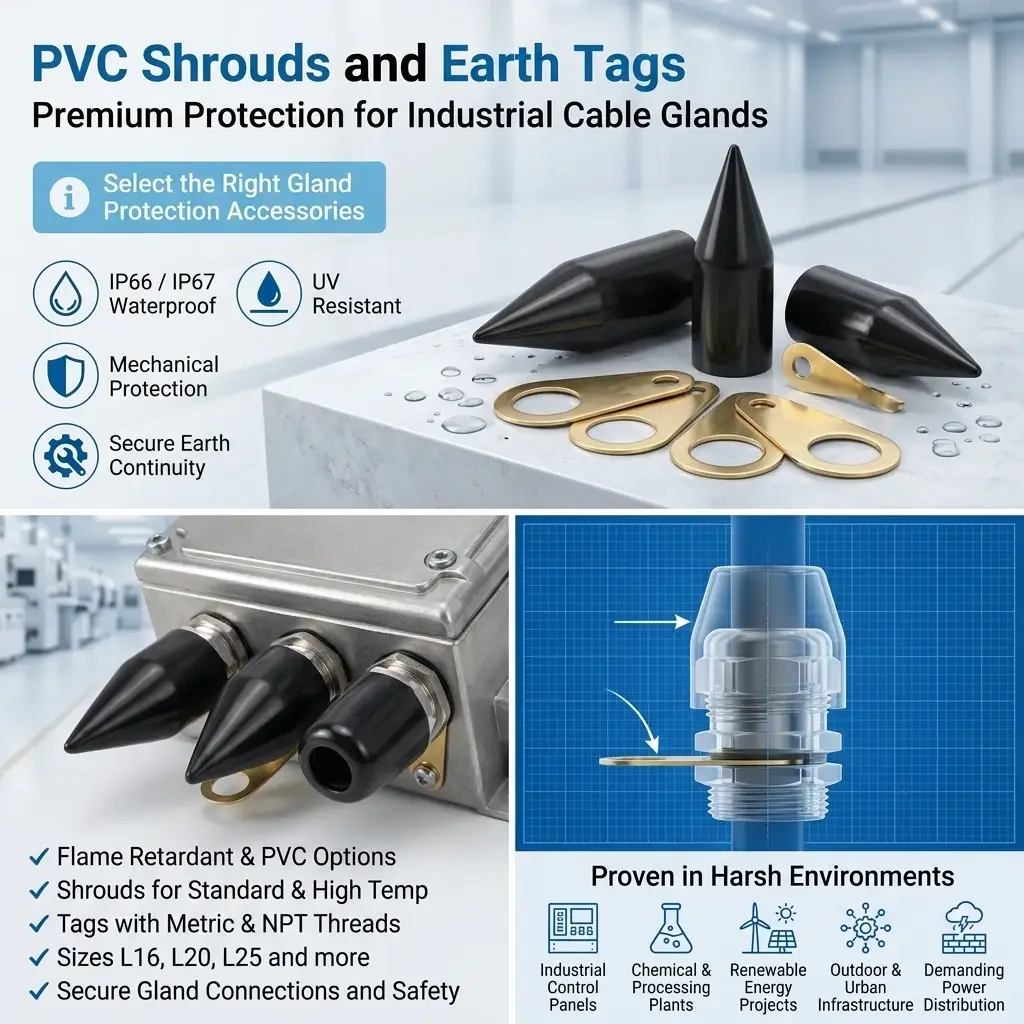
Selecting the correct explosion-proof cable gland body is only half the battle in hazardous area cable terminations. During site audits across refineries, chemical processing plants, and offshore facilities, field failures rarely stem from a cracked metal housing. Instead, failures occur because critical PVC Shrouds and Earth Tags for Cable Glands were either omitted, incorrectly sized, or treated as optional accessories.
Omitting these two essential hazardous area cable termination accessories leaves electrical enclosures vulnerable to ingress breakdown, galvanic thread binding, and dangerous earth fault current loops. This technical guide explains why soft PVC shrouds and earth tags are mandatory for Ex d and Ex e armored cable terminations, how they maintain long-term ingress protection and grounding continuity, and why sourcing factory-matched gland kits prevents costly site downtime.
The Anatomy of Hazardous Area Cable Terminations: Beyond the Gland Body
In Zone 1, Zone 2, Zone 21, and Zone 22 hazardous environments, cable terminations must fulfill three simultaneous functions: mechanical cable retention, explosion containment or ignition prevention, and environmental isolation.
Why Gland Bodies Alone Cannot Guarantee Long-Term Safety
A bare nickel-plated brass or stainless steel cable gland secures the inner sheath and armor. However, metal-to-metal entry threads leave micro-gaps exposed to atmospheric humidity, salt fog, and acidic fumes. Over time, environmental exposure degrades entry thread seals, oxidizes contact surfaces, and compromises ingress ratings. Complete isolation requires an integrated barrier system where the gland body, protective shroud, and earthing component work in unison.
The Technical Role of Soft PVC Shrouds in Environmental Protection
Maintaining IP66/IP68 Ratings in Harsh Industrial Environments
External elastomeric sealing rings on cable glands endure continuous thermal expansion, UV radiation, and atmospheric pollutants. Fitting a soft PVC protective shroud for armored cable gland acts as a sacrificial barrier, encapsulating the entire gland body and entry thread interface. By shielding the internal seals from direct sunlight, ice accumulation, and aggressive washdowns, high-grade PVC shrouds preserve ingress ratings over extended operating cycles.
Preventing Thread Corrosion and Chemical Degradation
When brass glands mate with aluminum or painted steel enclosure walls, moisture ingress triggers galvanic corrosion. This chemical reaction welds entry threads together, making future maintenance impossible without damaging the enclosure wall. Fitting a UV-stabilized PVC shroud eliminates water pooling at the enclosure boundary, mitigating galvanic action and thread seizing in coastal refineries and offshore platforms.
Why Earth Tags Are Essential for Electrical Grounding and Fault Current
Ensuring Low-Impedance Grounding Continuity in Armored Cables
When terminating Steel Wire Armored (SWA) or Steel Tape Armored (STA) cables, the metallic armor serves as a primary protective earth conductor. During a short-circuit fault, thousands of amperes pass through the cable armor, across the gland body, and into the station earthing grid. Installing a dedicated earth tag provides a positive, low-resistance connection point to attach an earthing jumper directly to the main ground busbar.
Direct Enclosure Thread Contact vs. Dedicated Earth Tag Earthing
Engineers often ask why use earth tag on explosion proof cable gland when the gland is already screwed into a metallic enclosure wall. Relying solely on entry thread contact introduces significant risk. Non-conductive paint coatings, anodized layers, thread lubricants, and operational vibration increase contact resistance across threads. Under high fault currents, high resistance causes arcing or localized heating at the entry thread—a catastrophic failure mode in explosive atmospheres.
| Earthing Method | Contact Resistance Stability | Enclosure Coating Sensitivity | Vibration Resistance | Ex d / Ex e Compliance |
| Direct Thread Contact | Unstable (deteriorates over time) | High (requires manual paint stripping) | Low (loosening increases resistance) | Non-compliant in high fault current specs |
| Dedicated Earth Tag | Low and permanent (< 0.1 mΩ) | Independent (fly-lead bypasses enclosure wall) | High (bolted lug with tooth washer) | Standard requirement across IECEx/ATEX |
Bare Glands vs. Complete Cable Gland Kits: Engineering & Sourcing Comparison
Why Component Mis-Matching Leads to Field Failures
Sourcing cable gland bodies, shrouds, and earth tags from separate suppliers frequently causes installation problems on site. A shroud with a neck diameter 1 mm too small will tear during installation; a shroud too loose will fail to maintain cable gland grounding and IP protection. Similarly, an undersized earth tag hole restricts full thread engagement, compromising the Ex d flamepath.
The Business Case for Pre-Packaged Gland Kits
Specifying an integrated Ex d cable gland shroud and earth tag kit streamlines procurement and guarantees dimensional compatibility. Pre-packaged kits reduce site assembly time, eliminate component shortages during field wiring, and ensure full compliance with hazardous area project standards.
| Selection Parameter | Separate Component Procurement | Factory-Matched Gland Kits |
| Dimensional Tolerance | High risk of neck/thread mismatch | 100% factory-verified compatibility |
| Site Assembly Speed | Slow (requires manual fitting tests) | Fast (plug-and-play field installation) |
| Procurement Overhead | Multiple SKUs, purchase orders, and lead times | Single SKU per cable specification |
| Compliance Assurance | Requires individual component audits | Single-certificate kit documentation |
If you are reviewing enclosure specifications or preparing an EPC bill of materials, consulting technical specialists can save significant field labor. Contact the engineering team at Wenzhou Xingwei Electrical Co., Ltd. to request customized technical datasheets or sample kits for your project.
Common Installation Pitfalls to Avoid with Shrouds and Earth Tags
Even high-quality components fail if installation procedures are ignored. Understanding how to install earth tag and PVC shroud correctly prevents compromising the hazardous area certification.
| Common Installation Pitfall | Technical Risk | Correct Standard Operating Procedure |
| Over-cutting the PVC shroud spout | Destroys the tight seal around cable outer sheath | Cut the shroud tip smaller than cable outer diameter to ensure an interference fit |
| Omission of tooth lock washers | Vibration causes earth tag locknut to loosen | Place a serrated tooth washer between earth tag and enclosure wall to lock torque |
| Galvanic mismatch of earth tag metal | Moisture causes rapid bimetallic corrosion | Match tag material: use nickel-plated brass tags for brass glands, SS316 for stainless |
| Installing shroud after gland termination | Requires disconnecting wires to fit shroud | Slide the PVC shroud onto the cable sheath prior to stripping cable armor and landing wires |
Frequently Asked Questions (FAQ)
1. Why do explosion-proof cable glands require an earth tag in hazardous areas?
Explosion-proof cable glands require an earth tag to ensure a reliable, low-impedance ground path for short-circuit fault currents. Because painted or anodized enclosure entry threads introduce high electrical resistance, a dedicated earth tag connects the cable armor directly to the ground busbar, preventing arcing hazards in explosive atmospheres.
2. Can a soft PVC protective shroud be reused during cable gland maintenance?
Yes, high-grade soft PVC shrouds retain elasticity and UV resistance over extended periods, allowing them to be slipped back during inspection and reinstalled. However, if the shroud exhibits chemical cracking, hardening, or tears from over-stretching, it must be replaced to maintain ingress protection.
3. What is the correct material selection for an earth tag on a nickel-plated brass cable gland?
Nickel-plated brass or high-grade tinned copper earth tags are recommended for nickel-plated brass glands. Matching metallic potentials prevents galvanic corrosion across the contact interface, ensuring long-term low contact resistance in humid or corrosive industrial environments.
4. How do I ensure the soft PVC shroud maintains its IP66/IP68 sealing performance?
To maintain IP66/IP68 performance, carefully trim the narrow end of the PVC shroud to a diameter slightly smaller than the cable’s outer sheath. Sliding the stretched shroud tightly over the gland hex body creates a weatherproof seal that sheds water, dust, and aggressive chemical spray.
5. Is it better to source cable glands, shrouds, and earth tags together as a kit?
Sourcing complete factory-matched gland kits eliminates dimensional mismatches between the gland body, shroud neck, and earth tag hole diameter. Kits reduce procurement complexity, accelerate field installation, and guarantee that all accessories meet project explosion-protection standards.
Conclusion & Selection Advice
Achieving certified safety in hazardous area cable terminations requires treating the gland, shroud, and earth tag as a unified protective assembly. Omitting protective shrouds accelerates seal degradation and thread corrosion, while skipping earth tags compromises short-circuit fault safety.
For EPC contractors, panel builders, and maintenance teams, specifying pre-configured, factory-matched PVC Shrouds and Earth Tags for Cable Glands eliminates field guesswork, protects ingress ratings, and guarantees ground continuity across demanding hazardous area applications.