In hazardous industrial facilities, electrical enclosures and junction boxes are exposed to flammable gases, combustible dusts, and aggressive ambient conditions. Installing an improper cable entry component risks sparking an ignition or compromising enclosure seal integrity. Achieving certified flameproof protection requires a high-specification nickel plated brass explosion proof cable gland engineered to seal non-armored cables while withstanding ambient pressure shocks and extreme temperature shifts.
Selecting the right cable gland involves evaluating explosion protection markings, sealing ring compounds, thermal tolerances, and thread standards. This guide breaks down the engineering requirements for specifying a BDM explosion proof cable gland across hazardous gas and dust zones, ensuring compliance with international IEC60079 and EN60079 standards.
What is a BDM Explosion Proof Cable Gland?
A BDM explosion proof cable gland is a specialized termination fitting designed to secure non-armored cables entering flameproof or increased safety electrical enclosures. Unlike standard industrial glands, a BDM series explosion proof cable gland incorporates robust metallic construction and engineered elastomeric seals to contain internal explosions and block external gas or dust ingress.
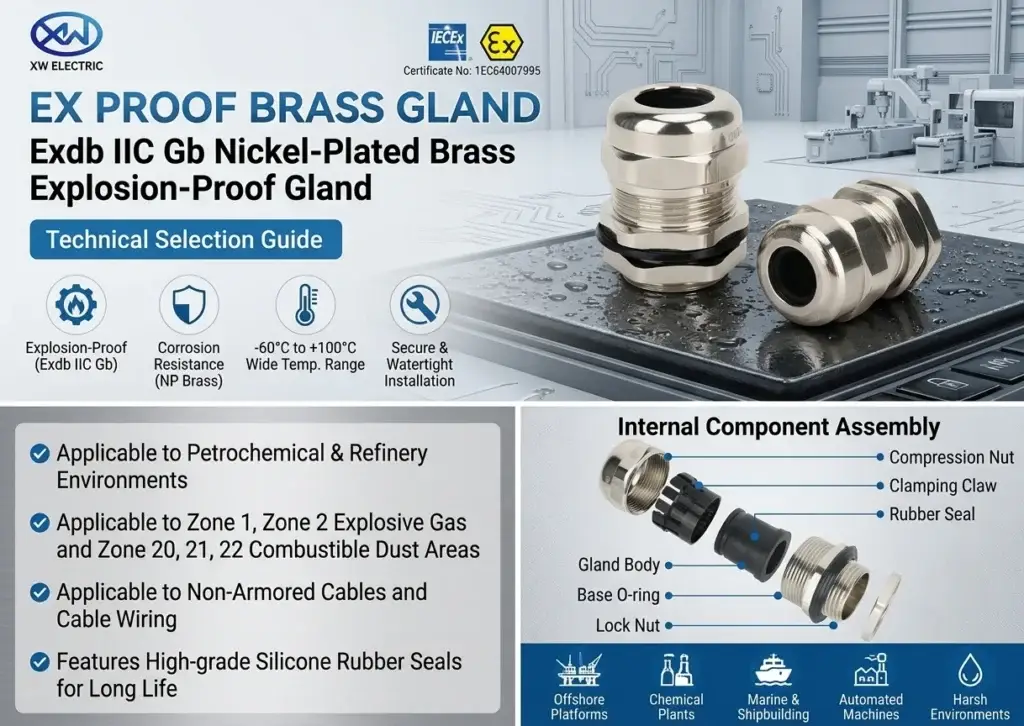
The internal assembly consists of four primary structural elements:
- Metallic Housing & Gland Body: Precision-machined from nickel-plated brass or optional 304/316 stainless steel to provide high mechanical strength and corrosion protection.
- Cap Nut (Compression Nut): Applies uniform radial pressure onto internal sealing components when torqued.
- Silicone Rubber Seal Ring: Compresses around the cable jacket to provide an airtight, watertight barrier across extended operating temperatures.
- Clamping Component: Grips the outer sheath of an explosion proof cable gland for non armored cable to deliver mechanical strain relief without crushing internal conductors.
Standard armored cable glands utilize internal clamping cones to lock steel wire armor (SWA). Conversely, fittings for non-armored cables rely on perimeter sealing and clamping rings to provide pull-out resistance and gas-tight containment around the smooth outer cable jacket.
Understanding Hazardous Area Ratings: Ex db IIC Gb vs. Ex tb IIIC Db
Deciphering explosion protection markings is mandatory when specifying an Ex d IIC Gb cable gland for certified industrial enclosures. Cable glands used in dangerous environments must carry dual certification for hazardous gases and combustible dusts.
Gas Protection: Ex db IIC Gb vs. Ex eb IIC Gb
- Ex db (Flameproof Enclosure): Designed to withstand an internal explosion without transmitting flame or hot gases to the surrounding explosive atmosphere. The IIC gas group designation covers the most volatile gas risks, including hydrogen and acetylene.
- Ex eb (Increased Safety): Prevents arc, spark, or excessive heat formation on electrical components during normal operation.
Dust Protection: Ex tb IIIC Db
Combustible dust hazards require specific protection. An Ex eb IIC Gb Ex tb IIIC Db cable gland supplier provides fittings rated to prevent explosive dust accumulation. The Ex tb marking signifies protection by enclosure, while IIIC covers conductive dusts in Zone 20 Zone 22 dust explosion proof cable gland applications, including Zone 21 installations.
| Protection Mark | Protection Concept | Applicable Hazardous Zones | Explosive Media Covered |
| Ex db IIC Gb | Flameproof Enclosure | Zone 1, Zone 2 | Gas Group IIC (Hydrogen, Acetylene, Ethene) |
| Ex eb IIC Gb | Increased Safety | Zone 1, Zone 2 | Gas Groups IIA, IIB, IIC |
| Ex tb IIIC Db | Protection by Enclosure | Zone 21, Zone 22 | Conductive & Non-Conductive Dusts (IIIC) |
Material and Seal Performance: Nickel-Plated Brass vs. Stainless Steel
Selecting fitting housing materials and elastomeric seals dictates long-term durability in corrosive chemical environments.
Housing Metallurgy
Nickel-plated brass is the predominant material choice for industrial hazardous areas. The nickel layer provides resistance against surface oxidation, atmospheric humidity, and mild chemical exposure while offering lower material costs than stainless steel. For environments subject to strong acids, alkalis, or marine salt spray, Grade 304 or Grade 316L stainless steel should be specified.
Silicone Rubber Sealing Advantage
Standard neoprene or NBR seals degrade when subjected to extreme freezing or thermal spikes. A silicone rubber seal brass explosion proof gland maintains structural elasticity and sealing compression across a temperature range of -60°C to +100°C.
When configuring wiring for control cabinets operating in low-temperature regions or heat-intensive refinery processing units, selecting a certified nickel plated brass explosion proof cable gland equipped with a high-grade silicone sealing ring prevents seal hardening, cracking, and loss of IP66 protection over years of service.
| Material Combination | Corrosion Resistance | Thermal Operating Limit | Recommended Facility Type |
| Nickel-Plated Brass + Silicone | High (Atmospheric/Mild Chemical) | -60°C to +100°C | Refineries, chemical storage, Zone 1/2 control panels |
| 304 Stainless Steel + Silicone | Superior (Washdown/Food Grade) | -60°C to +100°C | Pharmaceutical plants, food processing hazardous areas |
| 316 Stainless Steel + Silicone | Exceptional (Acid/Salt Spray) | -60°C to +100°C | Offshore platforms, marine terminals, coastal facilities |
Sizing and Thread Selection for Non Armored Cable
Correct sizing requires matching three dimensions: cable outer diameter (OD), entry thread specification, and enclosure knockout diameter. An explosion proof metric NPT G thread cable gland manufacturer produces fittings with multiple thread profiles to fit various junction box standards.
- Metric Threads (ISO Metric): Ranging from M12x1.5 to M63x1.5, commonly found on European-manufactured explosion-proof enclosures.
- NPT Threads (ANSI/ASME B1.20.1): Tapered threads ranging from NPT 1/2″ to NPT 2″, standard across North American oil and gas projects.
- G Threads (ISO 228-1 Parallel): Parallel pipe threads requiring an O-ring or sealing washer at the entry interface to achieve IP66 ingress protection.
To ensure an IP66 explosion proof cable gland for hazardous areas forms an effective seal, the cable OD must sit comfortably within the middle of the gland’s specified clamping range. Over-compressing a seal beyond its design tolerance will cause rubber extrusion, while under-tightening leaves void paths for moisture and gas migration.
| Thread Spec | Common Size Code | Cable OD Range (mm) | Matching Enclosure Knockout (mm) |
| Metric | M20 x 1.5 | 6.1 – 13.1 mm | 20.2 – 20.5 mm |
| Metric | M25 x 1.5 | 12.0 – 18.0 mm | 25.2 – 25.5 mm |
| NPT | NPT 1/2″ | 6.1 – 13.1 mm | ~21.3 mm (Tapered Hub) |
| G Thread | G 3/4″ | 12.0 – 18.0 mm | ~26.4 mm |
Key Industrial Applications in Hazardous Environments
High-level flameproof cable fittings serve critical safety functions across demanding industrial processing sectors:
- Oil Extraction and Refineries: Used in Zone 1 Zone 2 Zone 21 explosion proof cable gland applications to seal power leads running into ex-proof switchgear, terminal boxes, and remote I/O panels.
- Chemical and Petrochemical Processing: Protects instrument cabling against corrosive vapors while retaining gas-tight seals near distillation columns.
- Grain Silos and Flour Mills: Combats dust ignition hazards by blocking fine grain dust entering motor connection boxes under Ex tb IIIC Db standards.
- Offshore Drilling Rigs: Combines IP66 water ingress protection with resistance to salt-laden marine air and severe vibration.
When sourcing components for complete hazardous area wiring projects, reviewing product parameters across All Products catalogs helps engineers select matching locknuts, earth tags, and thread adapters certified under identical IECEx/ATEX standards.
Common Installation Mistakes to Avoid in Explosion-Proof Wiring
Prevent field failures and compliance audit rejections by avoiding these four common cable gland installation errors:
- Installing Non-Armored Glands on Armored Cable: Non-armored cable glands lack internal clamping cones for steel wire armor. Using them on armored cable leaves the armor ungrounded and fails to provide mechanical strain relief against pull-out forces.
- Over-Torquing the Gland Cap Nut: Applying excessive torque distorts the inner silicone seal ring, creating internal stress cracks that cause gas leakage under pressure.
- Mixing Parallel Threads in Tapered Entries: Forcing a parallel G thread fitting directly into an NPT tapered hub damages metallic threads and ruins flameproof flamepath tolerances.
- Ignoring Thread Sealing Washers on Flat Enclosure Walls: Metric and G-thread entry fittings require a specialized IP sealing washer between the gland shoulder and the enclosure face to maintain an IP66 rating.
Frequently Asked Questions (FAQs)
What is the difference between an Ex d IIC Gb cable gland and an Ex e cable gland?
An Ex d (flameproof) cable gland is built to withstand internal explosion pressures and prevent flame propagation outside the enclosure. An Ex e (increased safety) cable gland focuses on preventing arc or spark formation and ensuring high-ingress protection without containing explosive flamepaths.
Can a nickel plated brass explosion proof cable gland be used in Zone 21 and Zone 22 dust environments?
Yes, provided the fitting carries dual certification such as Ex db IIC Gb and Ex tb IIIC Db with an IP66 ingress protection rating. This dual rating verifies protection against both flammable gases and combustible dusts.
Why is silicone rubber preferred for explosion proof cable glands in extreme temperatures?
Silicone rubber retains its flexibility, tensile strength, and compression recovery at temperature extremes from -60°C to +100°C. Standard elastomeric materials often harden and crack under extreme cold or degrade when exposed to prolonged heat, risking seal failure.
Is an explosion proof cable gland for non armored cable suitable for armored cables?
No. Cable glands designed for non-armored cables seal directly around the outer cable jacket but lack internal armor clamping rings. Armored cables require dedicated glands that secure the inner armor layer to provide electrical continuity and mechanical strain relief.
What thread types (Metric, NPT, G) are available for BDM series explosion proof cable glands?
BDM series explosion proof cable glands are manufactured with Metric (M12 to M63), NPT (1/2″ to 2″), and G parallel pipe threads. Custom entry threads can also be produced to match specialized enclosure hubs or legacy equipment entries.
Conclusion
Selecting a nickel plated brass explosion proof cable gland requires balancing hazardous zone classifications, ambient temperature ranges, and cable sheath dimensions. Specifying fittings with Ex db IIC Gb / Ex tb IIIC Db markings and wide-temperature silicone rubber seals ensures your electrical enclosures remain certified, gas-tight, and resistant to environmental stress.
If you are verifying technical parameters for an upcoming facility expansion or need certified CAD drawings and datasheets for custom thread configurations, consult with our technical specialists to confirm exact cable gland specifications for your project requirements.