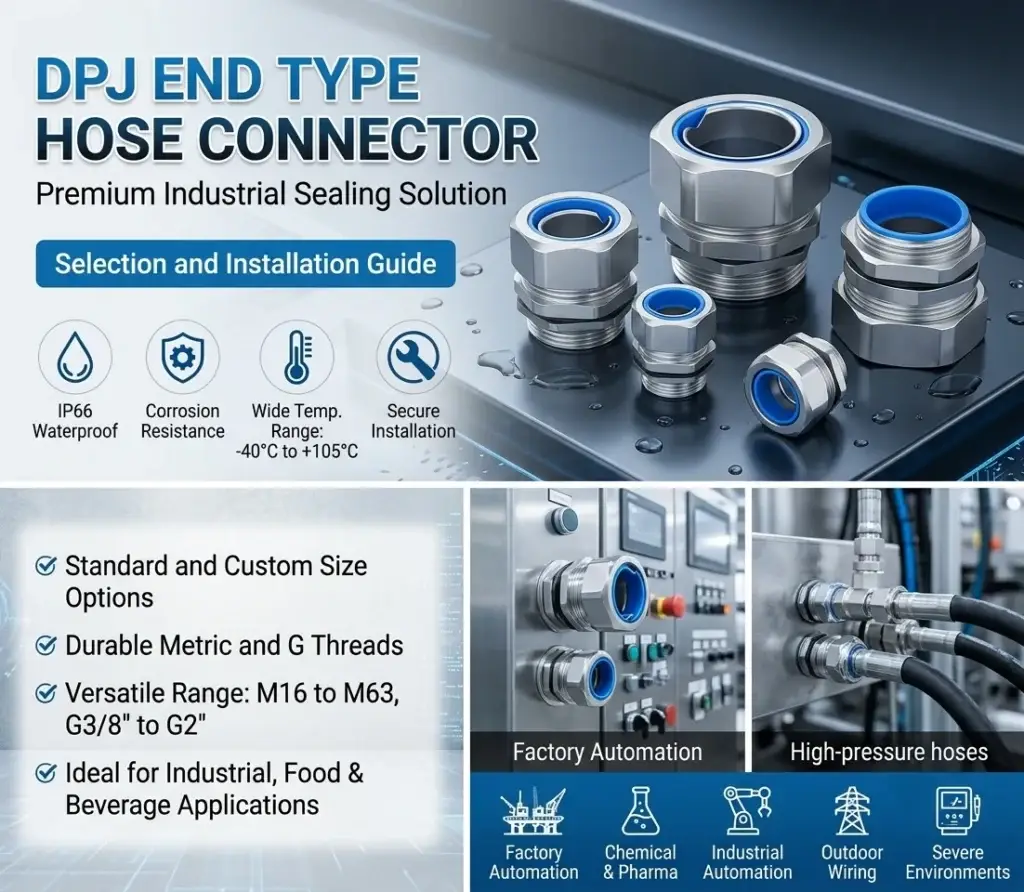
In industrial wiring environments, a single ingress point for moisture or dust can compromise an entire control cabinet, causing unscheduled downtime and expensive equipment repairs. Connecting flexible metal conduits to enclosures or motor terminal boxes requires an IP66 flexible conduit gland that balances ingress protection with mechanical pull-out strength. The DPJ flexible metal conduit connector serves as the critical termination hardware in these setups, clamping the flexible hose firmly while sealing out environmental contaminants.
Selecting the wrong fitting—or misjudging thread pitch and material compatibility—often leads to loose hose connections, frayed wire insulation, or seal degradation over time. This guide examines how the DPJ end type hose connector functions, how its internal sealing components operate, and how to choose between nickel-plated brass and stainless steel for your specific enclosure requirements.
What is a DPJ Flexible Metal Conduit Connector?
A DPJ flexible metal conduit connector is a specialized termination fitting engineered to join metallic or PVC-coated flexible conduit to junction boxes, control cabinets, and electric motors. Unlike standard rigid fittings, the DPJ end type hose connector is tailored specifically for dynamic or vibration-prone hose connections where wire protection and environmental sealing are mandatory.
The assembly relies on four integrated components working in tandem:
- Main Body & Cap Nut: Manufactured from nickel-plated brass or stainless steel (SS304/SS316L), providing structural rigidity, corrosion resistance, and mechanical thread engagement.
- TPE Protective Ring: Positioned inside the fitting to clamp onto the flexible hose profile, delivering high tensile retention without damaging the outer sheath.
- Modified Rubber Sealing Gasket: Compresses against the conduit jacket when the cap nut is tightened, creating an airtight, watertight seal.
- Mouthguard (Galvanized Sheet / SS304): Inserts into the cut end of the flexible conduit to shield internal wire insulation from sharp metal burrs and structural collapse.
How IP66 Sealing and Anti-Pullout Mechanisms Work
Achieving an IP66 rating means a fitting must completely prevent dust ingress and withstand high-pressure water jets from any direction. For a waterproof flexible metal conduit connector IP66 rating, sealing performance depends entirely on internal rubber compression under precise mechanical torque.
When the outer cap nut is torqued down, it compresses the modified rubber sealing gasket around the perimeter of the flexible metal hose connector. This uniform pressure fills micro-gaps on the conduit surface, blocking water, oil, and airborne dust particles.
Simultaneously, the TPE protective ring engages the conduit grooves. In industrial setups where motors vibrate or machinery moves along linear axes, strain relief is crucial. The flexible hose fitting must resist pull-out forces that could otherwise strip the conduit away from the junction box and expose bare conductors. The TPE ring distributes clamping pressure evenly over the hose body, maintaining mechanical grip without crushing the internal metallic core or cutting into the outer insulation jacket. Operating across a temperature range of -40°C to +105°C, this dual-action sealing and clamping structure preserves seal integrity during thermal expansion and contraction cycles.
Material Selection: Nickel-Plated Brass vs. Stainless Steel (304/316L)
Selecting the appropriate material for a nickel plated brass conduit connector or its stainless steel counterpart depends on environmental aggressiveness, mechanical stress, and project budget constraints.
Nickel-Plated Brass Fittings
Nickel-plated brass is the industry standard for general industrial automation, indoor control cabinets, and standard outdoor electrical installations. The nickel plating enhances corrosion resistance against atmospheric moisture, mild oxidation, and light industrial chemicals while maintaining excellent machinability and conductivity for grounding paths.
Stainless Steel (304 / 316L) Fittings
For extreme environments, a stainless steel 304 316L flexible hose fitting is required. Type 304 stainless steel offers superior mechanical strength and oxidation resistance for food processing plants and washdown areas. Type 316L incorporates molybdenum, making it suitable for marine applications, offshore platforms, and chemical processing facilities exposed to chlorides, salt spray, and aggressive acids.
When sourcing components for demanding industrial enclosures, selecting an engineered DPJ flexible metal conduit connector featuring nickel-plated brass or SS316 construction ensures compliance with strict IP66 standards while preventing galvanic corrosion between dissimilar metals.
| Material Option | Corrosion Resistance | Mechanical Strength | Temperature Range | Ideal Operating Environment |
| Nickel-Plated Brass | Moderate to High | High | -40°C to +105°C | Factory automation, machine tools, indoor/outdoor enclosures |
| Stainless Steel 304 | High | Very High | -40°C to +105°C | Food & beverage plants, washdown zones, general outdoor |
| Stainless Steel 316L | Exceptional (Salt/Acid) | Very High | -40°C to +105°C | Marine platforms, chemical plants, offshore installations |
Sizing Guide: Matching Conduit Sizes and Thread Standards
Improper thread selection is one of the most common causes of installation failure during field wiring. A DPJ series brass flexible conduit fitting must match both the inner/outer diameter of the flexible conduit and the pre-tapped knockout hole on the target enclosure.
Fittings are manufactured across three primary thread standards:
- G Threads (ISO 228-1 Parallel Threads): Widely used across Europe and Asia for industrial equipment, such as a G1/2 inch flexible conduit hose connector for standard terminal boxes.
- Metric Threads (ISO Metric): Standardized thread pitch ranging from M12 to M63, common in modern European machinery and automated control systems.
- NPT Threads (National Pipe Taper): Tapered American standard threads requiring thread sealant or Teflon tape when mated to threaded hubs.
To select the correct size, measure the inner diameter (ID) and outer diameter (OD) of your flexible metal conduit, then verify the enclosure knockout diameter. The fitting’s mouthguard must slip snugly inside the conduit ID, while the cap nut clamps the conduit OD.
| Thread Designation | Nominal Conduit Size (OD/ID) | Knockout Hole Diameter | Primary Application |
| G1/2″ / M20 x 1.5 | 15 mm / 12 mm | ~20.5 mm | Standard junction boxes, small sensor wiring |
| G3/4″ / M25 x 1.5 | 20 mm / 16 mm | ~25.5 mm | Distribution cabinets, medium motor leads |
| G1″ / M32 x 1.5 | 25 mm / 21 mm | ~32.5 mm | Heavy machinery power feeds, main control panels |
| G1-1/2″ / M50 x 1.5 | 38 mm / 32 mm | ~50.5 mm | Substation cable protection, large conduit runs |
Typical Industrial Applications of DPJ Connectors
Because of their dual-layer protection—combining mechanical hose gripping with fluid tightness—DPJ connectors are applied across several demanding sector applications:
- Industrial Robotics & Machine Tools: Flexible conduits routing power and data lines to moving robot arms experience constant motion. DPJ fittings prevent the conduit from backing out of terminal boxes due to repetitive flexure.
- Motor and Pump Terminal Boxes: Electric motors generate continuous vibration. An IP66-rated DPJ connector maintains an airtight seal around the flexible conduit, shielding motor lead splices from washdown spray, oil mist, and dust accumulation.
- Outdoor Power Distribution Cabinets: Utility junction boxes exposed to driving rain, snow, and intense solar radiation require weatherproof cable termination to prevent internal corrosion and short circuits.
- Chemical & Pharmaceutical Processing: In facilities requiring frequent hose-down sanitization with aggressive detergents, SS316L DPJ fittings ensure long-term structural integrity without pitting or gasket breakdown.
When specifying comprehensive wiring systems, consulting a verified wholesale flexible metal conduit connector supplier or reviewing All Products catalogues helps ensure all gland accessories, locknuts, and reducers match your system’s IP rating.
Common Installation Mistakes to Avoid
Even high-grade fittings can fail if installed incorrectly. Avoid these four common field installation errors:
- Over-Torquing the Cap Nut: Excess torque can crush the internal TPE ring or distort the modified rubber gasket, creating micro-gaps that allow moisture ingress under high pressure.
- Cross-Threading Mismatched Standards: Forcing a parallel G thread into a tapered NPT port damages brass threads and ruins seal integrity. Always verify thread pitch prior to assembly.
- Omitting the Internal Mouthguard: Trimming flexible metal conduit leaves sharp metallic burrs. Omitting the galvanized or stainless mouthguard allows these burrs to slice through wire insulation under vibration.
- Exceeding Thermal Limits: Using standard fittings in extreme high-temperature zones exceeding +105°C causes rubber gaskets to harden and crack, leading to eventual IP rating failure.
Frequently Asked Questions (FAQs)
What is the main difference between nickel-plated brass and stainless steel DPJ connectors?
Nickel-plated brass offers excellent cost-efficiency and corrosion resistance for standard industrial environments and outdoor cabinets. Stainless steel (SS304/SS316L) provides superior mechanical strength and chemical resistance needed for marine, offshore, and corrosive chemical processing environments.
How does the IP66 rating protect flexible metal conduit connections?
An IP66 rating guarantees complete protection against airborne dust ingress and protection against high-pressure water jets from any direction. The inner modified rubber gasket compresses around the conduit, creating an airtight and watertight seal under harsh washdown conditions.
Can DPJ flexible metal conduit connectors withstand outdoor and low-temperature conditions?
Yes, DPJ connectors engineered with modified rubber gaskets and TPE protective rings operate within a wide temperature range of -40°C to +105°C. They remain flexible and sealed in freezing outdoor climates as well as high-temperature industrial enclosure environments.
What is the function of the TPE protective ring inside a DPJ connector?
The TPE protective ring clamps firmly onto the outer wall of the flexible metal conduit. It provides mechanical strain relief and strong anti-pullout force, ensuring the hose does not detach under heavy vibration while preventing sharp edges from cutting internal wires.
How do I choose the correct thread size for my DPJ conduit fitting?
Measure the outer and inner diameter of your flexible conduit, then check your cabinet knockout size and thread standard (G, Metric, or NPT). Ensure the fitting’s mouthguard matches the conduit ID and the entry thread fits the panel hole or tapped hub (such as a G1/2″ thread for standard M20 knockouts).
Conclusion
Selecting the correct DPJ flexible metal conduit connector requires evaluating environmental corrosion risks, vibration exposure, and exact thread specifications. By combining a durable metallic outer housing with a TPE protective ring and a modified rubber seal, DPJ fittings deliver robust IP66 ingress protection and anti-pullout strain relief for industrial wiring systems. When designing control panels or upgrading plant infrastructure, matching fitting materials to ambient conditions prevents costly maintenance cycles and electrical failures.
If you are evaluating cable protection requirements or need precise dimensional datasheets for your upcoming project, review technical specifications or contact an experienced DPJ end type hose connector manufacturer to verify custom thread configurations, material certificates, and bulk wholesale options.