Industrial field installations frequently encounter a frustrating bottleneck: thread mismatch. If your distribution junction box is pre-drilled with an M25 Metric thread, but your heavy-duty armored cable arrives with an NPT 1/2″ termination, forcing a connection is out of the question. Forcing mismatched threads strips the entry walls, destroys the structural integrity of your assembly, and compromises environmental sealing.
Ignoring thread compatibility leads to costly project delays, failed field inspections, and moisture ingress that can short out expensive control systems. To solve this without re-drilling or replacing entire components, deploying a precision-engineered Metal Reducer or Cable Gland Adapter is the most effective approach. This guide breaks down the core technical criteria for industrial thread conversion, helping you maintain safety, compliance, and structural integrity across your electrical systems.
The Thread Mismatch Dilemma: What is a Cable Gland Adapter?
Industrial equipment is manufactured globally, meaning electrical enclosures follow regional standards. A control panel built in Europe typically features Metric or PG entries, while equipment built in North America relies almost exclusively on NPT standards. When these systems integrate on-site, thread standard conflicts are inevitable.
A Cable Gland Adapter acts as a mechanical bridge between two different thread types or sizes. Similarly, a Cable Gland Reducer allows a smaller cable gland to be safely fitted into a larger pre-drilled enclosure entry hole.
Using these specialized fittings eliminates the need for field modifications, such as welding or re-tapping enclosure walls. This preservation of the factory-finished enclosure surface is vital for maintaining certified ingress protection and explosion-proof compliance in industrial environments.
Material Matters: Why a Nickel-Plated Brass Metal Reducer Outperforms Plastic
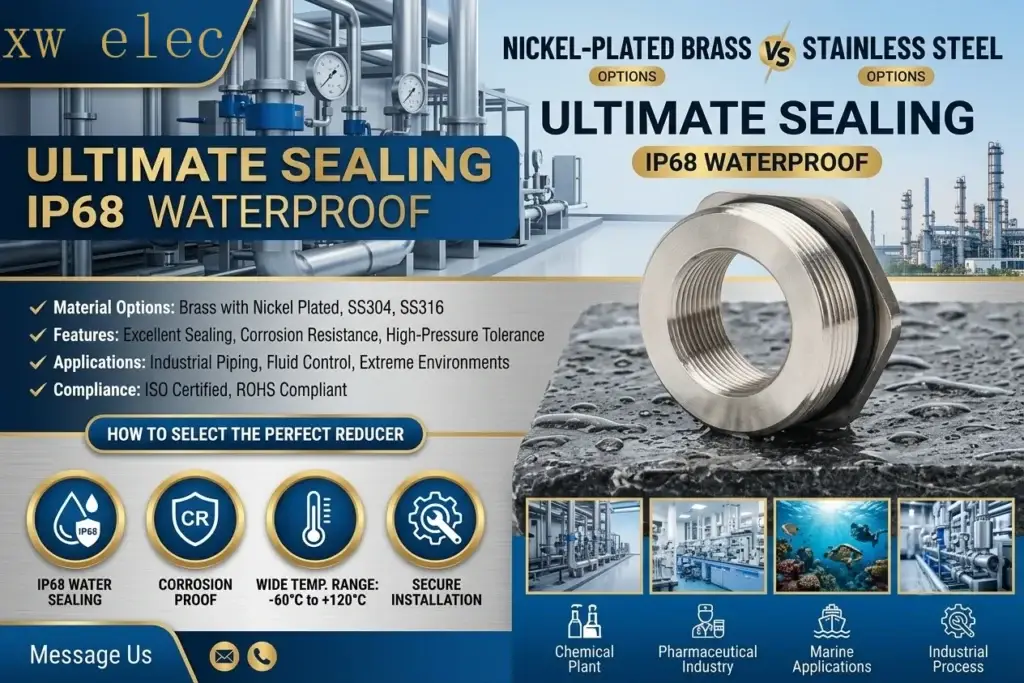
Choosing the right material for your conversion fittings directly dictates the lifespan and safety of the entire electrical installation. While engineered plastics are common in commercial settings, demanding industrial environments require rugged metal variants like a nickel-plated brass metal reducer.
Nickel-Plated Brass vs. Nylon/Plastic Reducers
- Mechanical Strength: Plastics deform under heavy mechanical loads or high vibration, which are common near heavy machinery or marine propulsion systems. A brass thread adapter withstands high tightening torques without cross-threading or shearing.
- Thermal Stability: Industrial enclosures frequently experience extreme temperature fluctuations. Under intense heat, plastics can soften and creep, compromising the tension required to hold a seal. Nickel-plated brass maintains structural stability from -40°C up to +120°C.
- Hazardous Area Safety: In explosion-proof areas, plastic components can accumulate static charges, presenting an ignition risk. Metal fittings ensure continuous electrical grounding across the enclosure boundary.
| Material Property | Premium Nickel-Plated Brass | Standard Nylon/Plastic |
| Tensile Strength | Very High (>400 MPa) | Low to Moderate (~70 MPa) |
| Corrosion Resistance | Excellent (Resists salt spray, acids, alkalis) | Good (But degrades under UV exposure) |
| Flame Retardancy | Inherently Non-combustible | Variable (Requires additives) |
| Grounding Continuity | Excellent (Maintains electrical path) | None (Insulator) |
Free Conversion Breakdown: Navigating Metric, PG, and NPT Standards
Achieving a clean, reliable installation depends on executing a free conversion between different thread diameters and types, whether you are dealing with Metric, PG, or NPT configurations.
Reducer vs. Enlarger: Know the Difference
- Reducer: Features a larger male thread on the outside (to screw into the enclosure) and a smaller female thread on the inside (to accept the cable gland).
- Enlarger: Features a smaller male thread on the outside and a larger female thread on the inside, allowing you to fit a larger gland into a constrained enclosure opening.
When selecting your fitting, you must map out the conversion pathway clearly. For example, moving from an NPT to Metric brass thread reducer requires matching both the NPT pitch angle (60° tapered) and the parallel Metric pitch (60° parallel, typically 1.5 mm pitch). The same precision applies when implementing a Metric to PG thread adapter for cable glands, ensuring the pitch profiles match perfectly without binding.
The table below outlines common industrial conversion paths used by field engineers to secure thread transitions:
| Male Thread Type (Enclosure Connection) | Female Thread Type (Gland Connection) | Common Application / Scenario | Recommended Gasket |
| NPT 3/4″ | M20 x 1.5 | Adapting American-spec junction boxes to European Metric glands. | Flat Chloroprene Rubber |
| M25 x 1.5 | PG16 | Retrofitting modern Metric panels with legacy German-spec PG glands. | O-Ring Silicone/NBR |
| PG21 | M20 x 1.5 | Scaling down older machine tool entries to accept compact Metric wiring. | Flat NBR Washer |
| M32 x 1.5 | M25 x 1.5 | Reducing size step within Metric systems for smaller diameter cables. | O-Ring NBR |
Engineering for Harsh Environments: Ensuring a Waterproof Seal
When installing a waterproof metal reducer for electrical enclosures, maintaining an IP68 ingress protection rating is crucial. An imperfect seal allows moisture to migrate into the enclosure via capillary action during temperature-induced pressure drops, leading to internal condensation and component failure.
To guarantee an IP68 rating, the assembly must achieve deep thread engagement alongside proper elastoprene compression. Using high-quality seating washers (such as NBR or silicone) at the interface between the male thread shoulder and the enclosure wall creates a barrier against high-pressure water jets and prolonged submersion.
Custom Solutions for Special Enclosures
Standard off-the-shelf adapters typically feature a fixed thread length designed for thin-walled sheet metal enclosures. However, heavy-duty applications—such as cast iron explosion-proof junction boxes or thick-walled marine bulkheads—require longer threads to achieve full penetration and secure locking.
       [ Thick Enclosure Wall ]
                  ||
   +--------------||--------------+
   |  MALE        ||      FEMALE  |
===|  THREAD ---->||----> THREAD  |=== (Cable Gland Entry)
   |  (Long)      ||     (Inside) |
   +--------------||--------------+
                  ||
       [ Custom Thread Length ]
When standard dimensions fall short, working directly with an experienced source factory capable of producing a custom thread length metal adapter becomes essential.
As an established manufacturer specializing in heavy-duty export components, XINGWEIDIANQI’s Custom Thread Adapters provide a reliable solution for non-standard wall thicknesses. They offer tailormade thread lengths and custom configurations to ensure your connections meet structural requirements without compromising safety.
Common Pitfalls to Avoid When Selecting an Industrial Brass Cable Gland Reducer
- Misidentifying Thread Pitch: Metric threads are characterized by diameter and pitch (e.g., M20 x 1.5), but some specialized machinery uses a 1.0 mm or 2.0 mm pitch. Attempting to force a mismatched pitch will cross-thread and ruin the fitting.
- Ignoring Galvanic Corrosion: Avoid screwing raw aluminum adapters into stainless steel enclosures in high-salt marine environments. Stick to a high-quality industrial brass cable gland reducer with nickel plating, as the nickel layer acts as a sacrificial barrier that prevents galvanic cells from forming.
- Over-tightening During Assembly: While brass provides excellent mechanical strength, over-torqueing can distort the soft elastomeric sealing washers. This distortion creates micro-gaps that compromise the IP68 waterproof rating.
Frequently Asked Questions (FAQ)
What is the primary difference between a cable gland adapter and a metal reducer?
An adapter changes the thread type between different standards (such as converting NPT to Metric). A reducer retains the thread type but changes the size (such as stepping down an M32 entry to an M25 entry).
Can a nickel-plated brass metal reducer be used in certified explosion-proof applications?
Yes, provided it carries the appropriate certification markings (such as Exd IIC T4) stamped on its body. The heavy brass construction and high thread engagement help safely contain internal ignition pressures within the enclosure.
How do I maintain an IP68 rating when converting from NPT to Metric threads?
Because NPT threads are tapered, they seal via thread crush, whereas Metric threads are parallel and seal via an interface gasket. When using an NPT-to-Metric adapter, apply an industrial thread sealant to the male NPT side and use a high-quality O-ring on the female Metric shoulder.
Do you support custom thread lengths for thick-walled cast iron boxes?
Yes. Through OEM/ODM manufacturing services, thread lengths can be adjusted to match specified wall thicknesses, ensuring deep thread engagement and secure locking on non-standard industrial enclosures.
Conclusion & Next Steps
Resolving thread mismatches requires balancing sizing alignment with environmental protection. A high-quality Metal Reducer does more than join mismatched components; it preserves the enclosure’s ingress protection rating, ensures electrical grounding continuity, and protects your system against harsh operating conditions. For heavy-duty industrial applications, choosing nickel-plated brass fittings provides the structural integrity needed to prevent costly field failures.
If you are managing a large-scale project with complex wiring specifications or require non-standard thread profiles, consulting a manufacturer early can streamline procurement.
Need a custom thread conversion chart, specific technical dimensions, or wholesale bulk pricing for an upcoming project? Contact the engineering team at XINGWEIDIANQI via WhatsApp at +86 15658735373 or email at cnxwelectric@gmail.com for a comprehensive technical review and quote.