What Is a Stainless Steel Explosion-Proof Cable Gland?
A stainless steel explosion-proof cable gland is a specialized cable entry device used on hazardous area equipment to seal, secure, and mechanically protect cables while preventing any internal explosion or ignition source from propagating into the surrounding atmosphere. It combines the basic functions of a cable gland—strain relief, sealing against dust and moisture, and mechanical retention—with an explosion-proof or Ex-rated design that complies with standards such as ATEX and IECEx for Zone 1, Zone 2, Zone 21, and Zone 22 installations.[exgrip]
In practice, this means the gland body, seals, and clamping components are designed to withstand explosion pressure, control flame paths, and maintain tight ingress protection (often IP67 or IP68) even under vibration, temperature cycling, and chemical exposure. Stainless steel versions, especially SS316 or 316L, are preferred in corrosive environments like offshore platforms, marine installations, and chemical plants where brass or mild steel would deteriorate too quickly.[scribd]
When you see “ATEX stainless steel cable gland” or “316 stainless steel explosion proof cable gland” in a datasheet, it usually indicates that the product has been tested and certified for use in specific hazardous zones and gas groups, with clearly defined temperature classes and sealing ranges. Using a non-Ex gland or the wrong Ex concept (for example, a non-flameproof gland on an Ex d enclosure) can compromise the integrity of the whole installation and lead to non-compliance or serious safety incidents.[hxcablegland]
Key Classification: Types of Stainless Steel Explosion-Proof Cable Glands
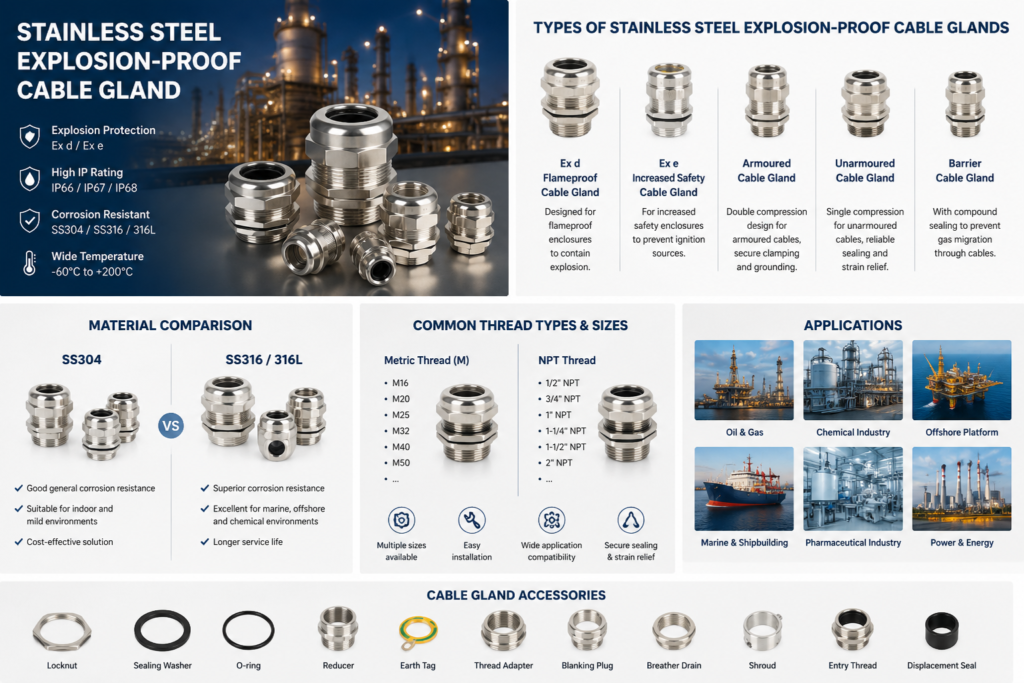
Explosion-proof cable glands are not all the same; even within stainless steel products, there are several important classification dimensions that drive selection and pricing. Understanding these types is the first step before comparing different stainless steel explosion-proof cable connectors or deciding whether SS316 is necessary for your project.[mam-ex]
304 vs 316 Stainless Steel in Explosion-Proof Cable Glands
Most industrial stainless steel cable glands are manufactured from either 304 or 316/316L stainless steel, and the choice between them is largely about corrosion resistance and lifecycle cost. SS304 provides good general corrosion resistance and is suitable for many indoor or mildly corrosive industrial environments, while SS316 or 316L offers superior resistance to chlorides, salt spray, and many chemicals, making it the default choice for offshore, marine, and coastal installations.[daqiml]
In a refinery located far from the sea with mainly atmospheric corrosion and limited chemical exposure, a 304 stainless steel explosion-proof cable gland may be technically sufficient if all Ex requirements are met. However, for exposed offshore skids, shipboard equipment, or coastal chemical terminals, SS316 or 316L is often specified explicitly by engineering standards to avoid pitting and crevice corrosion that could occur with 304 over time.[scribd]
Ex d vs Ex e Stainless Steel Cable Glands
From an explosion protection standpoint, one of the most important distinctions is between Ex d (flameproof) and Ex e (increased safety) cable glands. Ex d stainless steel glands are designed for use on flameproof enclosures where an internal explosion is possible and must be contained, so the gland must withstand explosion pressure and maintain flame paths that cool and quench combustion gases.[exgrip]
Ex e stainless steel glands, in contrast, are intended for increased safety enclosures where the design aims to prevent arcs, sparks, or hot surfaces in the first place, and the gland focuses on secure cable clamping, high IP protection, and robust insulation rather than containing an internal explosion. These two concepts are not interchangeable: fitting an Ex e gland to an Ex d enclosure can break the flameproof protection, while using an Ex d gland on an Ex e enclosure may be unnecessarily costly and bulkier than required.[adf-systemes]
Armoured vs Unarmoured and Barrier-Type Designs
Another critical classification is whether the cable is armoured or unarmoured, and whether a barrier seal is required. For armoured cables, stainless steel explosion-proof cable glands often use double compression or dedicated armour-clamping components to provide secure mechanical retention and proper earthing or bonding of the armour layer.[cabexindia]
Unarmoured or braided cables may use single compression designs, but in high-risk gas groups (for example IIC) or certain ATEX zones, a barrier-type stainless steel gland with compound sealing can be required to prevent gas migration through cable cores. Selecting an unarmoured gland for an armoured cable—or omitting a barrier gland where standards require one—is a common mistake that can lead to inspection failures and rework.[cablejoints.co]
Thread Types and Sizes (M25, NPT, G, PG)
On the mechanical side, stainless steel explosion-proof cable glands are produced in a wide range of thread standards, including metric (M20, M25, M32, etc.), NPT tapered threads, and G/PG pipe threads. For example, an M25 stainless steel explosion-proof cable gland is commonly used on equipment with M25 × 1.5 metric entries and is selected based on both the cable outer diameter and the size of the threaded entry.[cespledex]
Choosing the wrong thread type—such as fitting a metric gland into a NPT-tapped hole via improvised adapters—may compromise sealing, reduce thread engagement, and create potential leak paths or mechanical weaknesses. In hazardous areas, it is good practice to match the gland thread type exactly to the enclosure entries or use certified adaptors and reducers designed for the purpose.[cespledex]
Material Comparison Table
Below is a practical comparison of common materials used for explosion-proof cable glands, including stainless steel and nickel-plated brass.[wkk-europe]
| Material | Corrosion resistance | Typical environments | Cost level | Typical use cases | When to avoid |
|---|---|---|---|---|---|
| Stainless steel 304 | Good general resistance; limited in high-chloride | Indoor industrial, sheltered outdoor, light chemicals | Medium | General industrial Ex installations away from marine/coastal | Heavy chloride or strong chemical exposure |
| Stainless steel 316 / 316L | Excellent in chlorides, salt spray, many chemicals | Offshore, marine, coastal, aggressive chemical plants | Higher | Offshore platforms, shipbuilding, coastal refineries, marine | Cost-sensitive indoor projects with mild corrosion |
| Nickel-plated brass | Good in many industrial settings; less than 316 SS | General industrial, indoor panels, sheltered outdoor | Lower | Indoor MCCs, control panels, typical plant areas | Harsh marine, strong chemical or wash-down zones |
Stainless Steel vs Nickel-Plated Brass Explosion-Proof Cable Glands
In many projects, the main question is not whether to use an explosion-proof gland, but whether stainless steel or nickel-plated brass is the better choice for a specific environment and budget. Stainless steel, especially 316, provides superior resistance to saltwater, chloride-rich atmospheres, and many aggressive chemicals, making it ideal for offshore platforms, ship decks, coastal terminals, or wash-down areas in food and beverage plants.[metalcablegland]
Nickel-plated brass explosion-proof cable glands offer solid corrosion resistance for most general industrial environments at a significantly lower material cost than stainless steel, which can matter when thousands of terminations are involved. For indoor switchgear rooms, sheltered process areas, or equipment cabinets located away from direct chemical exposure, nickel-plated brass can deliver compliant Ex performance and a lower total installed cost.[wkk-europe]
From a lifecycle perspective, selecting stainless steel where it is not needed can over-specify the installation, increase initial CAPEX, and tie up budget that might be better allocated to redundancy or monitoring systems. Conversely, using nickel-plated brass in a heavily corrosive marine environment may save money in the first year but lead to rapid degradation, increased inspection findings, premature replacements, and unplanned downtime.[hxcablegland]
Corrosion and Environmental Resistance
For offshore and coastal environments with constant salt spray and high humidity, ATEX stainless steel cable glands made from 316 or 316L are widely recommended because they resist pitting and crevice corrosion that can quickly attack brass and even 304 stainless steel. In chemical processing plants, where cleaning agents and process media can be aggressive, stainless steel again tends to perform better over the long term, particularly when combined with high IP ratings and suitable sealing materials.[mam-ex]
In dry indoor environments such as MCC rooms, control panels, or instrument racks that are not subject to aggressive chemicals or wash-down, nickel-plated brass explosion-proof cable glands can provide more than adequate performance when installed and maintained correctly. The key is to match the material not only to the zone classification but also to the real exposure conditions over the 10–20 year design life.[onelecs]
Cost and Lifetime Considerations in Bulk Projects
When specifying hundreds or thousands of explosion-proof cable terminations, material choice has a visible impact on both project CAPEX and lifecycle OPEX. Stainless steel explosion-proof cable glands typically cost more per piece than equivalent nickel-plated brass models, and the difference multiplies in bulk procurement and distribution scenarios.[difvan]
However, for offshore and high-corrosion applications where brass glands may need replacement within a few years, the higher upfront cost of SS316 can be offset by reduced maintenance, fewer shutdowns for replacements, and better inspection results. Procurement teams and distributors therefore often evaluate not just unit price, but expected service life and inspection compliance costs when deciding between stainless steel and nickel-plated brass.[cabexindia]
Practical Scenarios: When Stainless Steel Is a Must
Stainless steel explosion-proof cable glands become “non-negotiable” in situations such as offshore wind turbines, FPSOs, shipboard engine rooms, and coastal chemical terminals where chloride-induced corrosion is severe and constant. They are also preferred in wash-down food and beverage facilities or pharmaceutical plants where hygiene and frequent cleaning can damage softer materials over time.[hxcablegland]
In contrast, indoor power distribution boards located in temperature-controlled electrical rooms, away from aggressive chemicals and salt spray, can often use nickel-plated brass explosion-proof cable glands without compromising safety or compliance. In these cases, stainless steel may only be specified for particularly exposed terminations, such as glands facing external door openings or coastal air intakes.[onelecs]
Environment vs Recommended Material and Type
| Environment / project type | Preferred material & type | Typical ATEX zone / notes |
|---|---|---|
| Offshore platform or marine skid | SS316 Ex d / Ex e, often double compression | Zone 1/2 gas; high chloride, IP67–IP68; barrier type for IIC gases |
| Coastal chemical or petrochemical plant | SS316 Ex d / Ex e, sometimes barrier-type | Zone 1/2 gas; exposure to chemicals and salt, long design life |
| Indoor industrial MCC and switchgear rooms | Nickel-plated brass Ex d / Ex e | Zone 1/2 or safe area; low corrosion; focus on cost and availability |
| Food & pharma with wash-down | SS316 Ex e with high IP rating | Zone 2 or safe area; frequent cleaning; hygiene requirements |
| Grain silos and dusty handling environments | Stainless steel or nickel-plated brass Ex d / Ex e | Zone 21/22 dust; focus on dust-tight sealing and correct temperature class |
How to Select the Right Stainless Steel Explosion-Proof Cable Gland (Step-by-Step)
Step 1 – Match the Hazardous Area and Ex Concept
Start by confirming the zone classification (Zone 1 or 2 for gas, Zone 21 or 22 for dust) and the protection concept required by the equipment (Ex d, Ex e, or combinations). If the enclosure is marked Ex d, you must select an Ex d stainless steel explosion-proof cable gland; if it is Ex e, using an Ex e gland is usually sufficient and more economical.[metalmecheng]
It is not acceptable to “upgrade” or “downgrade” the gland concept arbitrarily—for example, fitting an Ex e gland on an Ex d motor terminal box breaks the flameproof path and may invalidate the certification. Always match the cable gland’s Ex markings and temperature class to the equipment nameplate and local regulations.[adf-systemes]
Step 2 – Match the Cable Construction and Size
Next, confirm whether your cable is armoured, braided, or unarmoured, and measure both the overall outer diameter and, for armoured cables, the armour thickness. For armoured cables, choose a stainless steel double compression or dedicated armoured explosion-proof gland that can clamp and earth the armour correctly within its specified range.[wzchda]
For non-armoured cables in higher-risk gas groups or in situations where gas migration through cable cores is a concern, a barrier-type stainless steel explosion-proof cable gland may be required according to ATEX or IECEx guidance. Selecting a gland with an incorrect cable OD range can lead to over-compression (damaging the sheath) or under-compression (insufficient sealing), both of which are common causes of inspection findings.[cablejoints.co]
Step 3 – Match the Material and Environment
Once the Ex concept and cable construction are clear, select the material according to environmental exposure and expected lifetime. For offshore, marine, coastal, or strongly chemical environments, a 316 or 316L stainless steel explosion-proof cable gland is normally recommended to resist pitting and crevice corrosion.[scribd]
For indoor industrial environments with low corrosion risk, nickel-plated brass explosion-proof cable glands can be acceptable and more economical, as long as all Ex and IP requirements are met. When in doubt, consider the cost of replacement and inspection over 10–20 years, not just the unit price difference at the time of purchase.[wkk-europe]
Step 4 – Match the Thread and Enclosure
Verify the thread type and size of the equipment entries—whether they are metric (for example M25 × 1.5), NPT, or G/PG threads. Select stainless steel explosion-proof cable glands with matching threads to avoid using uncertified or improvised adaptors that can compromise mechanical strength and sealing.[aliexpress]
For M25 stainless steel explosion-proof cable glands, check the manufacturer’s datasheet for the exact cable OD range, thread length, and locknut compatibility, especially if you are using gland plates or thin stainless steel sheet enclosures. If reducers or adaptors are required to match different thread sizes, ensure they are also Ex-certified and compatible with the enclosure material.[aliexpress]
Step 5 – Verify Certifications, IP Rating, and Temperature Range
Before finalizing your selection, confirm that the stainless steel explosion-proof cable gland holds appropriate ATEX and/or IECEx certifications for your region, including the correct gas group and temperature class. Review the IP rating (typically IP66–IP68) and the operating temperature range on the datasheet to make sure they match your process conditions.[mam-ex]
For high-temperature applications or those with severe thermal cycling, pay close attention to sealing materials (for example NBR vs silicone) and torque recommendations, as these influence long-term sealing performance. For audits and inspections, keep manufacturer certificates, installation instructions, and torque tables accessible as part of the project documentation.[exgrip]
Step 6 – Consider Commercial Factors: Manufacturer, Bulk Purchasing, and OEM/ODM
Finally, many B2B buyers and distributors need to evaluate the manufacturer or supplier as carefully as the product. For stainless steel explosion-proof cable glands, factors such as production capacity, consistency across batches, stock holding for common sizes like M20 and M25, and experience in exporting to your target markets are all important.[iep.com]
If you are a distributor, panel builder, or OEM looking for a long-term partner, working directly with a stainless steel explosion proof cable gland manufacturer in China that can support bulk purchasing, stable pricing, OEM/ODM markings, private label, and tailored packing can simplify your supply chain. XINGWEI, for instance, offers stainless steel explosion-proof cable glands as well as nickel-plated brass explosion-proof cable glands, which allows engineers and purchasing teams to cover both harsh and general environments from a single factory partner.[iep.com]
Selection Checklist Table
| Criterion | What to check | Example choice |
|---|---|---|
| Hazardous zone & Ex type | Zone 1/2 or 21/22, Ex d or Ex e marking | Zone 1 gas, Ex d motor → Ex d SS316 gland |
| Cable construction | Armoured / unarmoured, OD, armour thickness | Armoured 3-core cable → SS316 double compression Ex gland |
| Material & environment | Corrosion level, marine/chemical exposure | Offshore skid → ATEX SS316 stainless steel explosion-proof gland |
| Thread and entry | M, NPT, G/PG, thread size and length | Enclosure M25 entries → M25 stainless steel Ex gland |
| IP & temperature rating | Required IP (IP66–IP68), operating temperature | Outdoor chemical area → IP68, –40 °C to +110 °C |
| Certifications | ATEX / IECEx, gas group, temperature class | Ex d IIC T6 ATEX stainless steel cable gland |
| Supplier & logistics | Manufacturer, lead time, MOQ, bulk and OEM/ODM options | China manufacturer with bulk stock and private-label capability |
[exgrip]
Common Mistakes and Compliance Risks
Typical Mistakes with Explosion-Proof Cable Glands
One frequent mistake is selecting a gland purely by thread size and physical fit, without checking Ex markings, cable range, or material suitability. This can result in glands that mechanically fit the hole but do not provide the correct sealing or explosion protection for the cable and environment.[mam-ex]
Another common issue is mixing Ex d and Ex e glands with incompatible enclosures, for example installing Ex e glands on Ex d motors or junction boxes. This practice may pass a casual visual inspection but can fail more detailed audits, and it risks invalidating the equipment’s flameproof certification.[metalmecheng]
Using nickel-plated brass in locations that clearly require SS316—such as exposed offshore or chemical wash-down areas—is another typical error driven by short-term cost considerations. Over a few years, visible corrosion on brass glands can become both a reliability concern and a trigger for unscheduled maintenance or replacement campaigns.[hxcablegland]
Mistakes, Consequences, and Fixes (Table)
| Typical mistake | Short-term effect | Long-term risk | How to fix |
|---|---|---|---|
| Choosing by thread only | Gland fits but may not seal cable properly | Water/gas ingress, Ex non-compliance | Always check cable OD, Ex rating, IP, and temperature range |
| Ex e gland on Ex d enclosure | Looks acceptable at a glance | Loss of flameproof integrity, failed inspections | Match gland Ex type exactly to enclosure marking |
| Using brass where SS316 is needed | Lower initial cost | Corrosion, leaks, possible replacement campaigns | Specify SS316 in marine/chemical areas despite higher unit cost |
| Wrong thread standard (M vs NPT vs G) | Need adaptors or forced fit | Poor engagement, leaks, mechanical weakness | Use correct thread or certified adaptors, avoid improvised fixes |
| Non-certified or unclear certification | Low purchase price | Non-compliance in audits, insurance and legal issues | Buy only from manufacturers with clear ATEX/IECEx certificates |
When to Work with a Stainless Steel Explosion-Proof Cable Gland Manufacturer in China
For small one-off repairs, buying a few glands from local stockists can be sufficient, but larger projects and distribution businesses benefit from direct relationships with manufacturers. If you are planning multi-site upgrades, new offshore installations, or standardized OEM equipment lines, working with a dedicated stainless steel explosion proof cable gland manufacturer in China can provide better control over specifications, pricing, and availability.[difvan]
Key evaluation criteria include the breadth of the product portfolio (stainless steel, nickel-plated brass, nylon, explosion-proof variants), ATEX/IECEx certifications, quality systems, and the ability to support bulk purchasing, distributor pricing, and private-label programs. A supplier like XINGWEI that can deliver stainless steel explosion-proof cable glands as well as nickel-plated brass explosion-proof cable glands allows panel builders, OEMs, and distributors to consolidate sourcing while still matching material and type to each environment.[inpratex]
If you handle international projects, you should also check export experience, packaging standards, and after-sales technical support, especially when end clients request cable gland selection support or documentation for audits. This is where OEM/ODM services, custom engraving, and consistent markings across product batches can help your company build its own brand in regional markets.[iep.com]
Example of Natural Product Integration
When specifying a Zone 1 offshore skid that uses armoured power cables with M25 entries exposed to salt-laden air, engineers typically select SS316 double compression ATEX stainless steel explosion-proof cable glands to ensure corrosion resistance and long-term sealing performance. In this type of project, you can configure the solution with stainless steel explosion-proof cable glands for the most exposed terminations and nickel-plated brass explosion-proof cable glands for sheltered indoor panels, using a manufacturer like XINGWEI that supplies both materials from a single factory:[daqiml]
- Stainless steel explosion-proof cable gland (SS316, Ex-rated):
https://xingweielec.com/product/stainless-steel-explosion-proof-cable-gland/ - Nickel-plated brass explosion-proof cable gland (Ex-rated):
https://xingweielec.com/product/nickel-plated-brass-explosion-proof-cable-gland/
This mixed-material strategy allows procurement teams, distributors, and panel builders to balance safety, corrosion resistance, and price across different parts of the same project while keeping BOM and supplier management simple.[wkk-europe]
Light CTA for Engineers, Procurement, and Distributors
If you are comparing different types of stainless steel explosion-proof cable connectors for an upcoming project and are not fully confident about the required Ex concept, material, or thread configuration, a short technical review before quotation can prevent costly changes later. You can prepare a simple summary of your hazardous zone classification, cable types and diameters, enclosure thread requirements (for example M25 metric), and any corrosion or wash-down conditions, then share these with a stainless steel explosion proof cable gland manufacturer or supplier in China for a recommendation that fits both safety and budget.[exgrip]
For distributors, wholesalers, and panel builders, this same data set is usually enough for a manufacturer like XINGWEI to suggest a standardized range of ATEX stainless steel cable glands and nickel-plated brass alternatives that can be stocked for bulk purchasing, OEM/ODM private-label programs, and long-term B2B cooperation.[difvan]
FAQs About Stainless Steel Explosion-Proof Cable Glands
1. What is a stainless steel explosion-proof cable gland and when do you need one?
A stainless steel explosion-proof cable gland is a cable entry device designed to terminate and seal cables on Ex-rated equipment while preventing any internal explosion from igniting the surrounding hazardous atmosphere. You typically need one whenever a cable enters an ATEX/IECEx-certified enclosure in Zone 1, Zone 2, Zone 21, or Zone 22, especially in corrosive or outdoor environments where stainless steel offers better durability than brass.[exgrip]
2. What is the difference between 304 and 316 stainless steel explosion-proof cable glands?
Both 304 and 316 stainless steel provide good mechanical strength and corrosion resistance, but 316 (and 316L) offers significantly better resistance to chlorides and many chemicals. For inland or mildly corrosive industrial environments, 304 stainless steel explosion-proof cable glands may be sufficient, whereas offshore, marine, and strong chemical applications generally require 316 or 316L to avoid premature corrosion and inspection issues.[daqiml]
3. How do I choose the right size M25 stainless steel explosion-proof cable gland for my cable?
To select an M25 stainless steel explosion-proof cable gland, first confirm that your enclosure entries are M25 × 1.5 metric threads and then check the cable’s outer diameter and, if applicable, armour dimensions. You should match these values with the manufacturer’s specified sealing range and armour clamping range, ensuring that the gland is certified for your hazardous zone and has the required IP and temperature ratings.[aliexpress]
4. When should I use a stainless steel explosion-proof cable gland instead of a nickel-plated brass one?
Stainless steel explosion-proof cable glands are usually chosen for harsh environments such as offshore platforms, ship decks, coastal refineries, chemical plants, and wash-down hygienic areas where corrosion is a major concern. Nickel-plated brass may be sufficient for indoor industrial panels and sheltered locations, but in high-chloride or chemically aggressive conditions stainless steel significantly reduces the risk of corrosion, leaks, and unplanned maintenance.[onelecs]
5. What should I check on an ATEX stainless steel cable gland before installation?
Before installation, verify that the ATEX stainless steel cable gland has the correct Ex markings, gas group, and temperature class for your equipment and zone, and that the certificate is valid. You should also confirm the cable OD range, armour compatibility, thread type and size, IP rating, and follow the manufacturer’s torque and installation instructions to maintain sealing and explosion protection.[adf-systemes]
6. How can I source stainless steel explosion-proof cable glands in bulk from a manufacturer in China?
To source stainless steel explosion-proof cable glands in bulk, prepare key information such as required Ex certifications, materials (for example 316 stainless steel), thread standards, cable ranges, and target quantities, then contact a specialized manufacturer or exporter in China that focuses on ATEX cable glands. Many manufacturers, including XINGWEI, can support OEM and ODM programs, private-label branding, and distributor pricing for stainless steel explosion-proof cable glands and complementary nickel-plated brass models, making it easier to build a standardized stock range for your market.[inpratex]
如果你希望,我可以再针对某个特定应用场景(比如海上平台或化工厂)单独扩展一个短小案例段落,让这篇文章更贴近你现在的重点项目方向,你更需要哪一类场景?